
NEWS
SoFi Workers Won Pay and an ICE Walk-Off Clause
SoFi Stadium food workers averted a World Cup strike, reached $40 an hour, and won a walk-off right if ICE threatened safety in Inglewood.

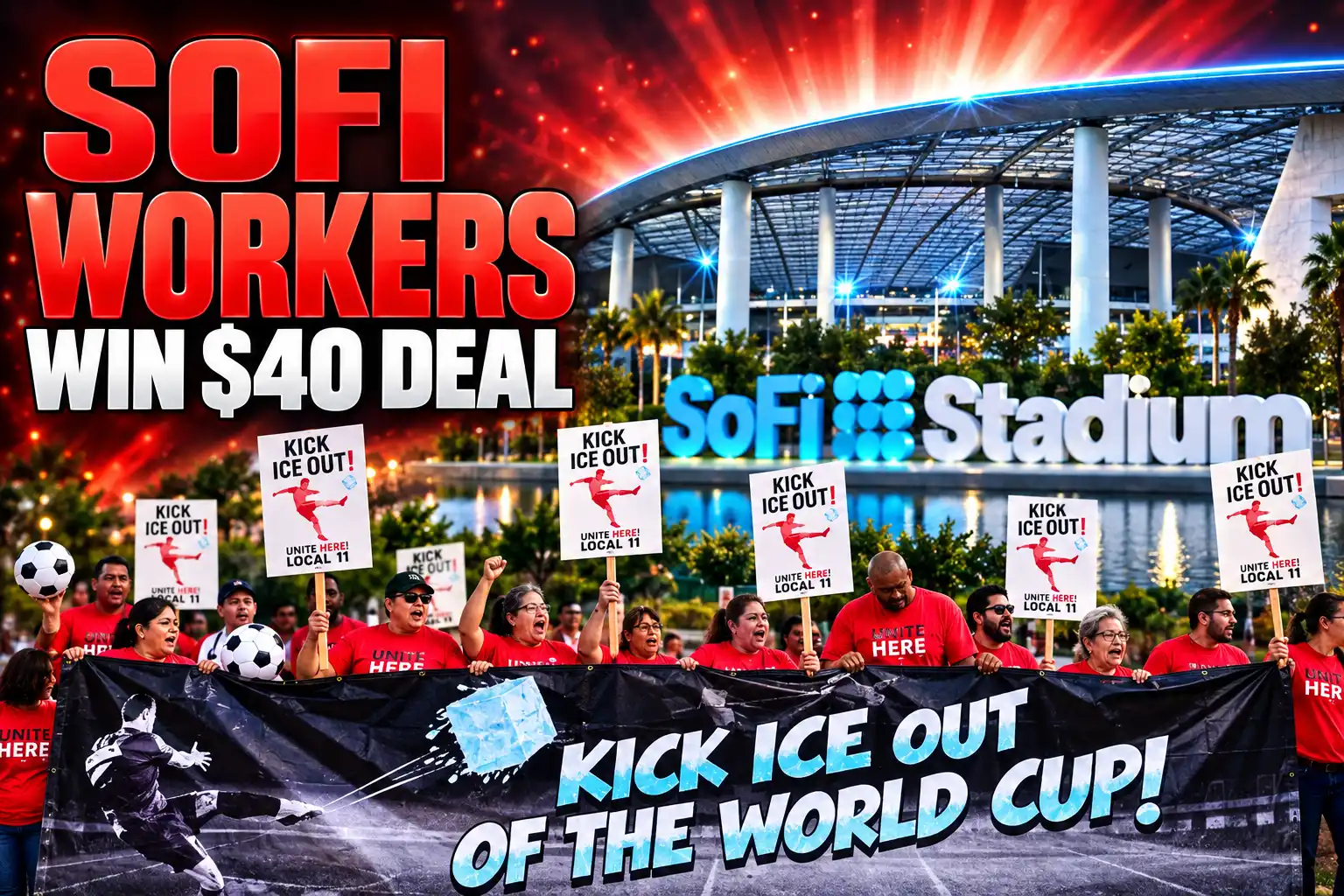
SoFi Stadium’s 2,000 hospitality workers approved a new contract on June 10, two days before the United States opened the World Cup there. The deal with Legends Hospitality raised concession pay to $40 an hour and wrote in a walk-off right if immigration agents threatened their safety.
FIFA kept saying it was not at the table. The badge forms, the name checks, and the fear of ICE still shaped the last week of bargaining in Inglewood.
Workers Authorized a Strike, Then Locked In the Deal
Cooks, bartenders, dishwashers, cashiers, suite attendants and concession staff had been working a year without a contract. Legends, the stadium’s food operator, had offered freezes for some jobs and a 25-cent hourly bump for cooks and dishwashers. Kurt Petersen, co-president of UNITE HERE Local 11, put the gap in one line: the company wanted to talk about quarters; the union wanted dollars.
Members then voted, by 96 percent, to authorize a strike that put the U.S. opener on alert. Petersen had already warned that 70,000 fans walking in for the United States against Paraguay on June 12 could meet pickets. “It could get ugly, yes,” he said. He also sketched the other picture: $100,000 FIFA suites left with bottled water and Doritos if the crews walked.
THE JUNE CLOCK AT SOFI
- June 5, 2026: Members vote 96 percent to authorize a strike after talks with Legends stall.
- June 9, 2026: Local 11 and Legends Hospitality announce a tentative deal, four days after the vote.
- June 10, 2026: Workers ratify, 99 percent in favor, per union spokeswoman Maria Hernandez.
- June 12, 2026: The United States opens against Paraguay with the crews on the job.
Stacey Escudero, speaking for Legends, said the company was pleased to have an agreement and still planned “an outstanding hospitality experience for fans at the FIFA World Cup matches.” Petersen reached for baseball instead of soccer and called the package a grand slam. Suite cook Isaac Martinez told reporters it was a fair contract and that the crews only wanted their rights as workers.
https://x.com/unitehere11/status/2064479418505154610
The Walk-Off Right FIFA Did Not Sign
The wage fight was loud. The first item workers put down, Petersen said, was not the scale. It was whether ICE could come through the building. “Before we talked about wages or World Cup premiums, our members said, ‘We will not allow ICE to terrorize us,’” he told reporters outside the stadium. A white worker, a Black worker and a brown worker had said the same thing in bargaining, he added: they would not tolerate ICE in the stadium.
Some people still treat that demand as extra politics on top of a pay dispute. The bargaining order runs the other way. DHS Secretary Markwayne Mullin had said ICE agents would be deployed to World Cup stadiums as part of security. ICE’s Todd Lyons had told Congress that Homeland Security Investigations would be “a key part” of the tournament apparatus. Local 11’s April filing with the National Labor Relations Board named Legends, stadium owner Kroenke Sports & Entertainment, FIFA and hospitality firm On Location, and accused them of refusing to limit ICE access.
FIFA’s line stayed fixed: the contract dispute was between Legends and Local 11 “and does not involve FIFA.” The signed deal still gave the union a walk-off if it found, in good faith, that federal immigration action threatened worker safety during a World Cup match. The union’s own summary lists that right to strike if ICE threatens safety as a clause legal experts told the local was new in modern U.S. labor contracts. Petersen said he hoped they would never need it.
These workers are heroes. They stood up to FIFA. They stood up to ICE. They won a historic contract, and they are ready for whatever comes during the World Cup. If federal immigration agencies threaten workers’ safety, our members have the right to walk off the job. That is now in their contract.
Kurt Petersen, co-president, UNITE HERE Local 11, Inglewood press conference
Yolanda Fierro, a suite runner for six years and a member of the bargaining team, said the safety of staff and guests had to sit beside the raises. “If we cannot get those things, our folks are ready to walk. Let them run the stadium without us.” On opening night, shop stewards handed out “Kick ICE Out” buttons inside the building. Petersen said fans were asking for them too.
From $27 to $40 an Hour
The union had gone into the vote asking for substantial increases to more than $30 an hour. What came back, the local said after ratification, reset the floor for non-tipped work at the venue and added match-day premiums on top.
WHAT THE NEW PAY SCALE LOOKS LIKE
| Job | Change in the deal |
|---|---|
| Concession stand workers | Pay rises from $27 to $40 an hour |
| Cooks | Pay rises to $40 an hour |
| All non-tipped workers | Raises of $9 an hour |
| Bartenders and servers | 30% increase in automatic gratuities |
| World Cup shifts | Time-and-a-half pay |
| Super Bowl shifts | Double-time pay |
Petersen told reporters most workers would earn more than $40 an hour, with World Cup and Super Bowl premiums stacked on that base, and that the economics were the strongest of any NFL stadium agreement. Stand lead Susana Lahargue said the crews had fought for fair wages, stronger job protections, “and the right to protect ourselves and our families.”
Money was only one column. Legends pledged a multimillion-dollar contribution to a fund for hospitality-worker housing. Subcontracting is to fall 75 percent over the life of the deal, with a penalty if the company misses. New self-checkout, kiosks and cashier-less setups are barred. Those automation limits were aimed at the next two years of mega-events, not only at June.
What FIFA Asked Workers to Hand Over
For the first time at a World Cup, FIFA took control of all 16 tournament stadiums, including operations, uniforms and the accreditation needed to walk into SoFi. Legends still wrote the paychecks. The badge ran through FIFA. That split is how a food-service contract became a privacy fight.
On May 7, Local 11, the ACLU of Southern California and the Los Angeles Alliance for a New Economy sent a complaint asking Attorney General Rob Bonta to investigate the accreditation terms under the California Consumer Privacy Act and the state constitution’s privacy clause.
WHAT FIFA PUT ON THE BADGE FORMS
- Identity data: Social Security numbers, home addresses, nationality and country of birth, plus fingerprints among other checks.
- The waiver: Workers had to consent to collection, use and disclosure of sensitive personal data and to sharing with local, regional or federal authorities for background checks.
- FIFA’s discretion: Personal data could go to law enforcement, intelligence agencies, host-city departments and international partners when FIFA deemed it necessary.
- Where it sits: FIFA’s privacy notice said U.S. workers’ information would be stored in a Western Europe database and kept “for as long as necessary.”
- The bind: The letter said crews were being forced to choose between their jobs and California privacy rights they were asked to waive.
The letter also cites April 15 testimony from Douglas Olson, the FBI special agent in charge coordinating World Cup work on the White House task force. Olson told the Senate that FIFA had asked the bureau to run records checks on hundreds of thousands of people seeking accredited access, and that DHS is the partner for the transfer of FIFA data into FBI systems. Sharing Social Security numbers with an agency that houses ICE and Border Patrol, the letter argued, put the people serving the games at risk of being targeted.
FIFA said the process was a name check with the U.S., Canadian and Mexican governments, not a pre-employment screen, and that data would be handled under applicable privacy law and deleted when it was no longer needed to decide credential access. Petersen said FIFA did agree, during the SoFi talks, to stop collecting that sensitive data for workers’ accreditation going forward. The contract goes further on Legends’ side: workers cannot be forced to surrender Social Security numbers, immigration status or country of origin for mega-event badges, and FIFA’s accreditation demands are prohibited by the deal. The letter still argues the process collides with California Consumer Privacy Act worker protections. Bonta’s office has not issued a public finding on that filing.
Eight World Cup Nights Without a Picket Line
Los Angeles County Sheriff Robert Luna said DHS had told him federal officers at the matches would help with security, not civil immigration enforcement. The union kept the walk-off anyway. It never used it.
WHAT THE CREWS COVERED
- Eight matches: SoFi hosted eight World Cup games from the U.S. opener through a quarterfinal.
- Opening night: About 70,000 fans came for the United States against Paraguay on June 12.
- Spain’s two visits: The local later thanked staff for hosting two games by Spain, who went on to win the tournament.
- Walk-offs: None. The crews stayed on the job through the last ball in Inglewood.
On July 24 the local posted a thank-you that put the sequence in order: the workers won before the first goal was scored, then they hosted the eight games. Cesar Zamora, a bartender of five years and a lifelong soccer fan, had said before the vote that it was heartbreaking to still be fighting for a contract days before the tournament. By mid-June he was working under one.
April 2028 Puts the Olympics on the Same Clock
The contract took effect the night it was ratified and runs through April 30, 2028. That date was not an accident. It lines up with more than 100 other Local 11 stadium, hotel and airport concessions deals that end before Los Angeles stages the 2028 Olympic and Paralympic Games. SoFi is due to host swimming and the opening ceremonies.
Petersen’s local represents more than 32,000 hospitality workers across Southern California and Arizona. The SoFi crew is one shop. The World Cup gave that shop a deadline Legends could not move: eight sold-out nights, a U.S. opener, and FIFA already inside the building on uniforms and badges. The company signed. FIFA still says it was never a party. ICE never sat down either. The clause about both of them is in a Legends contract that outlasts the tournament by almost two years.
The badges still hang on lanyards in Inglewood. The walk-off language sits in writing until the Olympic year.
Frequently Asked Questions
Did SoFi Stadium Workers Strike During the 2026 World Cup?
No. After the June 10 ratification they staffed all eight Inglewood matches, including the U.S. opener against Paraguay and two games by Spain, the eventual champions. Shop stewards handed out “Kick ICE Out” buttons on opening night, and the walk-off clause stayed unused.
How Much Do SoFi Stadium Concession Workers Earn After the Deal?
Concession stand pay is $40 an hour, up from $27, and cooks also move to $40, with a $9 hourly raise across non-tipped jobs. Tipped bartenders and servers received a 30 percent increase in automatic gratuities, and Petersen said the package is the strongest economically at any NFL stadium.
When Does the Unite Here Local 11 SoFi Contract Expire?
It expires April 30, 2028, about two months before the Los Angeles Olympics, on the same cycle as more than 100 other Local 11 stadium, hotel and airport deals. SoFi is slated to host swimming and the opening ceremonies at those Games, which is why the local wanted this clock, not a longer one.
Can SoFi Stadium Workers Walk Off Over ICE?
Yes, if the union determines in good faith that federal immigration agency action threatens worker safety during a World Cup match, a provision Local 11 said appears in no other U.S. collective bargaining agreement. Sheriff Robert Luna said DHS told him agents at the games would help with security rather than civil immigration enforcement, and Petersen said he hoped the clause would never be used.
Who Operates Food Service at SoFi Stadium?
Legends Hospitality, part of Legends Global, runs food and beverage; the stadium is owned by Kroenke Sports & Entertainment, which also owns Arsenal. During the World Cup, FIFA took control of venue operations, attire and accreditation at all 16 tournament stadiums, which is why badge data sat outside the pay talks.

Kily Gonzalez Has the Inter Miami Job Without Papers

Chelsea Puts USDC on the Shirt for One Year

Esther González Joins Al Qadsiah After Gotham’s Free Exit

Chelsea Stay on Adam Wharton After Palace Hold Firm

Fiorentina Pays for Pellegrino After Juve’s Loan Fails

Only One of Villa’s Five Winger Targets Actually Signed

SoFi Workers Won Pay and an ICE Walk-Off Clause

Hughes Hired Iraola Twice, Then Left for Al-Hilal

Sunderland’s 53-Year European Wait Ends Against AZ

Summerville Turned a Shock Call-Up Into Two World Cup Goals
-
 NEWS4 months ago
Only One of Villa’s Five Winger Targets Actually Signed
-
 NEWS5 months ago
Hughes Hired Iraola Twice, Then Left for Al-Hilal
-
 EUROPA LEAGUE5 months ago
Sunderland’s 53-Year European Wait Ends Against AZ
-
 NEWS4 months ago
Summerville Turned a Shock Call-Up Into Two World Cup Goals
-

 CHAMPIONS LEAGUE4 months ago
Jordan Brand’s 2018 Football Bet Pays on PSG’s Repeat
-

 NEWS5 months ago
SNRT Put Morocco’s World Cup Matches on Free TV
-

 NEWS3 months ago
Stefan Ortega Joins Olympiacos as Fan Tokens Skip Equity
-

 EUROPA LEAGUE4 months ago
Rangers Never Played the Sparta Prague Sharpener