
ANALYSIS
Sullivan Raises His West Ham Stake After the Youth Ban
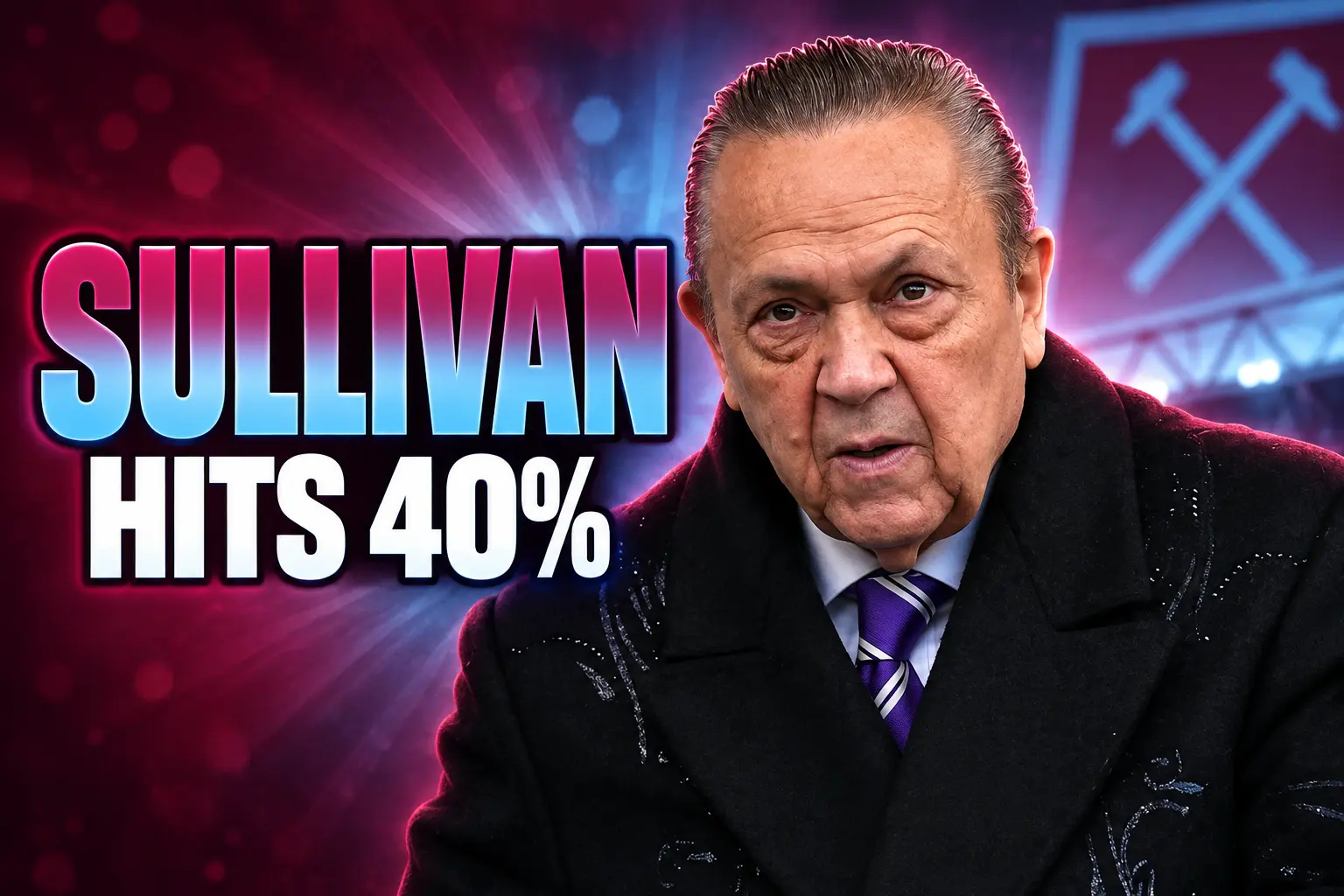
David Sullivan raised his West Ham stake to 40 percent in September, after a 2023 women and youth restriction left his shares untouched.

David Sullivan lifted his West Ham United stake to 40 percent in a 3 September share deal, after a 2023 safeguarding restriction kept him off the women’s and youth sides. Czech businessman Daniel Kretinsky moved to 46 percent in the same sale of the Gold family block, and the Independent Football Regulator’s fitness file on Sullivan stayed open.
Sullivan, 77, denies the historic allegations that pushed him to resign as joint-chair on 6 June. He still holds two-fifths of a Championship club.
He Called the Restriction Meaningless
The Football Association opened a safeguarding investigation in 2023 after it received allegations about Sullivan, then co-owner and joint-chair. A group drawn from the club, the FA and Newham’s local authority designated officer then stopped him having access to West Ham’s own youth and women’s teams.
The measures were not made public. Sullivan kept going to men’s games and sitting in the directors’ box at London Stadium. He was not barred from the first-team operation, and he remained the largest shareholder after David Gold died in January 2023.
When the restriction surfaced on 9 June, Sullivan said the coverage had mislabelled it. He said he had never met academy or women’s players one-to-one in 16 years at the club, and that he had agreed with the FA not to do so until a single anonymous complaint about an event in 1981 was resolved. He said that complaint had nothing to do with his time in football and that the event never happened.
I saw it as a meaningless restriction, as it didn’t impact on my work in any way, therefore I accepted it for a quiet life.
David Sullivan, then West Ham joint-chair, in a June statement
He also said it was wrong to call the deal a disciplinary “ban”. The FA’s public line was that it could not discuss individual safeguarding matters, including live cases, while it investigates people who may pose a risk of harm to children and adults at risk in football. Under football’s safeguarding framework, it can suspend someone from all or specific football activity when it believes that risk is there.
Reporting of the 2023 file said he was kept away from women’s and youth matches as well as from one-to-one contact, and that those limits were still in place in June. The 2023 contact restriction at West Ham never reached the share register. That is why a quiet containment plan could run for three seasons beside a man who still owned the largest slice of the club.
London Stadium and the Women’s Side Were Not Told
The split only held if almost nobody outside the file knew it existed. West Ham later said the 2023 measures followed its safeguarding policies as agreed with the FA and Newham’s officer, and that only a very limited number of staff were informed, under confidentiality rules. Sullivan, it said, was the only board member who knew.
Vanessa Gold and Kretinsky, speaking for the Gold family and 1890 Holdings, said in a 13 June club statement that the full West Ham United Board was not notified about the allegations against Sullivan until about a month earlier, when he warned that claims might be published. They said the other shareholders’ board representatives learned of the 2023 safeguarding measures only in the week those measures became public.
London Stadium, which owns and runs the ground, said it would expect to be told so it could assess risk to staff, contractors and the public. West Ham’s women’s team and the Women’s Super League were not told either. The club said external parties were left out because of agreed safeguarding practice.
PARTIES KEPT OFF THE 2023 FILE
- Other directors: Board representatives of shareholders other than Sullivan were not told about the 2023 measures until the June coverage.
- The venue: London Stadium said it would expect to be informed on safeguarding limits that affect who can be in the building.
- The women’s game: The women’s team and the Women’s Super League were not made aware of any access limits on Sullivan.
- A shirt partner: Boyle Sports, the club’s front-of-shirt partner in the last Premier League season, said it was extremely concerned and backed the regulator’s review.
- Fan groups: Karren Brady, a long-term Sullivan associate then in the club’s leadership, told concerned supporters there was “no investigation involving West Ham United”.
Brady’s line sat beside an FA safeguarding inquiry and police disclosures that had already been made. The secrecy was the point of a live case. It also left sponsors, the landlord and the women’s side to find out from television that the co-owner had been ring-fenced from part of his own club.
June’s Sale Calls Left the Share Register Untouched
The public case landed on 8 June in a joint television and newspaper investigation. Seven women, in their late teens or early twenties at the time, accused Sullivan of sexually exploitative and predatory behaviour over several decades, from the period when he owned the adult-themed Daily Sport and Sunday Sport titles. He said he “categorically denies” the claims, called them “factually incorrect and entirely false”, and said he would take legal action.
Eight women, including one from that investigation, made disclosures to police. None of those cases has brought charges. Essex Police arrested him in 2008 on suspicion of sexual assault after an allegation by a 25-year-old woman. No charge followed. He has said that after a lifetime building businesses in the adult industry it was “sadly inevitable” that a small number of improper-conduct claims would be made.
He resigned as joint-chair and as a director of the club and of WH Holding Limited on Saturday 6 June, two days before publication, after being told the investigation was coming. West Ham said none of the allegations relate to the club or its operations. Culture secretary Lisa Nandy called the revelations “utterly horrifying” and said that if an investigation had been serious enough to keep him from the youth and women’s teams, the FA had to explain why nothing further followed.
Uma Kumaran, the Labour MP for Stratford and Bow, said he should sell his then 38.8 percent stake. Andy Payne of the fan advisory board said there was “no way back for David Sullivan in football” and that the shares should be sold as soon as possible. A source close to Sullivan indicated in June he was open to selling. The register did not move.
FROM THE 2023 FILE TO THE SEPTEMBER REGISTER
- 2023: The FA opens a safeguarding investigation and, with the club and Newham’s officer, limits Sullivan’s contact with the women’s and youth teams.
- 6 June 2026: Sullivan resigns as joint-chair and director after he is told serious historic allegations are about to be published.
- 8 to 9 June 2026: Seven women make their accusations public; the 2023 restriction is reported; the regulator asks him for urgent information.
- 13 June 2026: Gold and Kretinsky agree key terms for a sale that would take Kretinsky to about 43 percent, subject to pre-emption.
- 1 August 2026: Vanessa Gold says she has agreed to sell the family’s 25.1 percent to a consortium led by Amanda Staveley, again subject to pre-emption.
- 8 August 2026: Sullivan attends a League Cup tie against Portsmouth after London Stadium had recommended he stay away from home games because of fan unrest.
- 3 to 4 September 2026: Existing shareholders take up pre-emption. Kretinsky is set for 46 percent, Sullivan for 40 percent, Tripp Smith for 11 percent.
West Ham went down to the Championship in 2025-26. The Portsmouth tie was the club’s first opening-round League Cup game in 15 years. Sullivan was still walking into the ground as a shareholder, not as a director, and the 2023 file still had not touched his holding.
How Pre-emption Raised Sullivan to 40 Percent
The Gold family stake had been on the market since October 2023. Vanessa Gold inherited 25.1 percent, and the joint-chair role, after her father died. A June plan for Kretinsky to buy enough of that block to reach about 43 percent did not complete. In August she struck terms with Staveley, the former Newcastle co-owner, alongside Mehrdad Ghodoussi and Ashland Forest Capital Partners.
West Ham’s articles give existing shareholders first refusal on a sale of that size. They have to take up the Gold block in line with what they already own. Sullivan, still the largest holder at 38.8 percent, had to commit to the largest slice if the clause was used. That is the mechanical reason a man facing a regulator’s honesty test ended up with more of the club, not less.
WEST HAM HOLDINGS BEFORE AND AFTER THE GOLD SALE
| Shareholder | June 2026 | After the September deal |
|---|---|---|
| David Sullivan | 38.8% | 40% |
| Daniel Kretinsky (1890s Holdings) | 27% | 46% |
| Gold family trust | 25.1% | sold in the deal |
| Tripp Smith (WHU LLC) | 8% | 11% |
| Other shareholders | 1.1% | 3% |
Kretinsky’s jump is 19 points. Sullivan’s is 1.2 points. Smith’s is 3 points. The remainder of the 25.1 percent Gold block lifts the smaller holders to 3 percent. The club’s own ownership page still listed the June split, because the transfers had not been declared complete.
On 4 September West Ham said it noted Kretinsky’s agreement, via 1890s Holdings, to acquire enough shares to become the single largest shareholder at the Club, and that it would not comment further until every transaction was finished. The IFR said this latest move would not, on its own, trigger a fresh examination, and that its existing enquiry into Sullivan remained active.
Kretinsky Moves to 46 Percent as Staveley Is Blocked
Kretinsky first bought 27 percent in November 2021 through 1890s Holdings. He already owned Sparta Prague and later bought Royal Mail. In the 13 June statement with Gold he said the pair were “deeply concerned” after the allegations, that “any abuse of power is abhorrent”, and that their thoughts were with the women who had spoken. He framed a larger stake as a way to put in the extra money needed for “an immediate return to the Premier League”.
On 4 September he said he was “deeply honoured” to become the largest shareholder and that he did not take the responsibility lightly. The same deal shut Staveley out of the Gold block. She had been a guest at London Stadium in the days before the pre-emption closed. Existing holders used the clause, then reshaped the new paper so Kretinsky landed on 46 percent rather than a dead heat with Sullivan.
That is a control outcome, not a cleansing one. Kretinsky is now the largest name on the register. Sullivan is still the second-largest, at 40 percent, with no board seat and a live fitness review. Smith, whose WHU LLC is ultimately owned by J. Albert Smith, moves to 11 percent. Minority names on the old register included Daniel Harris and Terry Brown.
Sullivan had signalled in June that he would consider an exit. Early September fan channels were already sketching a later Staveley run at his block, and at Smith’s, once this paper settled. Nothing in the club statement confirms that. What the paper does confirm is that the first chance to force him out through a Gold-family sale was used to keep the present owners in place.
The Fitness Test the Regulator Still Holds
English football’s Independent Football Regulator said on 9 June that the allegations were “extremely serious”. It said it was in contact with West Ham and would use its statutory powers to seek urgent information from Sullivan about his suitability under the owners, directors and senior executives regime. Honesty and integrity sit inside that test.
By 3 September the regulator said those enquiries were “active and ongoing” and that it was in touch with relevant authorities. It had already gone to Essex Police and to the FA. Incumbent owners do not have to apply for approval under the new rules. If the IFR has concerns about an incumbent, it can act, including by requiring an owner to divest. That power covers 116 regulated clubs.
Lisa Nandy had already asked the FA why a restriction on the youth and women’s teams had not been followed by further action. Prime Minister Keir Starmer’s spokesperson called the women’s accounts “harrowing”. The FA still will not discuss the individual case. West Ham still will not discuss an individual safeguarding matter. Sullivan still denies every allegation that has been put to him.
WHAT WE KNOW
- The 2023 file: Club, FA and Newham limits on Sullivan’s contact with women and youth teams ran for three years without being told to the rest of the board.
- The June exit from office: He resigned as joint-chair and director on 6 June and denies the historic claims published two days later.
- The September paper: Kretinsky has agreed terms for 46 percent, Sullivan for 40 percent, Smith for 11 percent, subject to the transfers completing.
- The live review: The IFR’s ODSE enquiry into Sullivan is active and has included the FA and Essex Police.
WHAT IS UNCONFIRMED
- Forced sale: No finding has been issued on whether Sullivan must divest, and he has not announced a sale of the 40 percent.
- Closed transfers: The club has said it will not comment until every share transaction is complete.
- A later Staveley bid: Talk of a run at Sullivan’s and Smith’s holdings after this deal is not backed by a club or bidder statement.
- Criminal charges: Eight women have made police disclosures; no charges have been brought in those cases or in the 2008 arrest.
The 2023 restriction was built to keep Sullivan away from women and children at his own club while he kept the men’s side and the shares. He called that a quiet life. The quiet life is why, three months after MPs told him to sell, the Gold family exit made him a larger owner, and why the only body left that can test that outcome is the regulator that still has his file.
Disclaimer: This article is news reporting and analysis of public statements, club notices and regulatory processes, and it is for information only. It is not legal advice on the allegations, which David Sullivan denies, and it is not investment advice on West Ham United shares or any related transaction. Anyone considering legal or financial steps should speak first to a qualified solicitor and, before any investment decision, to a regulated financial adviser. Figures and statuses follow the club, FA and Independent Football Regulator statements on the dates given and may change as the fitness review and the share transfers proceed.

Kily Gonzalez Has the Inter Miami Job Without Papers

Chelsea Puts USDC on the Shirt for One Year

Esther González Joins Al Qadsiah After Gotham’s Free Exit

Chelsea Stay on Adam Wharton After Palace Hold Firm

Fiorentina Pays for Pellegrino After Juve’s Loan Fails

Only One of Villa’s Five Winger Targets Actually Signed

SoFi Workers Won Pay and an ICE Walk-Off Clause

Hughes Hired Iraola Twice, Then Left for Al-Hilal

Sunderland’s 53-Year European Wait Ends Against AZ

Summerville Turned a Shock Call-Up Into Two World Cup Goals
-
 NEWS4 months ago
Only One of Villa’s Five Winger Targets Actually Signed
-
 NEWS4 months ago
SoFi Workers Won Pay and an ICE Walk-Off Clause
-
 NEWS4 months ago
Hughes Hired Iraola Twice, Then Left for Al-Hilal
-
 EUROPA LEAGUE4 months ago
Sunderland’s 53-Year European Wait Ends Against AZ
-
 NEWS4 months ago
Summerville Turned a Shock Call-Up Into Two World Cup Goals
-

 NEWS4 months ago
SNRT Put Morocco’s World Cup Matches on Free TV
-

 CHAMPIONS LEAGUE4 months ago
Jordan Brand’s 2018 Football Bet Pays on PSG’s Repeat
-

 EUROPA LEAGUE3 months ago
Rangers Never Played the Sparta Prague Sharpener