
NEWS
Turkey Finally Beat the United States When It No Longer Mattered
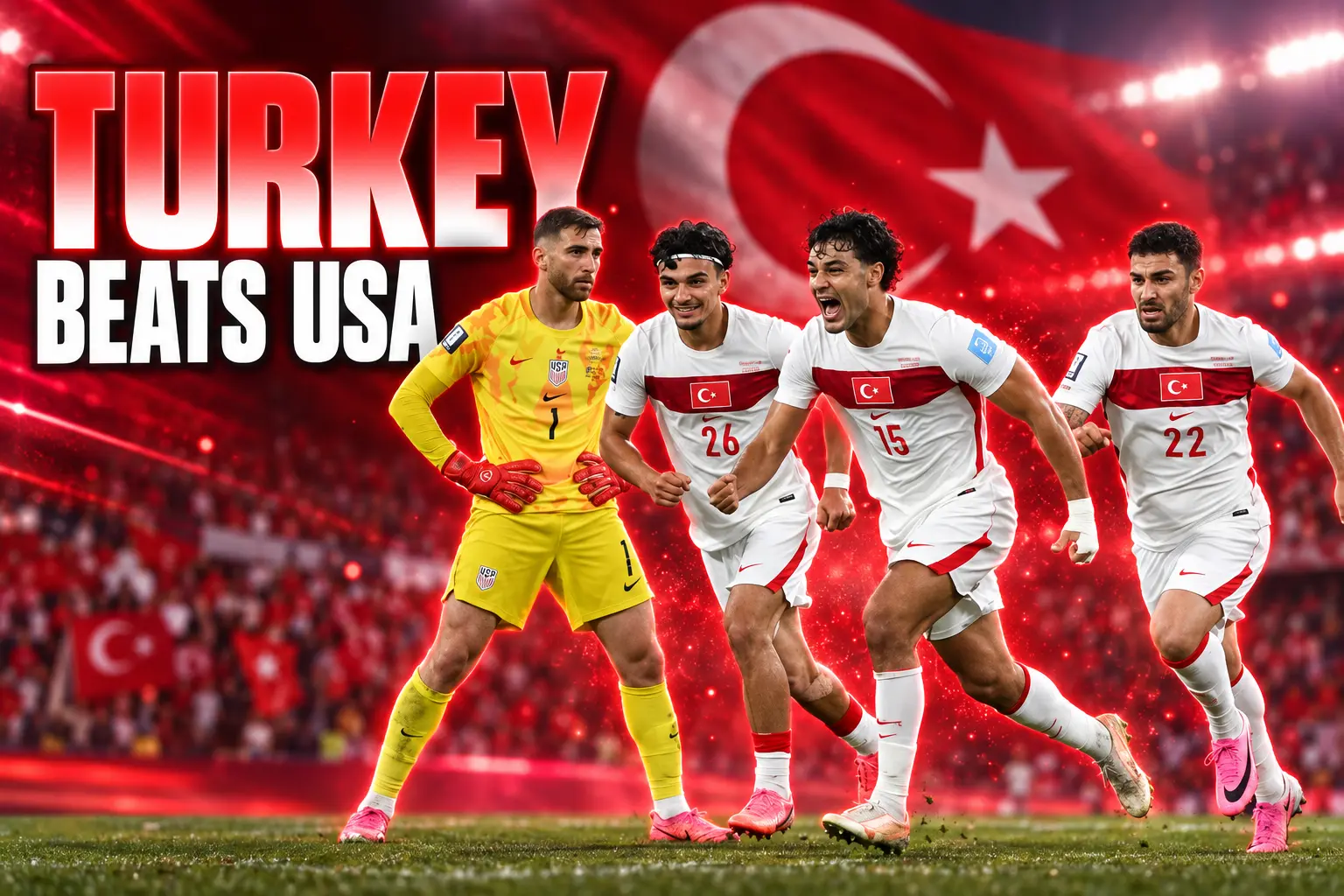
Turkey went out last in World Cup Group D after 62 shots without a goal, then beat a rotated United States 3-2 in Inglewood when the table was already closed.

Turkey left the 2026 World Cup last in Group D, with 3 points, after a 62-shot blank and a 3-2 win over a rotated United States that no longer moved the table. The same 26-man squad had been sold, in early June, as the side most likely to knock the co-hosts off first place.
Vincenzo Montella’s team lost 2-0 to Australia on June 14 in Vancouver and 0-1 to ten-man Paraguay on June 19 in Santa Clara, then beat the United States 3-2 on June 25 in Inglewood on Kaan Ayhan’s kick in the eighth added minute. First place was already gone. So was Turkey’s tournament.
The Preview Sold a Host Problem
Real Madrid’s Arda Güler, Juventus forward Kenan Yıldız and Inter captain Hakan Çalhanoğlu arrived as the faces of Turkey’s first World Cup since a third-place finish in 2002. Montella, in charge since September 2023, had taken the side to the Euro 2024 quarterfinals and through a playoff over Romania and Kosovo. In early June that roster was still being framed as the United States’ Group D problem.
A year earlier, in East Hartford on June 7, 2025, Turkey had already come from behind to beat Mauricio Pochettino’s side 2-1, with Güler among the scorers. The June 2026 billing treated that night as a warning. Group D, on paper, was Australia, Paraguay and the hosts. The draw looked kind to a team with European club names across the front.
FROM ISTANBUL TO INGLEWOOD
- June 1, 2026: Beat North Macedonia 4-0 in Istanbul, a send-off Montella used to look at fringe minutes.
- June 6, 2026: Beat Venezuela 2-1 in Fort Lauderdale, with Yıldız and Ferdi Kadıoğlu still managing calf trouble.
- June 14, 2026: Lose 2-0 to Australia at BC Place in Vancouver.
- June 19, 2026: Lose 0-1 to Paraguay at San Francisco Bay Area Stadium and go out with a game left.
- June 25, 2026: Beat the United States 3-2 at Los Angeles Stadium, already eliminated, already playing for pride.
The gap between that itinerary and the June preview is the whole campaign. The names were as advertised. The finishing was not.
Australia Caught Them Cold in Vancouver
Nestory Irankunda scored in the 27th minute at BC Place, and Connor Metcalfe added a second in the 75th. Turkey had the ball for long spells and still went in a goal down, then a second, in their first World Cup meeting with Australia.
Montella said afterward that his side had about 78 percent of the ball and 30 shots in the Vancouver opener. Opta had the expected-goals split at 1.33 to 0.77. Güler took eight of those shots, the most by any player in a match at the tournament to that point, and Patrick Beach, Australia’s shock starter, kept dumping them away.
The opener was a counter. Beach saved from Güler, and 17 seconds later Irankunda beat Merih Demiral down the left and slotted past Uğurcan Çakır. Yıldız, still easing back from a calf problem, waited until half-time. Montella said he wanted Güler on the pitch, that Kenan is better on the left, and that when you take 30 shots and do not score, the night ends like that.
He also said there was still time to fix it. There was one more live match. Paraguay, in Santa Clara, was that match.
62 Shots, Then Ten-Man Paraguay
Matías Galarza hit the bottom-right corner 1 minute and 4 seconds into the game, after a flick from Julio Enciso, and that strike stood up for 90 minutes. Opta timed it as the fastest World Cup goal since Denmark’s Zanka against Croatia in 2018, and as the earliest winning goal in the competition’s history, beating a strike from Morocco’s Ismael Saibari earlier the same day.
Mert Müldür met a Hakan Çalhanoğlu delivery in the 35th minute and saw the header hit the bar, then the post. Miguel Almirón was sent off in first-half stoppage time, a straight red after a VAR check for covering his mouth while speaking to Müldür. Turkey then had a player extra, 78.6 percent of the ball, and still no goal.
THE TWO-GAME BLANK
- Shot count: Thirty against Australia, 32 against Paraguay, 62 shots without a goal, the most by any team across a two-game World Cup span since records begin in 1966.
- The stars: Yıldız and Çalhanoğlu took six shots each against Paraguay and put one on target between them; Güler created three chances and still left empty.
- The passer: Abdülkerim Bardakcı completed all 98 of his passes, the most with a 100 percent rate by any player at a World Cup since 1966.
- The keeper: Orlando Gill turned away Merih Demiral from range, a weak Deniz Gül header, and a Can Uzun strike whose rebound Gül put wide.
Güler, speaking after the second defeat, did not hide. He said the team had tried, that they should have scored, that they should have won those games, and that everybody was sad and crying. Haiti had already gone. Turkey had lasted two and a half hours longer, and that was the joke waiting in the press box.
GROUP D FINAL TABLE
| Team | Pts | GD | GF-GA | Outcome |
|---|---|---|---|---|
| United States | 6 | +4 | 8-4 | Group winners |
| Australia | 4 | 0 | 2-2 | Second, automatic last 32 |
| Paraguay | 4 | -2 | 2-4 | Advanced as a best third |
| Turkey | 3 | -2 | 3-5 | Eliminated, last |
Australia and Paraguay later drew 0-0 in Santa Clara, which locked the Socceroos into second on goal difference and sent Paraguay through among the eight best third-place sides in the 48-team tournament. Turkey’s three points, all of them collected after the door had shut, left them fourth.
What the United States Faced in Inglewood
Pochettino had already beaten Paraguay 4-1 and Australia 2-0. First place was safe, and a round-of-32 date with Bosnia and Herzegovina was booked. He made nine changes. Weston McKennie and Ricardo Pepi were the two who kept their starts from the Australia win. Christian Pulisic, out with a calf problem since the opener, waited on the bench.
Montella changed almost as hard, keeping only four from the Paraguay night. Çalhanoğlu started on the bench. Zeki Çelik wore the armband. Ozan Kabak and Oğuz Aydın got their first World Cup starts. The United States still scored after 3 minutes, Auston Trusty finishing Sebastian Berhalter’s corner at the far post in front of 70,492 at Los Angeles Stadium.
THE GOALS IN INGLEWOOD
- 3rd minute: Trusty, unmarked from a corner, puts the hosts in front.
- 10th minute: Güler finishes after Barış Alper Yılmaz’s pass, Turkey’s first shot of the World Cup that counted.
- 31st minute: Yılmaz makes it 2-1 before half-time.
- 49th minute: Berhalter equalizes from outside the box, a goal and an assist on the night.
- 90+8: Substitute Ayhan bundles in from close range after fellow substitute Can Uzun’s effort, the last kick of the match.
The Turkish Football Federation’s match report lists the visitors’ scorers in that order: Güler, Yılmaz and Ayhan scored. FIFA’s match centre has the same three names. Pulisic came on in the 58th minute for Timothy Weah, forced a save from Çakır, and hit the right post. FIFA logged Turkey with 8 attempts and 42 percent of the ball against 18 and 48 for the United States. The hosts had the volume. Turkey had the last touch.
Pochettino, asked about the mood, said the vibe was that his team would go home that night and Turkey would stay. He was talking about the knockout bracket, not the table. Turkey were already out. The United States still went through as group winners with 6 points, the most the US men have taken in a World Cup group stage.
Güler Found the Night After the Group Was Gone
With Çalhanoğlu sat down, the 21-year-old finally ran the attack. He scored Turkey’s first World Cup goal in 24 years, at 21 years and 150 days, and FIFA named him player of the match. That is the version of Güler the June preview had promised, and it arrived in a game whose result could not send anyone through.
Today of all days, we finally won. We can return to our country with a little more pride.
Arda Güler, speaking to FIFA after Turkey 3-2 United States
He also told FIFA, in the same sit-down, that the team knew it could play at that level and had Today of all days, we finally won saved that performance for the last game. The sentence is cleaner in his other line from the night, the one that did not need a flourish. “We cannot make drama out of this,” he said. “We played badly and were eliminated.”
Club arguments have kept using that group-stage crash as a stick. Güler-versus-Bellingham threads still reach for the two goalless nights. A 2030 Turkey eleven circulating in September still has Güler, Yıldız and Yılmaz in the same front line. The dead rubber is the tape that shows what happens when Montella takes the veteran out of the middle and lets the Real Madrid player take the ball. It is also the tape that does not count in the table.
Yıldız started in Inglewood after the half-time entry in Vancouver. Çalhanoğlu, 11 shots into the first two games, watched the only win from the bench. Ayhan, listed among the midfielders in the original 26, came on in the 88th minute for Orkun Kökçü and scored with almost no time left. The finishing that never arrived against Australia and Paraguay arrived against a United States reserve back line that had already done its job in the group.
A Contract Through 2028
Montella, asked before the United States game whether he would resign, said the answer was no. He said he still had energy, that he had the backing of federation president İbrahim Hacıosmanoğlu and of the players, and that anyone who wanted him out would have to accept that he was staying. After the 3-2 he said Turkey could go home with their chin up, and that he hoped they would do better, “not in 24 years but earlier than that.”
Hacıosmanoğlu had already drawn a line after the Paraguay defeat. He said the federation is not a club, that continuity is the point, and that they would stand by the coach and the players rather than swap the people who had walked the path for whoever they met on the road. Montella’s deal runs to June 2028. Staff changes were discussed. The head coach was not.
WHERE THEY DISAGREE
- Montella: The first two matches were unfortunate, a draw in either would have changed the fate, and football is not always fair.
- Güler: The team played badly, the criticism is fair, and there is no drama left to make of a last-place finish.
- The federation: Euro 2024 and a first World Cup in 24 years still count, and the next cycle starts with the same manager.
The June preview was not wrong about the talent. It was wrong about the timing. Turkey scored three times in Inglewood and none when Australia and Paraguay were still in reach, and the United States still topped the group. Montella is in the job. Güler has a World Cup goal. The table still reads fourth.
Frequently Asked Questions
How Many World Cups Has Turkey Played In?
The 2026 tournament was Turkey’s third World Cup and the first since a third-place finish in Japan and South Korea in 2002, which remains the country’s high-water mark. They also reached the Euro 2024 quarterfinals under Montella before this group-stage exit.
How Did Paraguay Reach the Knockout Round From Third?
The 2026 finals used a 48-team group stage in which the top two in each group went through automatically and the eight best third-place teams joined them in a round of 32. Paraguay’s 4 points and minus-2 goal difference were enough; Turkey’s 3 points were not.
Who Held Turkey’s Youngest World Cup Scorer Record Before Güler?
Emre Belözoğlu scored against Costa Rica at the 2002 World Cup at 21 years and 275 days. FIFA logged Güler’s equalizer in Inglewood at 21 years and 150 days, which took the mark.
How Many Saves Did Patrick Beach Make Against Turkey?
Beach made eight saves in Australia’s 2-0 win in Vancouver, the most by an Australia goalkeeper in a World Cup match, above Mathew Ryan’s seven against the Netherlands in 2014. Opta also noted Turkey as the first side since Portugal in 2006 (31 against England) to take 30 or more shots in a World Cup game and still fail to score.
Montella’s last public hope from Inglewood was simple, and it is still the open item. He does not want another 24-year wait. The players who took 62 shots and then scored three in a dead rubber are the ones he is taking into that wait.

Kily Gonzalez Has the Inter Miami Job Without Papers

Chelsea Puts USDC on the Shirt for One Year

Esther González Joins Al Qadsiah After Gotham’s Free Exit

Chelsea Stay on Adam Wharton After Palace Hold Firm

Fiorentina Pays for Pellegrino After Juve’s Loan Fails

Only One of Villa’s Five Winger Targets Actually Signed

SoFi Workers Won Pay and an ICE Walk-Off Clause

Hughes Hired Iraola Twice, Then Left for Al-Hilal

Sunderland’s 53-Year European Wait Ends Against AZ

Summerville Turned a Shock Call-Up Into Two World Cup Goals
-
 NEWS4 months ago
Only One of Villa’s Five Winger Targets Actually Signed
-
 NEWS5 months ago
SoFi Workers Won Pay and an ICE Walk-Off Clause
-
 NEWS4 months ago
Hughes Hired Iraola Twice, Then Left for Al-Hilal
-
 EUROPA LEAGUE5 months ago
Sunderland’s 53-Year European Wait Ends Against AZ
-
 NEWS4 months ago
Summerville Turned a Shock Call-Up Into Two World Cup Goals
-

 CHAMPIONS LEAGUE4 months ago
Jordan Brand’s 2018 Football Bet Pays on PSG’s Repeat
-

 NEWS5 months ago
SNRT Put Morocco’s World Cup Matches on Free TV
-

 NEWS3 months ago
Stefan Ortega Joins Olympiacos as Fan Tokens Skip Equity