
NEWS
Tottenham Extends Maeson King Into a Crowded Defence
Tottenham extended Maeson King on 9 June after injury, then stacked senior left-sided cover ahead of the academy defender.

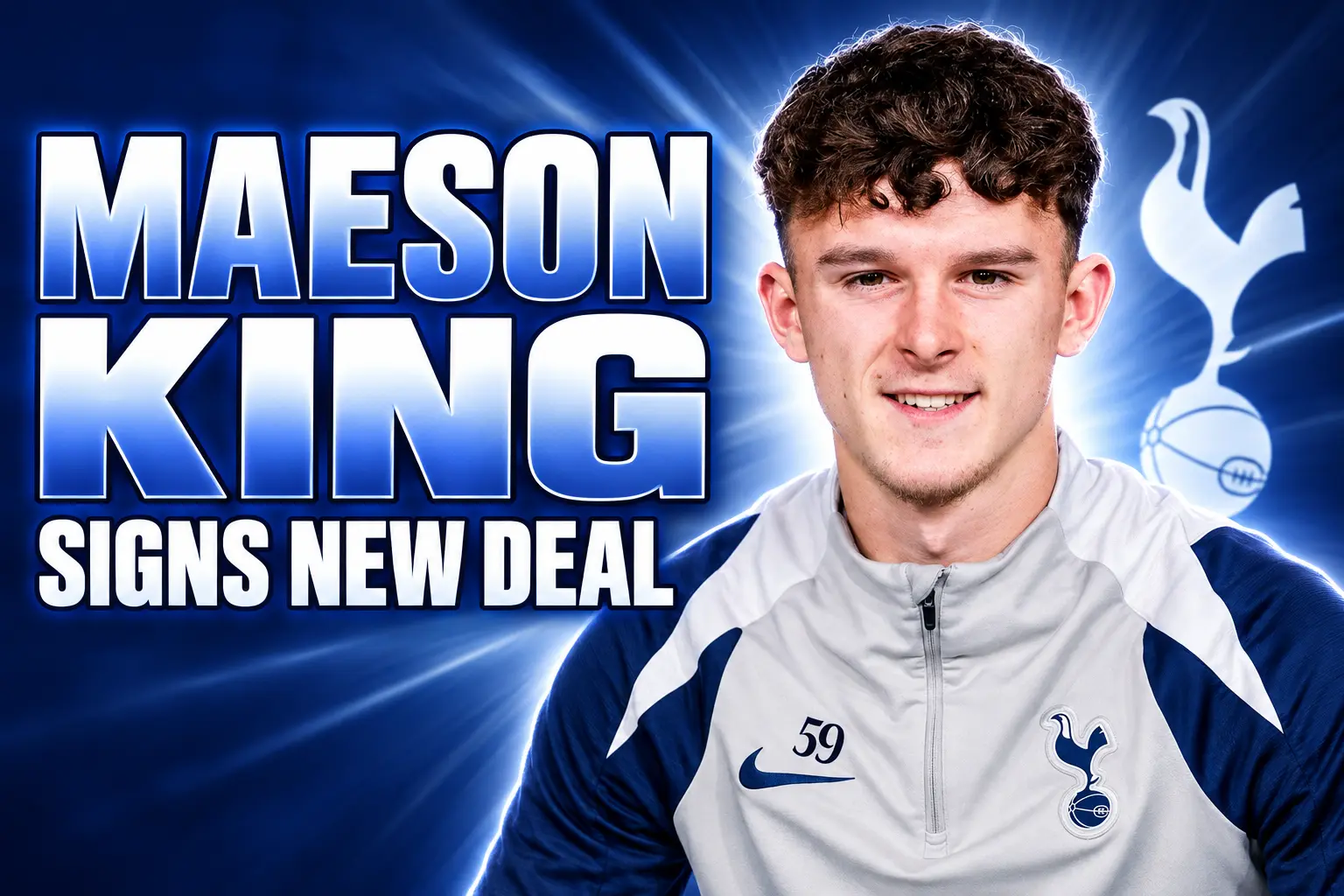
Tottenham handed left-sided defender Maeson King a new contract on 9 June, four days after sealing Andy Robertson on a free. King was 20, back from a long injury, and had made eight Premier League 2 appearances. He turned 21 on 9 September and is still lining up for the Under-21s.
The deal kept a homegrown left-footer in the building. It did not clear a senior seat on the side he actually plays.
A New Deal After Eight Games Back
Tottenham said King had signed a new contract with the club and left the length unpublished. The note called him a left-sided defender who joined as a 10-year-old, went full-time as a scholar in 2022, and signed his first professional deal midway through 2023/24.
He helped Wayne Burnett’s Under-21s lift the Premier League 2 title at the end of that season and became a regular at that level in 2024/25. That campaign also put him in the first-team squad twice. A long-term injury then wiped out most of 2025/26 until he returned for those eight Premier League 2 games.
King spoke to the club after he signed. He sounded like someone who had never wanted to leave.
It’s an amazing feeling, you always want to be here and keep pushing and when you look around it’s one of the best places to be so, yeah it’s a really good feeling.
Maeson King, defender, Tottenham club interview
He can play left-back or centre-back. He is left-footed, and he treats that as a practical edge rather than a branding line, because as he put it, there are not many left-footed defenders about.
Davies Stays for a 13th Season
The player King thanked first was Ben Davies. The Wales defender had spent the same winter on the sidelines after ankle surgery and, on 10 June, Tottenham gave him a new one-year contract. That takes him into a 13th season in north London, on 363 appearances and 10 goals, with a Europa League winner’s medal from 2025.
King said Davies brought him into first-team training the same way a senior left-back should, by shrinking the room rather than enlarging it.
Ben Davies especially being a left-back and him being a senior player, he brought me in quite well. He just brings you into the environment and tells you to just be yourself and train as if you’re over with the under-21s so you don’t have any stress or worries about who you’re training with.
Maeson King, defender, Tottenham club interview
Davies, for his part, talked about a club that still feels like home and about months when he could only help off the pitch. Roberto De Zerbi kept that voice in the senior group. King kept the same left-sided map, one floor down.
Robertson’s Deal Landed Four Days Earlier
On 5 June, four days before King’s renewal, Tottenham announced the free signing of Andy Robertson from Liverpool. The Scotland captain joined on 1 July. Sporting director Johan Lange called him an outstanding left-back first and a leader second. De Zerbi said he had admired him for years.
The club post about King went up on a Tuesday when the timeline was waiting for a centre-back and a winger. Replies treated the academy name as a spelling error for Marcos Senesi or Savinho. Senesi did arrive from Bournemouth later in the window as a free agent, and Jan Paul van Hecke came in from Brighton. Tottenham’s summer transfer window rebuilt the senior defence around those deals. King’s new contract sat underneath them.
LEFT-SIDED OPTIONS AFTER THE WINDOW
| Player | Roles | June business | Where he is |
|---|---|---|---|
| Andy Robertson | Left-back | Free from Liverpool, announced 5 June | First team from 1 July |
| Ben Davies | Left-back and centre-back | One-year deal, 10 June | Senior squad, 13th season |
| Marcos Senesi | Centre-back | Arrived from Bournemouth as a free agent | First team |
| Maeson King | Left-back and centre-back | New deal, 9 June, length unpublished | Under-21s |
A first senior loan was the obvious next step once the ink dried. It has not come. King is still the older head in Burnett’s development side, which is exactly what the June copy promised, and nothing more.
What the New Contract Leaves Unsaid
Tottenham never printed a term. Transfermarkt records a last contract extension on 9 June and still shows a blank expiry. His agency is CAA Stellar. Shirt number for the Under-21s is 74.
The club’s own career widget lists 76 matches, 70 starts, no goals and six clean sheets across the youth sides. That is the body of work the new deal is paying for, not a Premier League minute count.
WHAT WE KNOW
- The date: King signed on 9 June 2026 after returning from a long-term injury.
- The role: He is a left-footed left-back and centre-back who has trained with the first team.
- The 2025/26 return: He made eight Premier League 2 appearances after January.
- The mentor: Davies, who signed his own one-year deal a day later, is the senior left-sided player King credits.
WHAT IS UNCONFIRMED
- The term: Tottenham has not said how many years the new contract runs.
- A loan: No Championship or League One move has been announced.
- A debut: He has still not appeared in a first-team match.
In June he said being around the first-team group every day during the injury kept his mind on the return. That is still the bargain: stay close, stay useful, wait.
Sunday League, Two Cups and a Long Layoff
King was born in Basildon on 9 September 2005 and brought up in Thurrock. He went to Hassenbrook Academy. His own version of the joining story is Sunday league at nine; the club lists him as a 10-year-old arrival. Both can sit in the same file. He then moved through every age group, which he called a smooth ride, until the injury year that was not.
Stuart Lewis’s young side won the Under-17 and Under-18 Premier League Cup double in 2022/23. The first professional contract arrived midway through 2023/24, and Burnett used him in the run that delivered the Premier League 2 title. In 2024/25 he was named on the bench for a Premier League win at Southampton and a Europa League draw with Roma. He did not come on.
THE PATH TO THE NEW DEAL
- 2022: Goes full-time as a Tottenham scholar.
- 2022/23: Wins the Under-17 and Under-18 Premier League Cup double under Stuart Lewis.
- 2023/24: Signs his first professional contract and helps the Under-21s win Premier League 2.
- 2024/25: Becomes a regular at that level and is named in the first-team squad twice.
- 2025/26: Misses most of the season to a long-term injury, then plays eight Premier League 2 games after January.
- 9 June 2026: Signs a new Tottenham contract of unpublished length.
He described the layoff in plain terms. Being in the building every day, he said, stopped him disconnecting, and it also made him want the comeback quicker. Eight games on the left of the Under-21 back line was the proof of work Tottenham chose to reward.
The Under-21s Still Have Their Older Head
Pre-season put him back in the picture without promoting him through it. He came on in a 3-1 run-out at Hornchurch on 25 July. On 8 August the Under-21s lined up against the first team, with King on the left of a back four alongside Kota Takai and Malachi Hardy, and the senior side won 2-1.
The club’s 2026/27 line on his page is one Premier League 2 start. FBref logs that outing at 61 minutes. On 8 September he started the EFL Trophy trip to Exeter City, which the Under-21s lost 2-0, wearing 74.
KING’S 2026/27 OUTINGS
- 25 July, Hornchurch: Comes off the bench in a 3-1 pre-season defeat.
- 8 August, first team: Starts at left-sided centre-back as the Under-21s lose 2-1 to the seniors.
- Premier League 2: One start, 61 minutes in the FBref log, matching the club’s single 2026/27 line.
- 8 September, Exeter: Starts the EFL Trophy group game in a 2-0 defeat.
The academy account posted a birthday picture on 9 September. The first-team account had already posted his interview in June, and the words still fit the season he is actually having.
https://x.com/SpursOfficial/status/2064339510674989136
De Zerbi’s rebuilt defence now runs through Robertson, Davies, Senesi and van Hecke. King remains the left-footed academy defender who signed on, came back from the injury, and is still waiting for a first-team minute. The new deal did its job. It kept him here.
Frequently Asked Questions
How long is Maeson King’s new Tottenham contract?
Tottenham has not published the term. Transfermarkt logs the extension date as 9 June 2026 and leaves the expiry blank, and his representation is listed as CAA Stellar.
Has Maeson King made his Tottenham first-team debut?
No. He was an unused substitute for a Premier League win at Southampton and a Europa League draw with Roma in 2024/25, and he is still waiting for a first senior appearance.
Where did Maeson King grow up?
He was born in Basildon on 9 September 2005, brought up in Thurrock, and attended Hassenbrook Academy before joining Tottenham’s academy from Sunday league football.
What academy titles has Maeson King won at Tottenham?
He was in the side that won the Under-17 and Under-18 Premier League Cup double in 2022/23 under Stuart Lewis, then played a key role as Wayne Burnett’s Under-21s won Premier League 2 in 2023/24.

Kily Gonzalez Has the Inter Miami Job Without Papers

Chelsea Puts USDC on the Shirt for One Year

Esther González Joins Al Qadsiah After Gotham’s Free Exit

Chelsea Stay on Adam Wharton After Palace Hold Firm

Fiorentina Pays for Pellegrino After Juve’s Loan Fails

Only One of Villa’s Five Winger Targets Actually Signed

SoFi Workers Won Pay and an ICE Walk-Off Clause

Hughes Hired Iraola Twice, Then Left for Al-Hilal

Sunderland’s 53-Year European Wait Ends Against AZ

Summerville Turned a Shock Call-Up Into Two World Cup Goals
-
 NEWS3 months ago
Only One of Villa’s Five Winger Targets Actually Signed
-
 NEWS4 months ago
SoFi Workers Won Pay and an ICE Walk-Off Clause
-
 NEWS4 months ago
Hughes Hired Iraola Twice, Then Left for Al-Hilal
-
 EUROPA LEAGUE4 months ago
Sunderland’s 53-Year European Wait Ends Against AZ
-
 NEWS4 months ago
Summerville Turned a Shock Call-Up Into Two World Cup Goals
-

 NEWS4 months ago
SNRT Put Morocco’s World Cup Matches on Free TV
-

 CHAMPIONS LEAGUE4 months ago
Jordan Brand’s 2018 Football Bet Pays on PSG’s Repeat
-

 EUROPA LEAGUE3 months ago
Rangers Never Played the Sparta Prague Sharpener