
LIGA MX
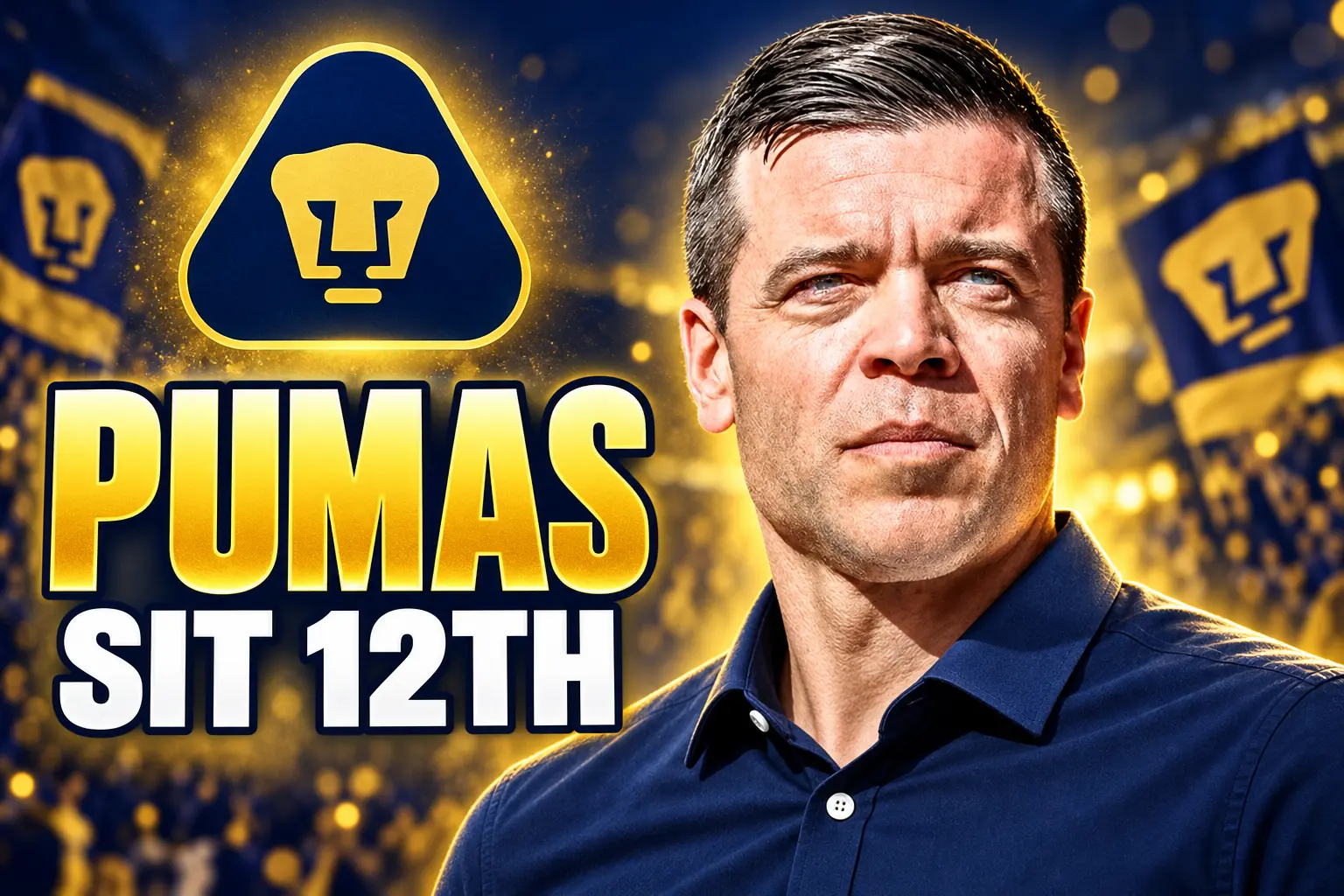
Pumas Bet on Solari and Sit 12th After Six Games
Esteban Solari took a two-year Pumas deal after a Clausura final, and Apertura 2026 has him 12th with eight points and no home win.

Pumas UNAM are 12th in Apertura 2026 with eight points from six games under Esteban Solari. They have not won a league match at the Estadio Olímpico Universitario.
Club Universidad Nacional signed the former Pumas striker on June 21, 2026, to a contract through June 2028. Efraín Juárez had just taken them to 36 points and a Clausura final.
Pumas Handed Solari a Two-Year Bet
The club posted the appointment on a Sunday night, 13 days after Juárez left. Solari, 46, was coming off one Liga MX semester at Pachuca, the same Pachuca that Pumas had just knocked out of the Clausura semifinals on seeding after a 1-1 aggregate.
The welcome note on the official account called him home. He had worn the shirt in 2007 and 2008. The contract runs four tournaments, through June 30, 2028, which is the length he wanted when talks stalled over term.
https://x.com/PumasMX/status/2068879257435091107
Former Mexico midfielder Alberto García Aspe later said sports vice president Antonio Sancho had been looking for a different coach. The board still gave Solari the job, and it gave him the players Juárez would not wait around to shape.
At his first media session, around a July 12 Fan Fest that ended 0-1 to América de Cali on a 35th-minute Yeison Guzmán finish, Solari asked for the one thing a table never grants on credit.
I’m not here to sell empty promises, and we have to build this process together.
Esteban Solari, Pumas UNAM head coach, July 12 presentation
He also called the post a dream from his playing days and said the club had changed his life. Projects, he added, need trust and time.
The 36-Point Season They Walked Away From
Juárez, a former Pumas midfielder, had been in the job since March 2, 2025. Across 59 matches he went 22-21-16. The Clausura was the part that will be remembered, because it broke a club mark and still ended with Cruz Azul in the Olímpico stands.
In 17 regular-season games Pumas went 10-6-1 for 36 points and a plus-17 goal difference, first in the table. Juárez became the first Pumas coach to clear 35 points in a regular tournament. They went through América 6-6 on aggregate as the higher seed, then through Pachuca 1-1 on the same tiebreaker, with Solari in the other dugout.
FROM THE FINAL TO THE HIRE
- May 21, 2026: First leg of the Clausura final finishes 0-0 at Cruz Azul.
- May 24, 2026: Cruz Azul wins 2-1 in Ciudad Universitaria. Robert Morales scores at 31 minutes, Rubén Duarte puts through his own net at 54, and Carlos Rotondi hits the winner at 90+5 after Uriel Antuna and Ángel Rico are sent off.
- June 8, 2026: Juárez leaves at his own request after the two sides cannot agree on how to build the next roster.
- June 21, 2026: Solari is named head coach on a two-year deal.
- June 30, 2026: Sebastián Córdova is announced from Toluca.
- July 4, 2026: Cristian Calderón is announced from Necaxa.
- July 12, 2026: The Fan Fest friendly is lost 0-1, and Solari, Córdova, and Calderón meet the press.
Juárez took the Hungarian job at ETO Győr nine days after leaving Pumas. The university club kept Keylor Navas in goal, brought Pedro Vite and Guillermo Martínez back from the 2026 World Cup, and still chose a new voice for a group that had been 90+5 from a title.
Malaysia, Chile, Godoy Cruz, Then Pachuca
Solari’s 25-goal season eighteen years earlier is the memory the appointment sold. In 40 appearances in 2007 and 2008 he scored 25 times, including 14 in the Apertura, then left for Almería on June 15, 2008, for €3.8 million. The coach CV behind the two-year bet is thinner in Mexico than that headline.
Johor Darul Ta’zim in Malaysia is the line that still looks like a video game. He was the first coach there to win all four titles in one season, and the side was the first in that league to score 100 goals. The managerial record across four prior clubs after that job is the part Pumas actually bought.
SOLARI BEFORE THE PUMAS BENCH
| Club | Span | Games | W-D-L | Win % |
|---|---|---|---|---|
| Johor Darul Ta’zim | Dec 2022-Dec 2023 | 44 | 40-1-3 | 90.91 |
| Everton Viña del Mar | Mar-Nov 2024 | 32 | 14-8-10 | 43.75 |
| Godoy Cruz | Feb-Aug 2025 | 22 | 5-12-5 | 22.73 |
| Pachuca | Nov 2025-Jun 2026 | 23 | 13-4-6 | 56.52 |
The Pachuca semester is the only Liga MX sample. Thirteen wins, four draws, six losses, 33 goals for and 23 against. He went out in the Clausura semifinals to the team he now coaches. Opening night of Apertura 2026 sent that same Pachuca side back to the Olímpico, and the welcome was 0-3 in front of 15,021.
How the First Six League Games Went
Solari’s Pumas have a 2-2-2 league start under Solari, eight points, and a 8-8 goal difference after six matches, which is 1.33 points per game. They are 12th. América lead on 16 points from six games. Guadalajara hold second on 14 from seven.
The six-match Apertura home-and-away split is the cleanest picture of the wager. Away from home they have two wins and six points. At the Olímpico they have two points, one goal, and no win.
APERTURA 2026, MATCH BY MATCH
| Date | Venue | Opponent | Score | Attendance |
|---|---|---|---|---|
| July 18 | Home | Pachuca | 0-3 | 15,021 |
| July 21 | Away | Toluca | 2-1 | 27,273 |
| July 31 | Away | Juárez | 5-1 | 9,594 |
| August 16 | Home | Querétaro | 0-0 | 17,420 |
| August 23 | Home | Necaxa | 1-1 | 13,323 |
| August 28 | Away | Tijuana | 0-2 | 24,333 |
The 5-1 at Juárez is the night the attack looked like the club that just played a final. Juninho scored at 17, 21, and 47 minutes, Morales added one at 39, and Martínez finished at 82. Two league wins sit on that burst and on the 2-1 at Toluca. Everything at home has been a blank, a draw, or a beating.
Leagues Cup did not offer cover. Cincinnati won 2-0, Charlotte won 3-0, and Columbus Crew went through on penalties. Across nine matches in all competitions through August 28 the line was two wins, three draws, four losses, nine scored and 14 conceded. The preferred shape has wandered from 4-2-3-1 to 5-4-1. Navas has captained the league games.
Córdova Called It Redemption at His Fifth Club
The presentation on July 12 was built around two Liga MX veterans with América on their résumés, plus a coach who still talks about 2007. Córdova, 29, arrived from Toluca on an 18-month contract with a six-month option. It is his fifth Liga MX club after Necaxa, América, Tigres, and Toluca, and the club noted his Tokyo 2020 Olympic bronze.
He already knew Sancho. He called the move a chance for redemption after a stretch with little playing time, and he waved away talk of pressure from the university crowd.
“The past is history. Today, we owe it to Pumas, and we have to give our best and strive for the championship,” Córdova said. He also said he has a title in mind and that a big club is motivation, not weight.
Calderón, the left-back known as Chicote, signed on July 4 from Necaxa after Atlas, Guadalajara, and América, and he takes shirt number 12. He is 29. He told the room he had played for two of the big clubs and had not expected a third, and that Pumas had stopped one step from an eighth league title.
THE SUMMER MOVES AROUND SOLARI
- In, midfield: Sebastián Córdova joins from Toluca on 18 months with a six-month option and goes straight into Solari’s first-team group.
- In, left back: Cristian Calderón arrives on July 4 from Necaxa, with Chivas and América already on his path.
- Back from the World Cup: Pedro Vite and Guillermo Martínez return to a squad that had just played a final without a full preseason.
- Out, to Chivas: Jordan Carrillo leaves on a permanent deal after Santos sold his contract, the hole Córdova is meant to fill.
- Also presented: Víctor Arteaga is introduced at the same Fan Fest, with Alan Medina back from a Clausura injury.
Calderón’s line about defending the shirt “with the greatest care” was the one aimed at fans who saw two more América names walk into CU. Córdova’s was blunter. He has been around, he wants minutes, and he wants a championship at a fifth stop.
One Home Goal in Three League Matches
Three home league games have produced one goal, four conceded, and two points. Luciano Herrera’s 87th-minute strike against Necaxa is the entire Olímpico account. Pachuca took the opener 3-0. Querétaro left with a 0-0. Average home attendance across those three is a little over 15,000 in a stadium listed at 62,700.
Away from that building the same team has scored seven times in three games. The split is the early Solari problem, because the two-year pitch was heart and grit in front of that crowd, and the crowd has watched a blank, a late equalizer, and a 3-0 from the coach’s last employer.
A Pumas-focused reading of the roster in early September treated Martínez, 31 and third in the striker order, as a forward being moved on, with Tigres named as the landing spot and his deal running to December. The same voices spent less heat on that sale than on a back line that still looks short a centre-back. Solari has also said he does not give academy space away for free, and that the club needs better raw material in scouting.
Squawka’s model still gives Pumas a 62% chance of reaching the Liguilla and 4.8% of winning the Apertura, with a 20% shot at the top four. Those numbers assume the next run of fixtures bends. León is listed at home on September 10. Guadalajara, second on 14 points from seven games, is listed on September 13.
Guadalajara hosts on September 13. The two-year clock Solari asked for still has three tournaments on it after this one, and the Olímpico is still waiting for a first league win of the Apertura.

Kily Gonzalez Has the Inter Miami Job Without Papers

Chelsea Puts USDC on the Shirt for One Year

Esther González Joins Al Qadsiah After Gotham’s Free Exit

Chelsea Stay on Adam Wharton After Palace Hold Firm

Fiorentina Pays for Pellegrino After Juve’s Loan Fails

Only One of Villa’s Five Winger Targets Actually Signed

SoFi Workers Won Pay and an ICE Walk-Off Clause

Hughes Hired Iraola Twice, Then Left for Al-Hilal

Sunderland’s 53-Year European Wait Ends Against AZ

SNRT Put Morocco’s World Cup Matches on Free TV
-
 NEWS3 months ago
Only One of Villa’s Five Winger Targets Actually Signed
-
 NEWS3 months ago
SoFi Workers Won Pay and an ICE Walk-Off Clause
-
 NEWS3 months ago
Hughes Hired Iraola Twice, Then Left for Al-Hilal
-
 EUROPA LEAGUE3 months ago
Sunderland’s 53-Year European Wait Ends Against AZ
-
 NEWS3 months ago
SNRT Put Morocco’s World Cup Matches on Free TV
-

 NEWS3 months ago
Summerville Turned a Shock Call-Up Into Two World Cup Goals
-

 CHAMPIONS LEAGUE3 months ago
Jordan Brand’s 2018 Football Bet Pays on PSG’s Repeat
-

 EUROPA LEAGUE3 months ago
Rangers Never Played the Sparta Prague Sharpener