
NEWS
Houston’s World Cup Million Was Mostly Visiting Crowds
Houston counted 1,086,499 World Cup event visits, mostly out-of-town tickets, while East Downtown and METRO absorbed the crowd after NRG’s last match.

Houston’s host committee counted 1,086,499 World Cup event visits after the tournament ended, a total built from matches, the fan festival, and marches. The figure landed on July 22, three days after the last festival night and 18 days after NRG Stadium’s final kick.
Most of those stadium tickets were not local. 81% of buyers came from outside the Houston area, and 44% were international, so the city spent June and July moving other people’s crowds.
Houston’s Million Is Three Crowds Stacked
The committee’s own arithmetic is additive. Match entries, festival visits, and marchers are totaled as one participation number, and a fan who did all three is in the pile three times. The host committee’s 1,086,499 participants across official events is that stack, not a unique-head census.
THE THREE COUNTS BEHIND 1,086,499
- Match entries: 480,186 fans went through Houston Stadium for seven World Cup games, an average of 68,598 a match.
- Festival visits: 551,313 people went to FIFA Fan Festival Houston and the Houston Dynamo Soccer Celebration in East Downtown.
- Fan marches: an estimated 55,000 supporters walked official routes toward the stadium.
Those three lines are 480,186 plus 551,313 plus 55,000, which is exactly 1,086,499. Chris Canetti, president of the FIFA World Cup 2026 Houston Host Committee, called the World Cup “the greatest sporting event ever staged” and said Houston had been “operationally sound and perfectly safe.” The million is the turnout he was pointing at, counted as visits.
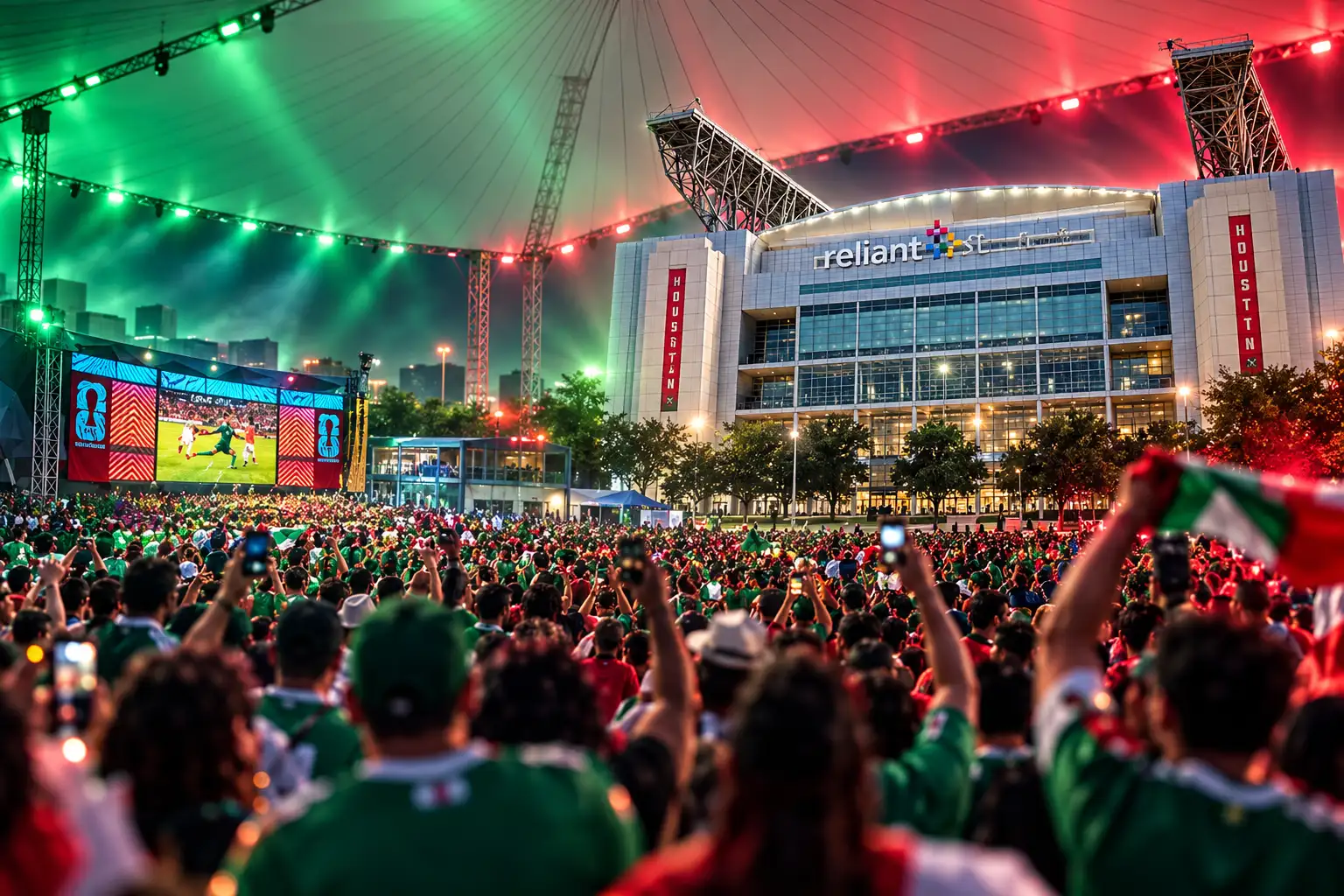
Seven Matches and a 27-Goal Tie
NRG Park staged seven matches at Houston Stadium, FIFA’s neutral name for the building, with a listed tournament capacity of 68,777. Five of the seven crowds were posted at that cap. Germany’s opener and Cabo Verde’s draw were the only ones under it.
HOUSTON’S SEVEN WORLD CUP MATCHES
| Date | Match | Round | Score | Attendance |
|---|---|---|---|---|
| June 14 | Germany vs Curaçao | Group E | 7-1 | 68,021 |
| June 17 | Portugal vs Democratic Republic of Congo | Group K | 1-1 | 68,777 |
| June 20 | Netherlands vs Sweden | Group F | 5-1 | 68,777 |
| June 23 | Portugal vs Uzbekistan | Group K | 5-0 | 68,777 |
| June 26 | Cabo Verde vs Saudi Arabia | Group H | 0-0 | 68,278 |
| June 29 | Brazil vs Japan | Round of 32 | 2-1 | 68,777 |
| July 4 | Canada vs Morocco | Round of 16 | 0-3 | 68,777 |
The seven games produced 27 goals, which the committee’s written release listed as tied for the most of any host city. Curaçao scored its first World Cup goal in the opener. Cristiano Ronaldo became the first player to score in six World Cups during Portugal’s Houston stay, and Brazil needed a late Round of 32 win over Japan to keep the building open into July 4.
Who Bought Houston’s World Cup Tickets?
Ticket buyers came from all 50 states and more than 200 countries. Mexico and Canada led the international list, then Germany, Brazil, and Portugal. Brazil, Canada, Germany, and Portugal actually played five of the seven games here. Mexico did not play in Houston at all.
That split is the second crowd inside the million. The Sports Authority later described an influx of 500,000 visitors. Bank of America data on the committee’s recap put the group-stage lift in non-local card spending across host cities at 17.4%, while Houston’s year-over-year spending was up nearly 3% by July 5. The same summer left hotel rooms that never filled even as stadium seats did.
East Downtown Stayed Packed After July 4
The neighborhood that took the overflow was East Downtown, on a former gravel lot next to Shell Energy Stadium. Ryan Walsh, chief executive of the Harris County-Houston Sports Authority, walked the site before it opened.
Basically, they walk into this parking lot that’s essentially dilapidated. It’s a gravel pit with stuff sticking out of the ground and bare walls, and they had this vision to say, ‘This is where we’re going to have fan fest and it’s going to be epic.’ And it was.
Ryan Walsh, CEO, Harris County-Houston Sports Authority
Nearly 1 million visitors came through EaDo during the tournament, a 225% rise over the same stretch of 2025 and 280% over 2024. Every bar, restaurant, and bakery around the festival posted year-over-year traffic growth from 33% to 1,600%. Greater Houston Partnership later cited East End mixed-beverage sales of about $7.4 million in June, up from $4.3 million in June 2025.
The festival grounds held 7,500 people at a time. That cap was always going to cycle bodies rather than hold a single bowl, and on June 27 it still recorded 24,407 visits, more than three times the operating cap, with England, Croatia, Ghana, Colombia, Portugal, and Argentina on the screens. The committee’s top five festival days were 24,407, 23,616, 21,970, 21,689, and 20,847.
EAST DOWNTOWN’S BUSIEST TOURNAMENT DAYS
| Date | Neighborhood visits | Matches on the screens |
|---|---|---|
| July 5 | 78,000 | Brazil vs Norway, Mexico vs England |
| June 30 | 77,000 | Mexico vs Ecuador |
| June 18 | 64,000 | Mexico vs South Korea |
| June 24 | 58,500 | Mexico vs Czechia |
| June 27 | 49,000 | Colombia vs Portugal |
July 5 was the day after Houston’s last match. Mexico still owned the neighborhood from the screens. Four of EaDo’s five biggest days were Mexico dates. By August, some residents were asking for grass back on the promenade the festival had paved, and the East Downtown Management District said the harder surface was the long-term plan.
METRORail Carried 500,000 Riders on Matchdays
John Coppins, the host committee’s vice president of operations, said moving hundreds of thousands of visitors across venues was one of Houston’s biggest tournament jobs. METRO logged about 5.5 million rides from June 12 through July 8. METRORail carried about 500,000 riders across the seven matchdays, nearly a 50% rise over normal daily boardings.
METRO AND AIRPORT TOTALS
- First four rail days: 48,183, 59,937, 69,765, and 68,284 boardings, or 246,169 through June 23.
- Peak egress: after Portugal-Uzbekistan, METRO estimated 25,000 to 30,000 riders in the post-match surge, the agency’s highest event spike.
- Airports: IAH and Hobby saw 4.5 million passengers from June 12 through July 6.
- Customs: U.S. Customs and Border Protection processed more than 439,000 international arrivals through July 3, up more than 2% year over year, and IAH handled 60 World Cup charters, 30 of them team flights for 13 national sides and 30 more carrying more than 5,800 passengers.
A METRO ride was $1.25. Green and Purple trains dropped festival traffic at EaDo/Stadium Station, and the Red Line ran as often as every six minutes on peak match windows. Downtown, from the start of the tournament through the end of June, recorded 1.47 million visits from more than 933,000 unique visitors, averaging 113,000 visits a day, 6.2% above the prior 12-month daily average. Pedestrian counts rose 48.1% during the tournament and 53.7% on matchdays. The $17 million Main Street Promenade, the Cool and Connected Corridor on Texas Avenue, and the Underpassage lights between Downtown and EaDo were finished in time for that foot traffic.
The Oranje March Left From Rice
Official marches became Houston’s street show, running from East Downtown toward the stadium. The committee put the full-tournament walk count at about 55,000, including Portugal, Uzbekistan, Sweden, Brazil, Japan, and Canada. Midway through June it had already counted 25,000 Netherlands supporters at the fan walk from Rice University, listed as the largest Oranje walk in the United States during the tournament, plus 5,000 from Sweden and 3,000 each from Portugal and Uzbekistan.
Heat sat on all of it. Fewer than 70 people went to hospitals for heat illness out of the half-million-plus festival visitors, and the committee later put the arrest rate across official venues at less than 0.002%. Cooling stations and shade did the quiet work that never shows up in a goals table.
Reliant Lettering Went Back Up in July
On July 22, the same day the million was published, Reliant Stadium signs were going back on NRG. Houston’s World Cup building lasted as long as FIFA’s naming rules. What stays is smaller and farther from the bowl.
Impact Houston 26, parked inside the Houston Sports Authority Foundation, has 23 soccer fields being developed or upgraded with Mayor John Whitmire and Harris County commissioners. Five youth clubs, Albion Hurricanes, Baytown Saints, GFI Academy, HTX Soccer, and SG1, committed $1.5 million to the FREEKICKS program for more than 1,200 annual scholarships. The Sports Authority’s August recap also put Houston’s economic impact at an estimated $1.5 billion and said 138,429 square feet of festival turf would go to community partners.
https://x.com/HC_HSA/status/2089457365439422906
Walsh said the tournament showed Houston and Harris County can still host the world’s biggest events. Whitmire said the success belonged to public servants, volunteers, businesses, and community partners, and that the street work would keep paying after the last whistle. 4,190 volunteers had already gone home.
THE HOUSTON WORLD CUP CALENDAR
- June 11, 2026: The tournament opens and FIFA Fan Festival Houston begins a 39-day run in East Downtown.
- June 14, 2026: Germany beats Curaçao 7-1 in Houston’s first match, 68,021 in the building.
- June 20, 2026: The Oranje walk from Rice fills the approach to a 5-1 Netherlands win over Sweden.
- June 27, 2026: The festival records 24,407 visits against a 7,500-person cap.
- July 4, 2026: Morocco beats Canada 3-0 in Houston’s last match, 68,777 in the seats.
- July 5, 2026: EaDo draws 78,000 people to watch Mexico and others on the screens.
- July 19, 2026: The festival closes, 15 days after the stadium’s last World Cup game.
- July 22, 2026: The host committee releases the 1,086,499 total as Reliant lettering returns.
The million was a visit count, and it was real as throughput. The seats were full of travelers, EaDo took Mexico without hosting Mexico, and the trains carried the rest until the football name went back on the house.
Frequently Asked Questions
Did Houston Count Unique People in Its Million?
No unique-head figure was released. The host committee added match entries, festival and Dynamo celebration visits, and estimated marchers into one participation total, so anyone who bought a seat, walked a march, and spent a day in EaDo is in the 1,086,499 more than once.
What Was NRG Stadium Called During the World Cup?
FIFA requires neutral venue names, so NRG Stadium operated as Houston Stadium for the seven matches, with 68,777 listed as tournament capacity and five sellouts posted at that number.
How Many Volunteers Worked Houston’s World Cup?
4,190 volunteers supported tournament operations at the festival, Shell Energy Stadium, George Bush Intercontinental, and Hobby, after the committee had first talked about a larger volunteer need during the spring uniform unveiling.
How Much Did a METRO Ride Cost During the Tournament?
A ride cost $1.25. Festival traffic used the Green and Purple lines to EaDo/Stadium Station, and Red Line trains were scheduled as often as every six minutes in peak match windows, with extra late service while bars were still open.
What Did Impact Houston 26 Commit for Youth Soccer?
Five Houston-area clubs committed $1.5 million to the FREEKICKS program for more than 1,200 annual scholarships for boys and girls in underserved communities, tied to the 23 fields going in across the region.
Reliant letters are already on the bowl. The 23 fields still have to be finished, and EaDo is still arguing over what the gravel pit should be now that the screens are gone.

Kily Gonzalez Has the Inter Miami Job Without Papers

Chelsea Puts USDC on the Shirt for One Year

Esther González Joins Al Qadsiah After Gotham’s Free Exit

Chelsea Stay on Adam Wharton After Palace Hold Firm

Fiorentina Pays for Pellegrino After Juve’s Loan Fails

Only One of Villa’s Five Winger Targets Actually Signed

SoFi Workers Won Pay and an ICE Walk-Off Clause

Hughes Hired Iraola Twice, Then Left for Al-Hilal

Sunderland’s 53-Year European Wait Ends Against AZ

FIFA Took IShowSpeed’s World Cup Bet to the Final
-
 NEWS5 months ago
Only One of Villa’s Five Winger Targets Actually Signed
-
 NEWS5 months ago
SoFi Workers Won Pay and an ICE Walk-Off Clause
-
 NEWS5 months ago
Hughes Hired Iraola Twice, Then Left for Al-Hilal
-
 EUROPA LEAGUE5 months ago
Sunderland’s 53-Year European Wait Ends Against AZ
-
 NEWS5 months ago
FIFA Took IShowSpeed’s World Cup Bet to the Final
-

 NEWS5 months ago
Summerville Turned a Shock Call-Up Into Two World Cup Goals
-

 NEWS5 months ago
SNRT Put Morocco’s World Cup Matches on Free TV
-

 CHAMPIONS LEAGUE5 months ago
Jordan Brand’s 2018 Football Bet Pays on PSG’s Repeat