
NEWS
Arsenal Still Carry Saliba’s World Cup Back Injury
Saliba played the World Cup on a bad back. Arsenal have zero minutes from him this season and still no return date.

William Saliba has not played a minute for Arsenal in 2026-27 after a back injury that ended his World Cup in the 29th minute of France’s semi-final. The 25-year-old started that night in Arlington, then walked off. France lost 2-0 to Spain.
The June fear was that he would miss the tournament. He did the opposite. He played it hurt. The club that now sits with the rehab file, and with no date on his return, is Arsenal.
He Played the World Cup France Thought He Might Miss
Didier Deschamps named Saliba in a 26-man France squad on 14 May, three weeks before Arsenal’s European final. The centre-back had already been carrying back pain through the run-in. On 30 May he started the Champions League final in Budapest and stayed on for the full 120 minutes.
Kai Havertz scored in the sixth minute. Ousmane Dembélé equalised from the spot in the 65th. Paris Saint-Germain won 4-3 on penalties after a 1-1 draw in front of 61,035 at Puskás Aréna. Saliba lined up between Gabriel Magalhães and the rest of a patched back line. Jurriën Timber only appeared from the bench.
By 3 June, after Saliba had joined France’s camp outside Paris, Deschamps was asked about a fresh scare. “William is fine and will be managed. If he had needed to play tomorrow, he would have played,” the coach said. He also said he would manage the six players who had just gone through the final, “even more so those who started.”
FROM BUDAPEST TO ARLINGTON
- 30 May 2026: Plays the full 120 minutes as Arsenal lose the European final on penalties to Paris Saint-Germain.
- 3 June 2026: Deschamps tells a news conference that Saliba is fine, will be managed, and would have been able to play if required the next day.
- 16 June 2026: Starts France’s World Cup opener against Senegal at MetLife Stadium, a 3-1 win, after missing early sessions in Boston.
- 22 June 2026: Starts against Iraq in a 3-0 win and tells reporters he is not at 100 percent.
- 14 July 2026: Goes down in the 29th minute of the semi-final against Spain at AT&T Stadium and cannot continue. France lose 2-0.
- 22 July 2026: Arsenal confirm a back injury, a managed recovery, and an extended spell out. Surgery is ruled out.
- 9 September 2026: Misses Arsenal’s Champions League opener at Napoli. Ezri Konsa starts beside Gabriel.
He sat out the 26 June group game with Norway as Deschamps rotated a side already through. He started the round of 32 against Sweden, the 1-0 win over Paraguay on 4 July, and the 2-0 win over Morocco on 9 July. Crystal Palace’s Maxence Lacroix was the man warming up when the back finally stopped him against Spain. He was unused in the 6-4 bronze-medal loss to England on 18 July, Deschamps’ last match in the job.
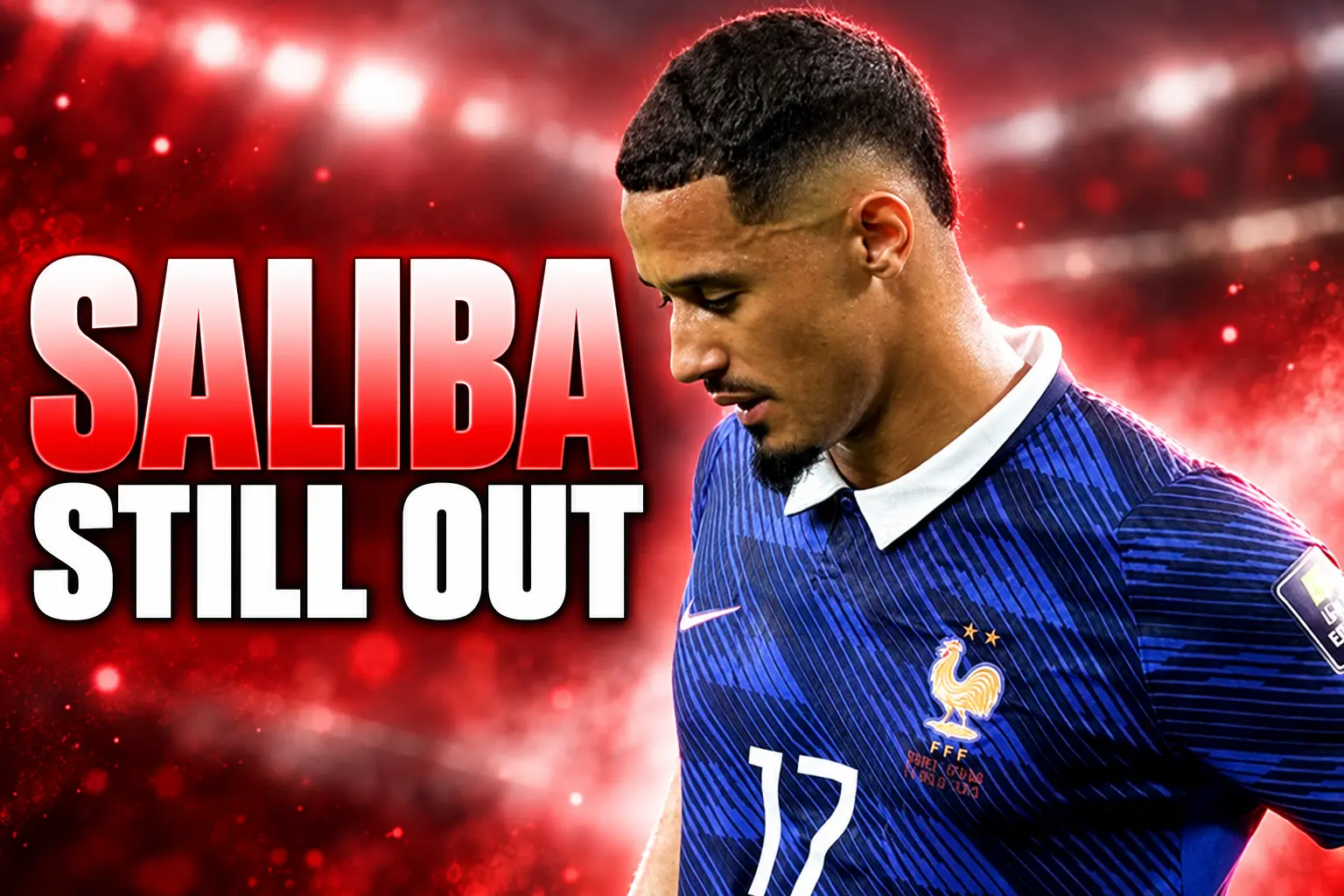
Grit Your Teeth Was Club Policy Too
Before France faced Iraq, Saliba described a problem that had already lived through a title race and a European final. He would not name the movements it stole from him, because that would help opponents. He did name the choice.
I have had small niggles for several months. I gritted my teeth. There was the Premier League and the Champions League. It is a World Cup. It only comes around once every four years. You have to grit your teeth. Lots of players play with niggles. Adrenaline plays a big role. I am not at 100% but that is also the case for several players.
William Saliba, France and Arsenal defender, World Cup press conference, 22 June 2026
Deschamps kept picking him. Before the Sweden tie he said Saliba was not at 100 percent, “but if he is at 99 per cent that’s fine.” He called him a true defender, good in the duel, quick enough, and reassuring for the players around him. Adrien Rabiot said there was a protocol to take load off him, including skipped training, and that Saliba was essential to the team.
French medical reporting before the tournament had floated surgery after the World Cup. Arsenal, watching from London, already expected a gap. The national staff’s public line stayed lighter than that. The player’s own line was the honest one. He was not right, and he was going to play anyway.
Arlington, the 29th Minute, and a Walk Off
The stop, when it came, was quiet. Saliba had the ball at his feet in the 29th minute at AT&T Stadium, lowered himself to the turf, kicked it out, and called for the doctors. He had a word with Deschamps on the way off and walked without being carried. Lacroix replaced him for a second tournament appearance.
Spain were already in front from a penalty won by Lamine Yamal against Lucas Digne, France’s first goal conceded in the knockouts. The defending that had carried Les Bleus through Senegal, Iraq, Sweden, Paraguay and Morocco had to be rebuilt in real time. France never recovered. The 2-0 defeat ended the run at the semi-final.
His World Cup match log shows six games and 480 minutes, then a seat on the bench for the England match. That is a full tournament for a centre-back who had told the room he was not at 100 percent. It is also the last football he has played.
Arsenal Took Back a Long-Term Patient
On 22 July, after specialist reviews in London, Arsenal published a medical update. The club said Saliba had “played an integral role in France reaching the semi-finals,” then confirmed a back injury that needed rehab. Extensive assessments had concluded that surgery is not recommended. He would start a managed recovery at once. He was expected to be out for an extended period.
That wording is the whole of the official timeline. There is still no club date attached to it.
WHAT WE KNOW
- The diagnosis: Arsenal call it a back injury and have ruled out an operation in favour of a managed recovery programme.
- The last match: He has not played since being withdrawn in the 29th minute of France 0-2 Spain on 14 July.
- The squad wrinkle: He was still named in Arsenal’s Champions League squad, even as a long-term absentee.
WHAT IS UNCONFIRMED
- A return date: Arteta has refused to put a week on it, and winter projections have come from outside the club, not from London Colney.
- The load test: On 4 September Arteta said recent progress was “really positive” but that staff still needed to see how the back reacted once they put load on it.
On 9 August, after a pre-season loss to Borussia Dortmund, Arteta said Saliba was “in rest mode at the moment for two weeks” and had to do almost nothing, so the injury was not aggravated. “It’s going to take some time to heal. We know that.” Twelve days later, explaining the signing of Konsa from Aston Villa, he said Arsenal had “two long-term injuries, one with Jurrien, and one with Willy.”
Why Arteta Signed Ezri Konsa
The hidden cost of that World Cup run is not a France post-mortem. Deschamps has left. Spain are champions. The bill arrived in N5, in a title defence that started without the centre-back who had just helped end a 22-year wait.
Arsenal beat Manchester City 3-0 in the Community Shield on 16 August, then opened the Premier League against promoted Coventry on 21 August. Timber has not played a minute in 2026-27 and was still only nearing a return in early September. Cristhian Mosquera, who started the Budapest final at right-back, has been out with a muscle problem. Riccardo Calafiori has been managed because of his own injury history. The defensive list Arteta is actually using is a different team from the one that closed last season.
WHO IS HOLDING THE LINE
- Ezri Konsa: Signed from Aston Villa after Arteta said seven defenders were not enough, and started beside Gabriel against Chelsea and at Napoli.
- Gabriel Magalhães: The remaining half of last season’s first-choice pair, now organising a new partner in real time.
- Piero Hincapié: The spare defender on the bench against Chelsea, then the starter at left-back in Naples.
- Ben White: Back at right-back in the league-phase opener, with Timber still waiting.
The early table has not punished Arsenal for the vacancy. Three Premier League wins from three, nine points, goal difference five, level with Manchester City. That run has quieted the noise around Saliba without shrinking the hole he left. Konsa has looked calm on the ball and sure in the duel, which is the job description Saliba made famous. It is still a different partnership, built because two first-choice defenders were classed as long-term.
Fifty Club Games, Then a Hard Stop
Last season’s numbers explain why France kept picking him, and why Arsenal cannot shrug the wait. He made 50 appearances across all competitions as Arsenal took the Premier League with 85 points from a 26-7-5 record, scored 71 and conceded 27, then went all the way to extra time in Europe. In the league he played 31 matches, 30 as a starter, 2,614 minutes, one goal, no assists.
SALIBA’S YEAR IN MINUTES
| Competition | Games | Minutes | Now |
|---|---|---|---|
| Premier League 2025-26 | 31 | 2,614 | Title won |
| All Arsenal competitions | 50 | 4,253 | Final lost on penalties |
| World Cup 2026 | 6 | 480 | Out in the 29th minute of the semi-final |
| Arsenal 2026-27 | 0 | 0 | Extended rehab, no date |
He had a previous back problem toward the end of 2022-23. The latest one, by his own account, had been managed for months, including from March, while Arsenal closed a league title and a European final. The World Cup was the extra month his back did not have. French reporting after the Spain game used darker language than the club later signed off. Arsenal’s published diagnosis stayed at back injury, rehab, no surgery. That is the version that governs his season.
A Clean Sheet in Naples Without Him
On 9 September, in the Champions League league-phase opener, Arsenal beat Napoli 1-0 at Stadio Diego Armando Maradona without him. Martin Ødegaard scored in the 75th minute, in off a post from the edge of the box. Arsenal took 26 shots, eight on target, for 4.05 expected goals, and still needed the late strike. Hincapié blazed over from close range. Bukayo Saka and Mikel Merino had already missed. The back line was White, Konsa, Gabriel, Hincapié. Saliba was listed as injured. Nothing else.
Arteta’s last public detail, on 4 September, was the load test that still had not been passed. Progress in the previous weeks had been “really positive,” he said, “but we need to wait and see how that one reacts when we start to put some load into it.” Five days later the player was still a long-term absentee. He is in the European squad, which keeps a path open. He is not in the XI, which is the only path that counts for a title defence.
The next league match is at Sunderland on 12 September. Saliba will not be in it. France already had their semi-final from him. Arsenal are still waiting on the version that can train, take a load, and play.

Kily Gonzalez Has the Inter Miami Job Without Papers

Chelsea Puts USDC on the Shirt for One Year

Esther González Joins Al Qadsiah After Gotham’s Free Exit

Chelsea Stay on Adam Wharton After Palace Hold Firm

Fiorentina Pays for Pellegrino After Juve’s Loan Fails

Only One of Villa’s Five Winger Targets Actually Signed

SoFi Workers Won Pay and an ICE Walk-Off Clause

Hughes Hired Iraola Twice, Then Left for Al-Hilal

Sunderland’s 53-Year European Wait Ends Against AZ

Summerville Turned a Shock Call-Up Into Two World Cup Goals
-
 NEWS4 months ago
Only One of Villa’s Five Winger Targets Actually Signed
-
 NEWS4 months ago
SoFi Workers Won Pay and an ICE Walk-Off Clause
-
 NEWS4 months ago
Hughes Hired Iraola Twice, Then Left for Al-Hilal
-
 EUROPA LEAGUE4 months ago
Sunderland’s 53-Year European Wait Ends Against AZ
-
 NEWS4 months ago
Summerville Turned a Shock Call-Up Into Two World Cup Goals
-
 NEWS4 months ago
SNRT Put Morocco’s World Cup Matches on Free TV
-

 CHAMPIONS LEAGUE4 months ago
Jordan Brand’s 2018 Football Bet Pays on PSG’s Repeat
-

 EUROPA LEAGUE3 months ago
Rangers Never Played the Sparta Prague Sharpener