
NEWS
New World Cup Rules Rewired the Last 15 Minutes
World Cup 2026 rules put 10-second exits and five-second restarts on a clock, then left mouth-cover reds as a FIFA option other competitions refused.

Only one substituted player in 72 World Cup group games missed the 10-second exit. Iceland had already paid for that mistake in Tokyo, when Japan scored with the visitors a man down.
The International Football Association Board spent the spring writing clocks into throw-ins, goal kicks, substitutions and injury breaks, then added red cards for covering a mouth and walking off in protest. The clocks changed habits. The reds stayed a FIFA tournament choice.
Iceland Lost a Player for a Minute, Then Lost the Match
On May 31 in Tokyo, Japan beat Iceland 1-0 in a send-off friendly at the National Stadium, in front of 62,212. The score was still 0-0 in the 85th minute when Iceland tried two changes at once. Hjörtur Hermannsson came on cleanly. Kristian Hlynsson took too long to get off, so Isak Thorvaldsson had to wait.
Under the new law, a player who is being replaced must leave within 10 seconds of the substitution board, usually by the nearest boundary. Miss that window and the incoming player may enter only at the first stoppage after one minute of running time. Iceland played that minute with 10 men. Koki Ogawa headed Yukinari Sugawara’s cross inside the far post in the 87th minute, the only goal of the night.
Hajime Moriyasu used 11 substitutes, which the new friendly cap allows if both teams agree, up to 11 from a base of eight. The match was a rehearsal, and the rehearsal produced a result. Japan opened the World Cup against the Netherlands, Tunisia and Sweden with that clip already in the coaching files.
Collina Counted One Slow Exit and 15 Countdown Misses
Pierluigi Collina, FIFA’s chief refereeing officer, published a group-stage note on June 30. Coaches and players had been walked through the clocks in a 48-team workshop and in online meetings. He wrote that the measures were “very effective and unanimously considered as very positive innovations,” and that only one substituted player failed to beat the 10-second limit across those 72 matches.
GROUP-STAGE CLOCK TALLY
| Restart | Limit | If it is missed | Times it broke |
|---|---|---|---|
| Player leaving for a substitute | 10 seconds | Replacement waits one minute | 1 |
| Throw-in | Five-second countdown | Throw goes the other way | 11 |
| Goal kick | Five-second countdown | Corner to the other team | 4 |
Players who were being replaced were seen running to the touchline even when their team was ahead. That is the second-order change. The punishment rarely fired because the threat was enough, which is what Major League Soccer’s earlier tests had suggested when Collina called them a success.
Outfield players who stop the game for treatment, or who are assessed on the pitch, must then stay off for one minute after the restart. Collina said injuries fell and that medical staff were called far less often. Goalkeepers, collisions, severe head injuries and a player about to take a penalty sit on the exception list, so a genuine knock is not treated like a stall.
Five Seconds or the Ball Changes Hands
The IFAB’s 140th annual meeting, chaired by Football Association of Wales president Mike Jones in Hensol on February 28, extended last season’s keeper-on-the-ball countdown to the other cheap delays. If the referee thinks a throw-in or goal kick is being held up, the whistle comes, then a five-second visual countdown. No release in time, and the throw is given to the other team from the same spot. A slow goal kick becomes a corner on the side closest to where the kick should have been taken.
Collina said before the tournament that he did not expect many of those restarts to be flipped, because players would respect the limit once they could see the hand. The group stage still produced those 15 misses, which is a small rate across 72 games and a live reminder that the countdown is not theatre. Referees count the last five seconds of a substitution the same way, a raised hand the player cannot claim not to have seen.
Circular 32, issued March 31, put the protocols in the Laws of the Game 2026/27 from July 1, with competitions that started earlier free to use them on time for the World Cup. The clocks are now ordinary law, not a FIFA experiment.
Keepers Can Still Go Down, Coaches Cannot Cluster
The one stall the AGM did not fully kill is the goalkeeper who goes down so the bench can talk. IFAB ordered trials rather than a shared sanction. Collina told coaches the referees would still step in.
The goalkeeper has the right to be injured, but the players do not have the right to leave the field of play to have some sort of time out with their respective coaches.
Pierluigi Collina, FIFA chief refereeing officer
There is no yellow card for wandering toward the technical area. Referees are told to stop the gathering, and Collina admitted IFAB “didn’t get a shared solution” on punishments. Each half also carries a three-minute hydration break, so coaches are not starved of a planned pause. Circular 34, dated July 27, opened a trial in which an outfield player must leave for one minute when the goalkeeper needs on-field treatment, a way to make the fake injury cost someone other than the keeper.
VAR Can Now Look Before the Corner Is Taken
Set-piece wrestling was the other complaint behind the spring rewrite. VAR used to wait until the ball was live. At the World Cup it could flag an attacking foul committed before a corner or attacking free kick if that foul led to a goal, a penalty, or a sending-off for denying a goal or a promising attack. Circular 34 listed that power as a trial first used at the tournament, so a shirt pull in the six-yard box before the kick is no longer a free hit.
THREE VAR ADDITIONS IN THE 2026 LAWS
- Second yellow: VAR may step in when a second yellow that produces a red is clearly wrong. It may not recommend a second yellow that was never shown.
- Wrong player: A card given to the wrong person, on either team, can be moved to the player who committed the offence. The offence itself is not re-judged.
- Wrong corner: A clearly incorrect corner may be flipped to a goal kick if the check is instant and does not delay the restart, as a competition option.
Tracking data from Hawk-Eye cameras and the Kinexon sensor in the match ball can alert the video official on those out-of-play calls, the same stack already used for semi-automated offside. Collina also told teams that an attacker who is not playing the ball and steps across a defender, or the goalkeeper, to block a run should be punished, with VAR in support. That instruction sat beside the new corner trial and was aimed at the same dead-ball mess.
Covering a Mouth Became a Red Card FIFA Used
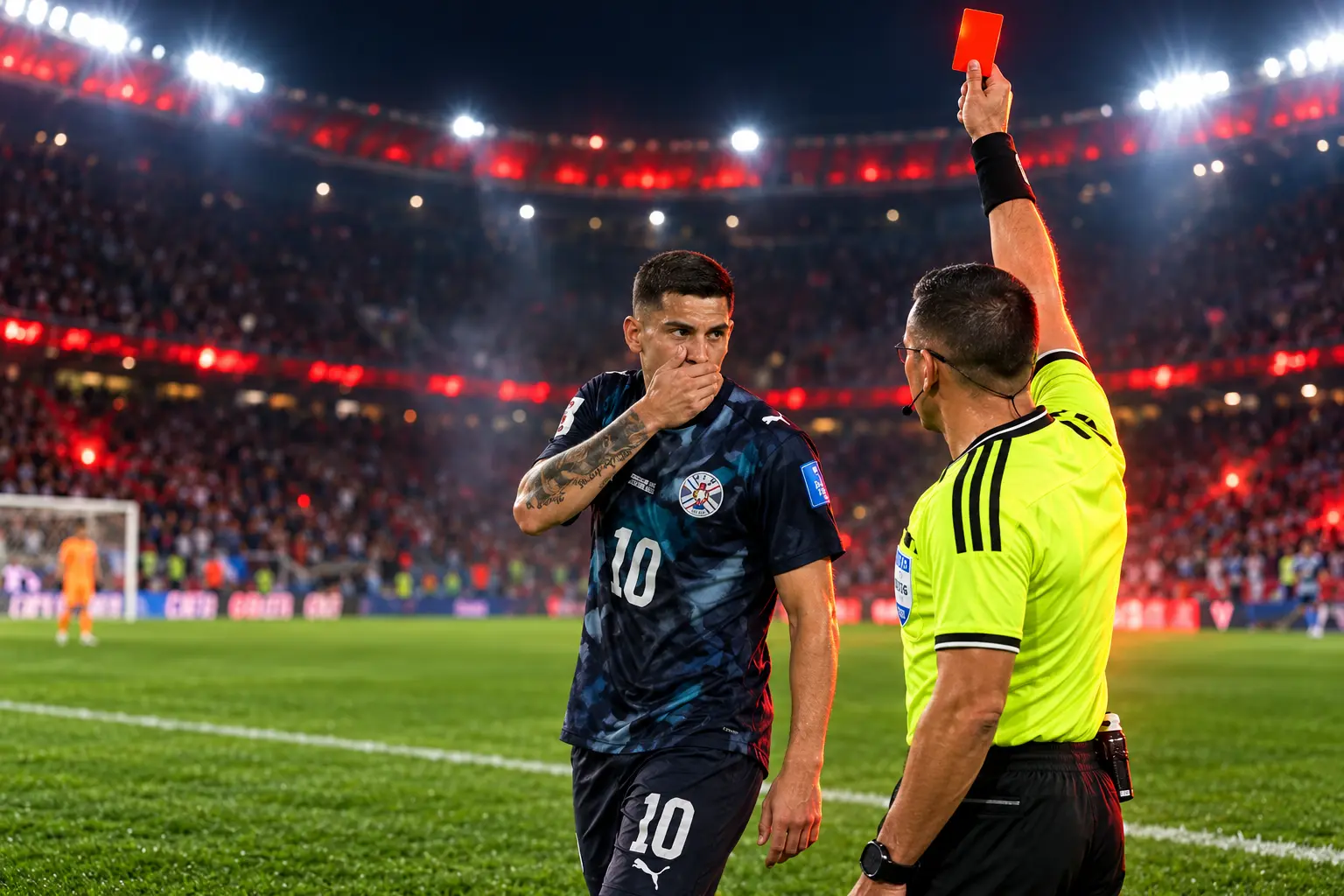
The mouth rule was not in the February package. After a special IFAB meeting in Vancouver on April 28, circular 33 made it an optional red card for competitions. The wording targets a player who covers the mouth with a hand, arm or shirt while communicating with an opponent in a provocative, derisory or inflammatory situation, a deterrent aimed at racist or other abusive language that cameras cannot read.
FIFA switched the option on for the World Cup after Benfica winger Gianluca Prestianni covered his mouth in a clash with Vinícius Júnior and was later banned six games for homophobic language. Collina’s test was simple. Friendly chat can stay covered. A confrontation with a hidden mouth is treated as something the player chose to hide.
Paraguay forward Miguel Almirón became the first World Cup player sent off under that law, on June 20 against Türkiye in Santa Clara. Play had stopped, Mert Müldür pointed to the gesture, and referee Iván Barton went to the monitor. Almirón missed the Australia game. FIFA posted the decision the same day.
https://x.com/FIFAcom/status/2068352481780699242
By June 30 Collina had counted 10 red cards in the group stage, six for denying an obvious goal-scoring opportunity and one for a covered mouth. Ecuador defender Piero Hincapié was later sent off in stoppage time of a 2-0 round-of-32 loss to Mexico after an exchange with Santiago Giménez, Slavko Vinčić showing the card after a review. The result was already settled.
The same gesture did not always bring the same card, which is the fight the optional law created. Jude Bellingham covered his mouth while speaking to Ghana staff in a 0-0 draw and was left on because the exchange was judged not confrontational. In the final, Marc Cucurella briefly covered his mouth talking to Lionel Messi after Enzo Fernández’s second yellow; Messi asked for a red and did not get one. English league organisers have already left the sending-off unused, and UEFA told its associations it will not treat covering a mouth, by itself, as a red-card offence, without prejudice to later disciplinary cases. The card does not require proof of the words. It treats the cover, in a confrontation, as the offence, which is why a dive can be a yellow and a hand on a mouth can be a red.
A Team That Leaves Can Forfeit the Match
The walk-off law has the same origin story: a final that stopped, a title that moved, then an optional red. On January 18 in Rabat, Senegal left the field after Morocco were given a stoppage-time penalty, and the match was delayed 15 minutes. Senegal came back, Edouard Mendy saved Brahim Díaz’s Panenka, and Pape Gueye won it in extra time. On March 17, CAF’s appeal board declared a forfeit and awarded Morocco a 3-0 win. Senegal called it a robbery and went to the Court of Arbitration for Sport.
HOW THE 2026 PACKAGE WAS BUILT
- February 28, 2026: The IFAB AGM in Hensol approves the substitution, throw-in, goal-kick and injury clocks, plus the three VAR additions.
- April 28, 2026: A special meeting in Vancouver adds covering a mouth and leaving the field in protest as competition-option red cards.
- May 19, 2026: Circular 33 sends those options to associations, including a forfeit if a team is responsible for a match having fewer than seven players.
- May 31, 2026: Hlynsson’s slow exit in Tokyo gives the substitution clock its first public goal.
- June 20, 2026: Almirón is sent off for covering his mouth, the first World Cup red under the Vancouver amendment.
A player who walks off in protest, or who tells teammates to walk off, can now be sent off where the organiser has taken the option. UEFA declined that red card too, while pointing clubs to the seven-player forfeit line now written into the Laws. No World Cup side tested it on the field. The Senegal file was the point of the clause.
Circular 34 was still answering edge cases in late July, including a slow-leaving goalkeeper, who is cautioned while the new keeper comes on immediately because Law 3 requires each team to have one. The clocks are in force for competitions from July 1. The red cards remain a menu, which is why a World Cup sending-off for a hand on a mouth does not automatically follow a player into the league season.
Frequently Asked Questions
How long do players have to leave the pitch when substituted?
The 10 seconds start when the board is shown, or when the referee signals if there is no board, and the player should go to the nearest boundary unless the referee points elsewhere. The referee may count the last five seconds with a raised hand. If several changes happen in one stoppage, the board for the last of them starts the clock. A goalkeeper who overruns the limit is booked, and the new goalkeeper still enters at once.
What happens if a goalkeeper takes too long over a goal kick?
After the referee starts the five-second countdown, a goal kick that is still not taken becomes a corner to the other team, taken on the side of the field closest to where the goal kick was going to be. The same countdown on a throw-in gives the throw to the opponents from the original spot.
Can VAR review a second yellow card?
Only to correct a second yellow that was clearly wrong and produced a red, or to move a card onto the right player in a case of mistaken identity. VAR cannot add a second yellow that the referee never showed, and circular 34 says the mistaken-identity tool cannot be used to re-judge whether the offence happened, only who receives the card.
Is covering your mouth a red card in every competition?
No. Circular 33 makes it a competition option, aimed at a cover used while talking to an opponent in a provocative, derisory or inflammatory way, including with a shirt. A friendly conversation can still be shielded. FIFA used the red at the World Cup; UEFA and the Premier League have not adopted that sending-off as a stand-alone offence.
What is the punishment if a team walks off in protest?
Where the organiser has taken the option, a player who leaves in protest, or who tells others to leave, can be shown a red card. If a team is responsible for the match dropping below seven players and not continuing, the Laws now say that team forfeits, subject to the competition’s own rules, which is the line UEFA flagged even as it declined the individual red.
The slow walk to the halfway line is now a numbers problem, which Tokyo had already shown and which 72 group games then confirmed. The hidden sentence and the dressing-room protest are still a local choice, written into the same law book with an opt-out sitting next to the sending-off.

Kily Gonzalez Has the Inter Miami Job Without Papers

Chelsea Puts USDC on the Shirt for One Year

Esther González Joins Al Qadsiah After Gotham’s Free Exit

Chelsea Stay on Adam Wharton After Palace Hold Firm

Fiorentina Pays for Pellegrino After Juve’s Loan Fails

Only One of Villa’s Five Winger Targets Actually Signed

SoFi Workers Won Pay and an ICE Walk-Off Clause

Hughes Hired Iraola Twice, Then Left for Al-Hilal

Sunderland’s 53-Year European Wait Ends Against AZ

FIFA Took IShowSpeed’s World Cup Bet to the Final
-
 NEWS5 months ago
Only One of Villa’s Five Winger Targets Actually Signed
-
 NEWS5 months ago
SoFi Workers Won Pay and an ICE Walk-Off Clause
-
 NEWS5 months ago
Hughes Hired Iraola Twice, Then Left for Al-Hilal
-
 EUROPA LEAGUE5 months ago
Sunderland’s 53-Year European Wait Ends Against AZ
-
 NEWS5 months ago
Summerville Turned a Shock Call-Up Into Two World Cup Goals
-
 NEWS5 months ago
FIFA Took IShowSpeed’s World Cup Bet to the Final
-

 NEWS5 months ago
SNRT Put Morocco’s World Cup Matches on Free TV
-

 CHAMPIONS LEAGUE5 months ago
Jordan Brand’s 2018 Football Bet Pays on PSG’s Repeat