
NEWS
FIFA Says No Evidence Ball Hit Cable Before England’s Norway Goal
FIFA says its Connected Ball sensor found no contact with an overhead cable before England’s controversial 2-1 extra-time win over Norway.

FIFA says its Connected Ball sensor recorded no sign the ball clipped an overhead Skycam cable before Jude Bellingham’s equalizer against Norway. The goal stood, England won 2-1 after extra time, and Norway’s deepest World Cup run in decades ended Saturday in Miami.
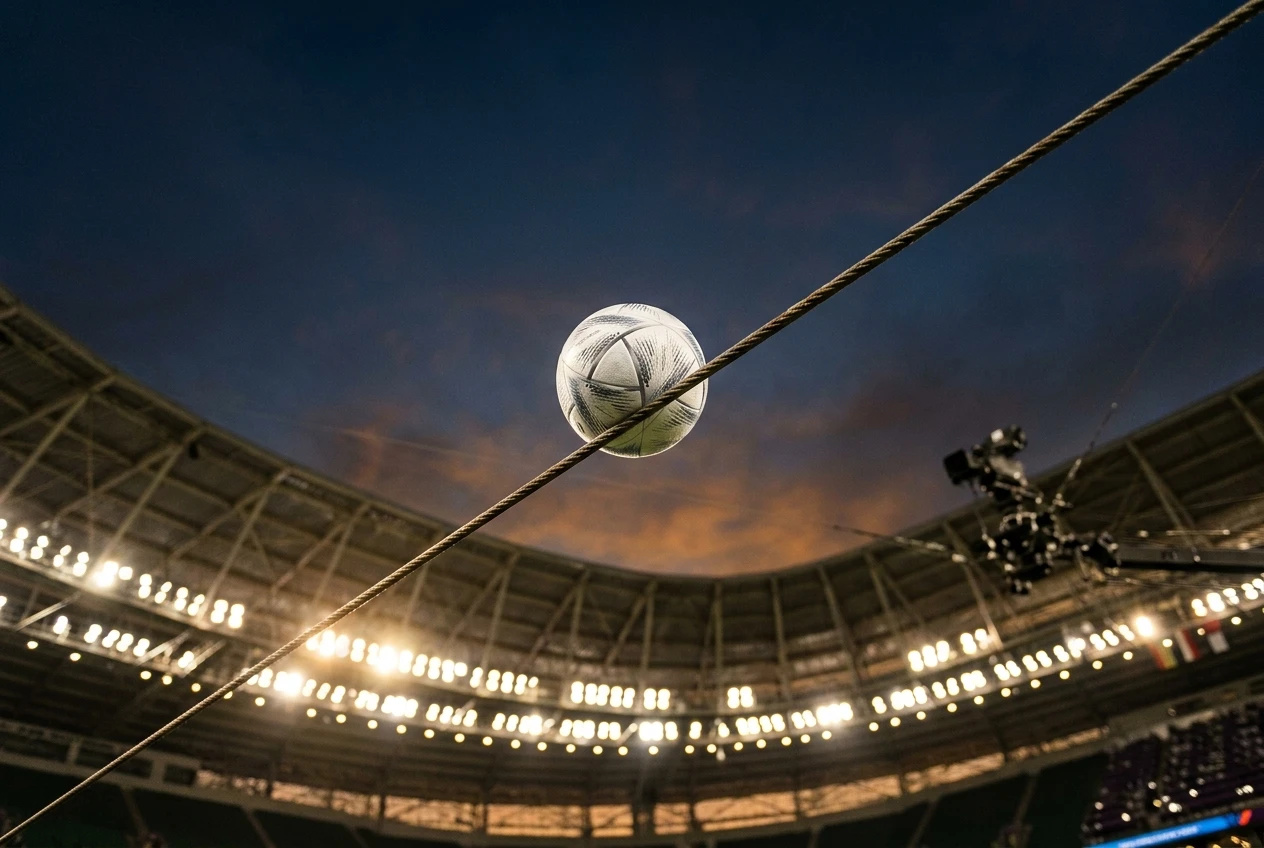
Replays showed the ball dying in midair before dropping to an England player’s feet. FIFA’s data says nothing touched it. Nobody actually pulled up a monitor to check before the goal counted.
The Kick That Split a Quarterfinal
Norway led 1-0 in the World Cup quarterfinal at Hard Rock Stadium in Miami, Andreas Schjelderup’s 36th-minute strike beating goalkeeper Jordan Pickford off the far post. Then, in the second minute of first-half stoppage time, everything turned.
- The goal kick – Norway goalkeeper Ørjan Nyland cleared long from the back under England pressure.
- The contact – Replays appeared to show the ball brushing the taut cable that carries the stadium’s robotic Skycam, and it dropped sharply out of the sky.
- The break – Elliot Anderson collected the falling ball and fed Anthony Gordon.
- The finish – Gordon squared it for Jude Bellingham, who beat Nyland low to the far post to make it 1-1.
Norway’s bench erupted. Ståle Solbakken, Norway’s manager, confronted the officials at halftime, and several players surrounded referee Clément Turpin on the pitch demanding an explanation.
The Ball’s Flat Heartbeat
FIFA settled the dispute hours later in a statement distributed through its media account.
Before England’s goal in minute 45+2 against Norway, the sensor in the Connected Ball showed no peak in the “heartbeat of the ball” when in the air, and therefore no evidence that the ball touched the overhead wire and changed the movement of the ball.
The explanation leans on hardware built into the adidas Trionda match ball. It carries an Inertial Measurement Unit (IMU), an accelerometer-and-gyroscope package that samples the ball’s motion 500 times a second and feeds that data straight to Video Assistant Referee (VAR) officials in real time.
That same feed powers Semi-Automated Offside Technology (SAOT), the camera-and-avatar system used to flag offside calls, which this tournament upgraded to 16 high-resolution tracking cameras from the 12 used at the 2022 tournament in Qatar. FIFA’s argument is simple: if the sensor felt nothing, nothing legally happened.
Has the World Cup’s Smart Ball Been Wrong Before?
Yes, in both directions. The Connected Ball has already swayed two major calls this tournament, canceling a goal for Croatia over a hidden touch and reviving one for Sweden that was wrongly flagged offside. Saturday marked the first time players openly doubted what the chip reported.
Earlier in the group stage, the same sensor restored a Sweden goal ruled out for offside after detecting a stray touch off a teammate that played the scorer on. It has also cut the other way: officials waved off a Croatia equalizer against Portugal in the round of 32 after the chip showed the ball had come off a Croatia player first.
| Match | What the Sensor Showed | Result |
|---|---|---|
| Portugal vs. Croatia, round of 32 | Ball had touched a Croatia player before the net | Croatia’s equalizer ruled out for offside |
| Sweden vs. Tunisia, group stage | Slight touch off a Sweden player played the scorer onside | Initially disallowed goal restored |
| Canada vs. El Salvador, Gold Cup, last summer | Obvious contact, debris visibly fell from the camera rig | Referee stopped play immediately |
| England vs. Norway, quarterfinal, Miami | No peak recorded in the ball’s motion data | Goal stood, no stoppage |
Sports Illustrated recalled that the Gold Cup case was unmistakable, with debris falling from the rig after a lofty clearance connected. Miami’s contact, if it happened at all, left no such trace for anyone to point to.
Norway’s Locker Room Won’t Let It Go
Solbakken said he did not see the ball hit the wire himself, though he said several players on his bench did. Asked whether the cable deserved an assist for England’s leveler, he did not dodge the question.
“Yeah, it probably will,” Solbakken said. “That was unlucky for us. The ball fell straight down from the sky, so it changed its direction.”
He added later: “I don’t think we will play the game again, so that’s how it is.”
Sander Berge, the Norway and Fulham midfielder, was blunter. “It’s ridiculous, this one with the wire,” Berge said after the match.
Former England striker Wayne Rooney, speaking on BBC Sport, described the same flight path without going as far as Norway’s players. “The ball seems to deviate and come down quickly,” Rooney said. “It sort of deviates the ball.”
Norway had a second grievance. In the 55th minute, defender Torbjorn Heggem scored from a corner, but the goal was wiped out after a VAR check found Erling Haaland had pushed England’s Elliot Anderson before the corner was taken. Fox Sports rules analyst Mark Clattenburg agreed with that call, even as he argued the cable incident should have gone the other way.
The Review That Never Came
Clattenburg said the cable contact met the threshold for a VAR review no matter what the sensor later showed. “Yes they can interfere if that contact of the ball on the camera cable is part of a reviewable incident. If the contact leads to a goal, it is a part of the VAR reviewable incidents,” Clattenburg said.
No such review happened in real time. Turpin told Solbakken at halftime that he had not seen the contact himself and had not received any alert about it.
“That’s a good explanation and since FIFA says there was no touch and there was no signal from the chip of the ball, then he can’t do anything about it,” Solbakken said.
- Mark Clattenburg, Fox Sports rules analyst, says any contact with an object outside the field of play should have stopped play and triggered a VAR review, sensor reading or not.
- FIFA says the Connected Ball’s motion data showed no anomaly, so there was nothing to send to review in the first place.
- Ståle Solbakken, Norway’s manager, accepts he cannot argue with the sensor but maintains the ball fell straight down from the sky and changed course.
Whatever the chip did or did not register, no monitor went up pitchside before the goal counted. That gap, not the sensor reading itself, is what Norway is left holding.
England Turns to Messi’s Last Dance as Norway’s Run Ends
Norway leaves the tournament with its deepest World Cup run on record. Saturday marked the country’s first World Cup appearance since 1998, a run carried by Erling Haaland’s performances through the group stage and knockout rounds.
“I hope we can think about and talk about other things,” Solbakken said of the wire controversy. “I hope that this will not be the story about this team.”
England moves on to face Lionel Messi’s Argentina, the two nations meeting at a World Cup for the first time since 2002. England’s Football Association confirmed fixture details for the semi-final at Mercedes-Benz Stadium in Atlanta on Wednesday, July 15.
Bellingham’s brace made him the first player to score twice or more in consecutive World Cup knockout matches since Diego Maradona in 1986, having also scored twice against Mexico in the round of 16. Messi, who has scored in every knockout round so far, arrives in Atlanta for what could be his final World Cup match.

-

 NEWS3 months ago
The Five Wingers Aston Villa Are Chasing This Summer
-
 NEWS3 months ago
SoFi Stadium Strike Vote Puts U.S. World Cup Opener on Alert
-
 NEWS3 months ago
Liverpool Agree Deal With Iraola to Lead Anfield’s Rebuild
-
 EUROPA LEAGUE3 months ago
Sunderland’s Europa League Dates Start a Travel Race
-
 NEWS3 months ago
SNRT Gives Morocco’s World Cup Games a Public TV Window
-

 NEWS3 months ago
Summerville Went From Zero Caps to a World Cup in Seven Days
-
 CHAMPIONS LEAGUE3 months ago
Michael Jordan’s PSG Payday Runs Through the Club Shop
-
 LA LIGA3 months ago
Real Madrid Now Pay More for Mourinho After Benfica Clause Lapsed