
NEWS
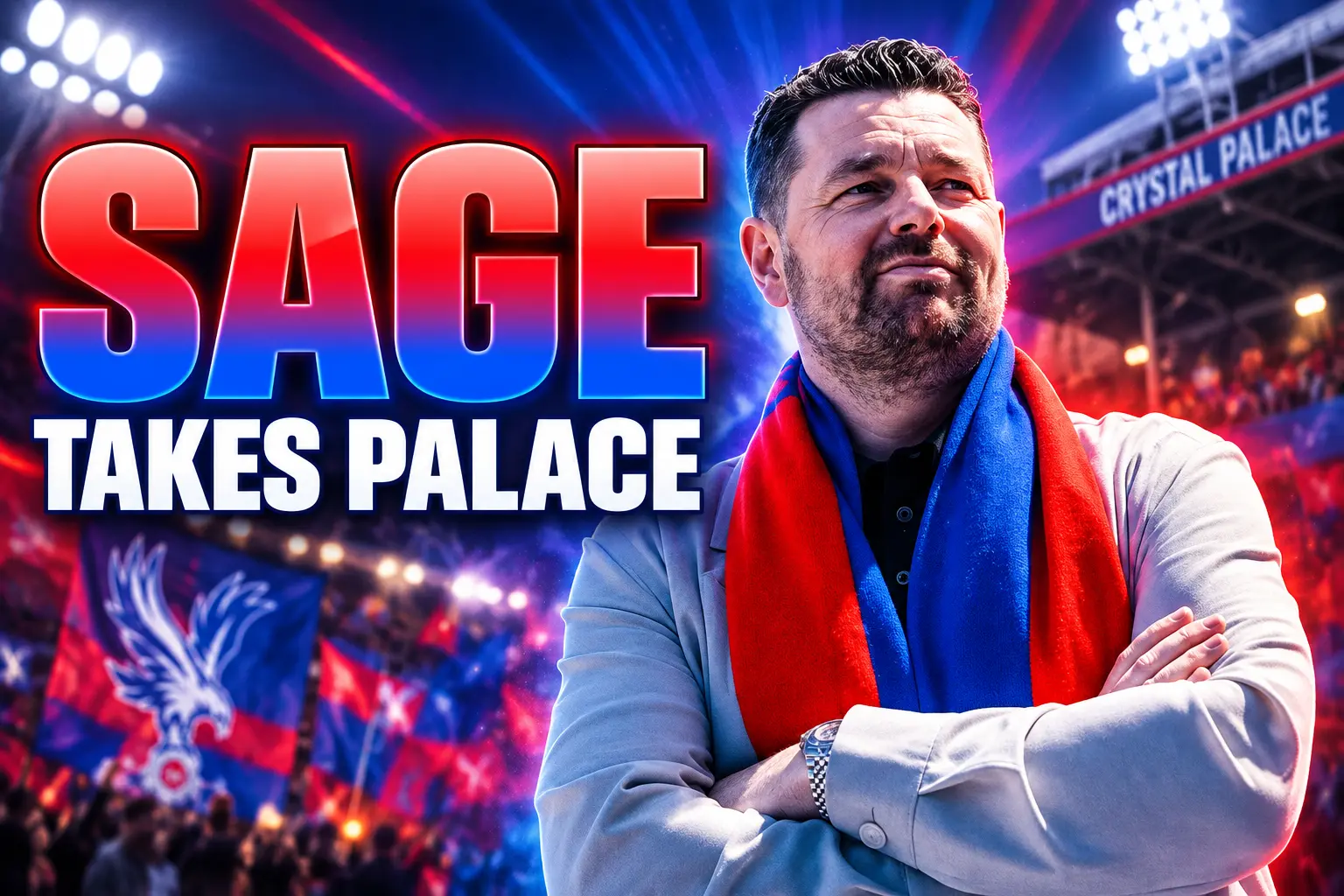
Pierre Sage Takes Palace After Walking Out on Lens
Pierre Sage left a Champions League Lens side for Crystal Palace after Iraola chose Liverpool, and his first four games already show the cost.

Crystal Palace appointed Pierre Sage as manager on 15 June 2026 on a three-year deal after the Lens coach walked away from a Champions League place. The 47-year-old replaces Oliver Glasner and has started with two wins and two losses from four games.
Palace wanted Andoni Iraola first. Liverpool took him. Sage, who had just told French television he would stay at Lens, signed until the summer of 2029 anyway.
Palace Signed Sage on a Three-Year Deal
Sage was born in Lons-le-Saunier on 5 May 1979 and arrived from RC Lens with his assistant Jamal Alioui. He started work on 6 July, four days before most of the first-team squad reported on 10 July.
Glasner had spent two and a half years in south London and left when his contract expired. He had already told chairman Steve Parish in October that he wanted a new challenge, then said so in public in January, on the same day Marc Guehi’s £20 million move to Manchester City landed.
The Austrian still signed off with the club’s first major trophies: the FA Cup in 2025, the Community Shield, and a Conference League trophy won in Leipzig, 1-0 against Rayo Vallecano. The league table did not match the cabinet. Palace finished 15th in 2025-26, then handed Sage a Europa League campaign and a squad in flux.
I am tremendously excited to welcome Pierre, who joins us off the back of a trophy-winning season at Lens as well as a fabulous second-place finish in Ligue 1. As we move into another European campaign off the back of our success in Leipzig, I know he will give everything to target more success for our fantastic football club.
Steve Parish, Crystal Palace chairman, club statement
Sage answered in the same register. “Oliver Glasner achieved some amazing things, and now I have to do the same,” he said. “That’s why we come here with a lot of ambition.” The ambition sat on a Plan B hire, and on a coach who had just left the Champions League on the table.
The French Cup He Lifted and Left
Lens had given Sage a three-year contract on 2 June 2025. One season later the club posted the best home record in Ligue 1, with 14 wins, finished second, six points behind Paris Saint-Germain, and qualified for the Champions League.
On 22 May 2026 at the Stade de France he beat Nice 3-1 and delivered the first Coupe de France in the club’s 120-year history. The UNFP named him Ligue 1 manager of the year. Across all competitions Lens logged 28 wins, 4 draws and 8 defeats in 40 games.
THE TEN DAYS AFTER THE CUP
- 22 May 2026: Sage wins the Coupe de France, 3-1 against Nice.
- 24 May 2026: Asked on a French studio show if he will be Lens coach the next season, he says yes.
- 3 June 2026: He tells the Lens board he is leaving, ten days after that yes.
- 9 June 2026: Palace and Lens settle a fee around the coach and Alioui.
- 15 June 2026: Both clubs announce the move, and Sage starts a three-year Palace deal.
The Premier League wage, and the chance to work in England, pulled harder than the group-stage nights he had just earned. Lens supporters heard a coach who had asked them for courage, then watched him board a flight before the Champions League list came out. Palace supporters heard a trophy coach. Both readings can sit in the same week.
Opta’s Lens file shows why Parish paid up. The side made 426 high turnovers in 2025-26, turned those steals into 69 shots and 7 goals, and ran 65 direct attacks and 55 fast breaks while holding 51.9% of the ball. They pressed high and went forward fast. That is the tape Palace bought.
Lyon Cut Him Loose With the Team Still Sixth
The tape also includes a sacking. Lyon made Sage interim manager on 30 November 2023 after Fabio Grosso went, then confirmed him in January 2024. He took a side that had been bottom and finished sixth, with Europa League football attached, and he signed a contract through 2026.
On 27 January 2025, 14 months into the first-team job, Lyon owner John Textor sacked him anyway. The team still sat sixth. A Coupe de France exit to fifth-tier Bourgoin-Jallieu had landed in the same bad January, and Textor said he did not trust Sage to reach the Champions League. Paulo Fonseca walked in three days later.
Sage later called the dismissal a market opportunity. Four months after it, Lens hired him. The same coach Lyon had discarded as not Champions League material then finished six points off PSG and won a cup Lens had never won. Then he left before the Champions League he had just qualified for, which is the loop Palace have now joined.
Why Andoni Iraola Never Took the Palace Job
Palace’s first choice was Andoni Iraola, who left Bournemouth after a sixth-place finish and the club’s first European qualification. Liverpool sacked Arne Slot and moved for him. Talks with Palace had covered the squad and the market, but no financial offer went in, and the south London board read the room: bigger clubs were circling.
Frank Lampard, Kieran McKenna and Sean Dyche were also in the mix, per the names that circulated while Glasner played out the season. Sage rose once Iraola was off the board. The Frenchman’s Glasner’s succession at Selhurst Park made sense on shape as much as on résumé, because both men build from a back three and want wing-backs high.
Sage has said the Premier League was the point, not the pay packet. He told French interviewers that Saudi clubs had tabled money “ten times” Palace’s offer, and that Turkey had come in above London too. “If I had really been the mercenary people wanted me to be, I would have gone to Saudi Arabia,” he said. He took Selhurst instead, and he took it after the man Parish wanted had already said yes to Anfield.
Two Wins, Eight Goals Shipped, and a Leaky Start
Transfermarkt lists 3-4-2-1 as his preferred shape, and he has used it. The first month in England has shown the other half of that Lens tape: when the press does not bite, the box behind the wing-backs gets crowded.
SAGE’S FIRST FOUR PALACE MATCHES
| Date | Competition | Opponent | Score |
|---|---|---|---|
| 22 August 2026 | Premier League | Everton (A) | 0-2 L |
| 28 August 2026 | Premier League | Manchester City (H) | 1-4 L |
| 5 September 2026 | Premier League | Fulham (A) | 3-2 W |
| 8 September 2026 | Carabao Cup | Middlesbrough (H) | 3-0 W |
As of 8 September he stands at two wins and two losses, 7 goals scored and 8 conceded. The league column after three matches was 1 win, 2 defeats, 4 scored, 8 shipped, 3 points, 14th. Ismaila Sarr has not been fit to start the season, and Sage said after Middlesbrough that the winger “is not ready for the moment.” Chadi Riad left the Everton defeat on a stretcher.
THE FULHAM ESCAPE
- First points: Tyrick Mitchell scored in each half at Craven Cottage, and Ben Chilwell, on as a 74th-minute substitute, hit the 77th-minute winner.
- Sage’s verdict: He called the 3-2 a dose of “petrol” for a group that had opened with two league defeats, then told a BBC microphone they had not played as he hoped.
- The trade: Palace came from behind twice against a side with no points. The win stopped a third straight league defeat to start a season, last done in 2017-18.
Deadline-day arrivals such as Chilwell and Quinten Timber are already in the picture. Honest Ahanor made a case in the 3-0 cup win. The summer did not give Sage every name he chased, and the public noise around that window has followed him into September. The football has followed a simpler line: the 3-4-2-1 can win a cup tie at home and still look open on a Premier League Saturday.
A Champions League Place Sold for €3 Million
French journalist Fabrice Hawkins put Palace’s payment to Lens at €3 million plus €2 million in bonuses, with no option year on Sage’s 2029 contract. Sage himself pointed to that fee as money that would help Lens pay the next coach. The next coach was Dino Toppmöller, named the day after Sage’s exit.
WHAT LENS PUT ON THE RECORD
- The season: Vice-champions, 14 home league wins, a first Coupe de France, and a Champions League return.
- The tone: Sage had “informed the club of his wish to leave,” and the board “heard him,” then struck a deal with the Conference League winners.
The staff: Alioui left with Sage, and Lens thanked both men in the same note.
The Lens statement still reads like a eulogy for a first Coupe de France and a Champions League place their coach would not manage. Sage wrote his own goodbye the same afternoon: the Sang et Or people would stay “forever in my mind and in my heart.” He will now see Lyon, the club that sacked him, in Palace’s Europa League league phase, on a list that also includes Lech Poznań, Beşiktaş, Hoffenheim, Real Sociedad, Jagiellonia Białystok, Sparta Prague and Red Bull Salzburg.
Lens are already on the Champions League road without him. Palace have a 15th-place squad, a European Thursday-Sunday calendar, and a coach whose last golden year ended with a suitcase. The 3-0 against Middlesbrough bought him a clean midweek. The league table has not.
Frequently Asked Questions
Who Did Pierre Sage Play For as a Professional?
He did not. Sage spent his playing years as an amateur at CS Belley from age 6 to 24, then moved into coaching and scouting via Oyonnax Plastics Vallée and a season as a scout at Châteauroux. His first senior dugout job was a 13-game stint at Chambéry in 2013, with 7 wins, before the Lyon academy path that dumped him into the first-team job in November 2023.
How Long Is Sage’s Crystal Palace Contract?
It runs three years to the summer of 2029, and there is no extra option year on the deal Palace struck in June. Lens had him under contract until 2028 when they agreed to sell the remaining term, which is why a compensation fee was due rather than a free exit at the end of June.
Did Sage Reach a Coupe de France Final Before Lens?
Yes. In 2023-24, in his first months as Lyon head coach, he took Lyon to the final and lost 2-1 to Paris Saint-Germain. That runner-up finish sits beside the 2026 win with Lens and is why French observers already knew he treated the cup as a competition a smaller staff could still plot, not a distraction from the league.
Which Other Managers Were Linked With the Palace Job?
Andoni Iraola was the first target and joined Liverpool instead after Arne Slot’s sacking. Frank Lampard, then at Coventry, Kieran McKenna, who had left Ipswich, and Sean Dyche were the other names in the conversation while Glasner played out 2025-26. Sage became the preferred candidate only once Iraola was gone.

Kily Gonzalez Has the Inter Miami Job Without Papers

Chelsea Puts USDC on the Shirt for One Year

Esther González Joins Al Qadsiah After Gotham’s Free Exit

Chelsea Stay on Adam Wharton After Palace Hold Firm

Fiorentina Pays for Pellegrino After Juve’s Loan Fails

Only One of Villa’s Five Winger Targets Actually Signed

SoFi Workers Won Pay and an ICE Walk-Off Clause

Hughes Hired Iraola Twice, Then Left for Al-Hilal

Sunderland’s 53-Year European Wait Ends Against AZ

SNRT Put Morocco’s World Cup Matches on Free TV
-
 NEWS3 months ago
Only One of Villa’s Five Winger Targets Actually Signed
-
 NEWS3 months ago
SoFi Workers Won Pay and an ICE Walk-Off Clause
-
 NEWS3 months ago
Hughes Hired Iraola Twice, Then Left for Al-Hilal
-
 EUROPA LEAGUE3 months ago
Sunderland’s 53-Year European Wait Ends Against AZ
-
 NEWS3 months ago
SNRT Put Morocco’s World Cup Matches on Free TV
-
 NEWS3 months ago
Summerville Turned a Shock Call-Up Into Two World Cup Goals
-

 CHAMPIONS LEAGUE3 months ago
Jordan Brand’s 2018 Football Bet Pays on PSG’s Repeat
-

 EUROPA LEAGUE3 months ago
Rangers Never Played the Sparta Prague Sharpener