
NEWS
US Border Rules Split the 2026 World Cup Welcome
The 2026 World Cup athlete exception got players onto US pitches, then shifted fans, staff, and Iran’s camp onto Mexico, Canada, and diaspora crowds.

President Trump’s travel rules let World Cup players onto US pitches and then sent their fans, a referee, and Iran’s camp somewhere else. The June 11 to July 19 tournament went ahead across the United States, Mexico, and Canada. The welcome did not travel with the ball.
A December 16, 2025, proclamation kept a sports carve-out for World Cup athletes and support staff. It did not write in ultras, photographers, or a Somali referee who had to train in Miami. Mexico and Canada inherited the parts of a World Cup that look like a festival. US cities hosted the matches that look like a security file.
The Athlete Exception Stopped Short of Fans
The June proclamation on entry restrictions fully barred nationals of 12 countries, among them Iran, Haiti, and Somalia, and put partial limits on 7 more. The December follow-up expanded that map to a thirty-nine country travel ban and added Senegal and Ivory Coast to the partial list, which suspends tourist visas. Four of those countries had teams in the 48-nation field.
Section 6(b)(iv) of the December text excepts “any athlete or member of an athletic team, including the coaches, persons performing a necessary support role, and immediate relatives.” Fan associations are not in that sentence. Customs and Border Protection said every traveler, including athletes, coaches, and staff, still faces inspection, with admissibility decided case by case.
A Council on Foreign Relations country guide updated on September 1, 2026, said that broader ban remains in effect. A separate freeze on immigrant visas for 75 nationalities was struck down in August and is a different policy.
THE FOUR WORLD CUP TEAMS ON THE LIST
| Country | Ban type | Players | Fans from home |
|---|---|---|---|
| Iran | Full | Visas issued about 10 days before the opener | Fifteen of a 70-person party stayed out of the US |
| Haiti | Full | Sports exception | Home-based fans barred; US diaspora filled gaps |
| Senegal | Partial (tourist visas suspended) | Sports exception | Home ultras cancelled; coach asked New York’s diaspora to show up |
| Ivory Coast | Partial | Sports exception | A planned 500-fan trip was called off; many went to Toronto instead |
Jules Boykoff, a professor and former professional player who wrote Red Card: The 2026 World Cup, Sportswashing and the FIFA Greed Machine, called the tournament “a massive paradox” before kickoff: more teams than ever, and a host writing people out. David Niven, who teaches sports and politics at the University of Cincinnati, called the airport delays a self-inflicted wound, “very tangibly when a referee is missing or a player is delayed.”
Omar Artan’s World Cup Ended at Passport Control
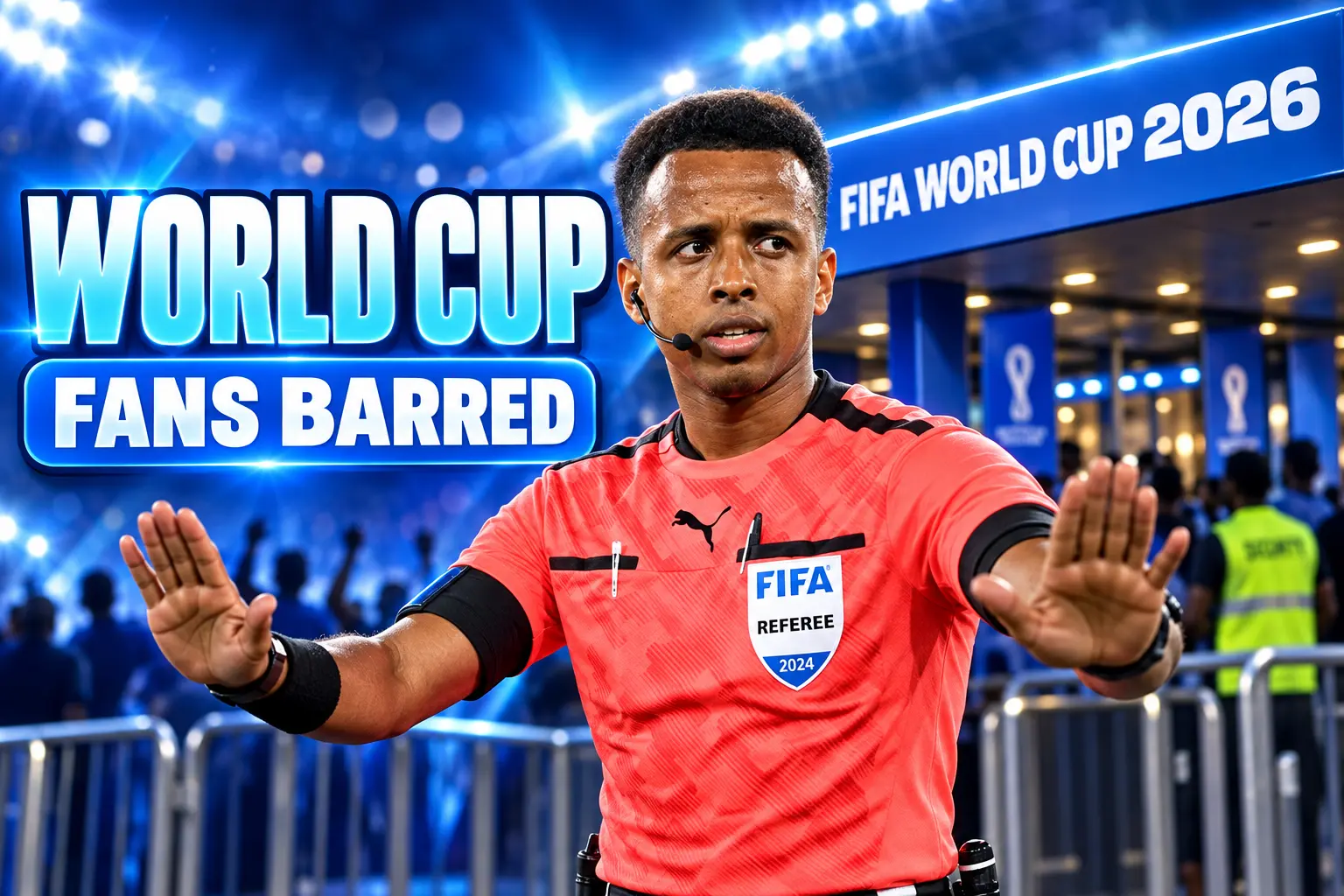
Omar Abdulkadir Artan, 34, was supposed to be the first Somali to referee a men’s World Cup. CAF had named him men’s referee of the year for 2025. FIFA put him on a list of 52 match officials who had to report to Pierluigi Collina’s training hub in Miami, with 88 assistant referees in the same camp. Canada and Mexico were co-hosts. The seminar was not.
He flew from Istanbul on June 6, his birthday, with multiple three-month US visas and a diplomatic passport arranged through Somalia’s embassy in Nairobi. Officers at Miami International Airport held him for 11 hours, asked about Al-Qaeda and Al-Shabaab, and put him on a return flight. CBP said he was “determined to be inadmissible due to vetting concerns.” A senior administration official later cited “association with suspected members of terror organizations” and said that made him ineligible under the Immigration and Nationality Act. Andrew Giuliani, executive director of the White House Task Force for the World Cup, said the denial was “for very good reasons” and did not add any.
Despite the circumstances, I am in a positive mood and I am focused on the next challenges in my refereeing career.
Omar Abdulkadir Artan, statement released through FIFA
FIFA confirmed he could not train or officiate and said it “is not involved in host country immigration processes, including visa adjudications.” Toronto Mayor Olivia Chow, whose city was staging matches, said denying entry to a man who had “earned his place on the world stage through hard work and perseverance, is not right,” and that he would be welcome to officiate there. Collina’s Miami base made that offer unusable for the tournament.
ARTAN’S SUMMER AFTER MIAMI
- June 6, 2026: Lands in Miami from Istanbul and is refused entry the same weekend.
- June 8, 2026: FIFA confirms he is off the World Cup list.
- June 10, 2026: Returns to Mogadishu, tells reporters it was “fate,” and asks Somalis not to lose heart.
- June 11, 2026: UEFA names him referee of the Super Cup.
- August 12, 2026: Takes charge of Paris Saint-Germain against Aston Villa in Salzburg, the first African to referee that match, and signs the ball “This was my World Cup.”
In early September, Turkish pundit Ahmet Çakar was still pushing Artan’s name for a Fenerbahce-Besiktas derby, which is how far the Miami decision traveled after the Cup ended.
Iran Played in America and Slept in Tijuana
Iran had booked Tucson, Arizona, then asked FIFA to move the camp to Tijuana after visa trouble and a live war with the United States and Israel. Mexico’s president, Claudia Sheinbaum, said her government had “no reason to deny them the possibility of staying in Mexico.” FIFA listed Centro Xoloitzcuintle as the base.
Players, head coach Amir Ghalenoei, and some assistants got US visas about 10 days before the New Zealand opener. Abolfazl Pasandideh, Iran’s ambassador in Mexico, said 15 of the 70 people who landed in Tijuana did not. The rejected group included federation president Mehdi Taj, a former Islamic Revolutionary Guard Corps officer, plus supervisor Mahdi Mohammad Nabi and secretary-general Hedayat Mombeini. A State Department official said Washington had issued “the visas necessary for Iran to compete” and “will not allow the Iranian team to abuse this system to sneak terrorists into the U.S. under false pretenses.”
The Iranian Embassy in Turkey said the conduct “violates FIFA regulations and breaches the United States’ host obligations,” and that Washington was “depriving Iran’s national team of its right to play in the World Cup under normal conditions and without undue pressure and stress.”
https://x.com/Iran_in_Turkiye/status/2063183699080782231
For the first two group games in Los Angeles, the squad was told to enter the day before and leave after full time. Captain Mehdi Taremi said the 127-mile (204-kilometer) hop from Tijuana to Los Angeles ate five hours with security and immigration. Iran drew New Zealand 2-2 and Belgium 0-0, then got two days in Seattle before Egypt, still with orders to fly back the same night as an 8 p.m. kickoff. The Egypt match ended 1-1 after a late Iran “winner” was ruled offside on VAR. Austria’s 3-3 with Algeria the next day dropped Iran out of the eight best third-place teams.
Forward Mehdi Torabi’s single-entry visa expired after the New Zealand game and had to be replaced before he could travel again. The people who build training plans and media feeds stayed in Mexico when the team crossed.
Why Did Senegal and Ivory Coast Fans Stay Home?
Senegal and Ivory Coast fans based at home largely never reached US World Cup stadiums, because both countries were on the partial ban that suspends tourist visas. The sports exception covered players and necessary staff, not ultras. Senegal coach Pape Thiaw asked New York’s Senegalese diaspora to replace the Gaindé who could not travel.
“It’s a political subject, and generally I prefer to stick to sports,” Thiaw said before the France opener in East Rutherford, “but of course, we’d like to have our fans with us. They push us, especially in tough moments, but we won’t have them with us.” He pointed to Little Senegal in Harlem and to communities in Chicago and Montreal.
Julien Kouadio Adonis, president of Ivory Coast’s National Committee of Elephants Supporters, had hoped to send 500 people across the Atlantic. He later said the trip was cancelled because “the US government does not want to see supporters from certain countries, including Ivory Coast, on its soil.” A handful of committee officials were cleared to look after Ivorian fans already in the United States, a pool the committee put above 1,000. Many who could still travel chose Toronto for the Germany game rather than test a US consulate.
Haiti, back at the World Cup for the first time since 1974, sat on the full ban. Scottish fans could use the Visa Waiver Program for the June 13 meeting in Foxborough. Haitian support in that building had to come from people already in the country. Ndeye Dome Thiouf, communications adviser to Senegal’s sports ministry, said it was the first World Cup with the Teranga Lions and no home-based supporter delegation, after 2002, 2018, and 2022.
WHO NEVER GOT THE TRIP THEY BOOKED
- Senegal’s Gaindé: The painted, dancing ultras who usually travel stayed home; Thiaw asked the US diaspora to make the noise.
- Ivory Coast’s CNSE: A planned 500-fan party was scrapped; the committee sent a few officials to mind local supporters.
- Haiti from Port-au-Prince: A full ban left the 1974 return dependent on Haitians already living in Miami, New York, and Boston.
- Jordan’s fan chief: Abu Kass said he took more than 42 documents to his Amman interview and was refused, and that he knew of one Jordanian who got a visa.
Nationals of Algeria, Cape Verde, Senegal, Ivory Coast, and Tunisia also faced a visa-bond pilot of $5,000 to $15,000. In mid-May the State Department waived that deposit for some ticket holders who had opted into FIFA PASS by April 15, a window that had already closed for people still waiting on interviews. FIFA PASS only speeds an appointment. It is not a visa.
Forty of Forty-Two Moroccan Coordinators Got No Visa
Morocco was not on the 39-country list. Its ultras ran into the older machine of B-1/B-2 refusals. Azzedine Al Attaraoui, head of the Sports Association of Moroccan National Team Fans, said 40 of 42 applicants from Casablanca, Marrakech, Fès, and Tétouan were refused with no useful explanation. Mourad Hamana, founder of the Sbouaa group, said nearly 50 coordinators applied and 6 were approved. “To organize thousands of fans, six people is a very small number,” he said.
Many refusals cited Section 214(b), the line consular officers use when they are not convinced an applicant will go home. Hamana said the coordinators had jobs in Morocco and no plan to migrate. State Department figures show Morocco’s adjusted B-visa refusal rate nearly doubled, from 14.45% in fiscal 2024 to 26.91% in fiscal 2025. MP Hanane Aterkin asked the foreign ministry to get written reasons and a path to recoup sunk costs.
Those costs were already gone. Tickets ran about $500, three-match bundles $1,500, visa fees 1,800 dirhams, hotels $400 to $1,000 a night. Al Attaraoui put some individual losses at 20,000 dirhams. That is not refundable. Khalid Belmaghraoui, who did get to Boston after applying in January from France, said Qatar in 2022 had been easier to reach at the last minute, and that the stands needed more of his compatriots.
The same week, Iraq vice-captain Aymen Hussein was held about seven hours at Chicago O’Hare after the squad flew in from Dubai on June 5, his phone inspected, then admitted. Team photographer Talal Salah was held more than 10 hours and sent back on “vetting concerns.” CBP called both inspections routine. Iraq was in the United States for the first World Cup since 1986, and for a friendly against Venezuela in Bridgeview, without its official photographer.
FIFA Left the Border to Washington
Gianni Infantino spent 2025 swatting away “misconceptions” about US travel. He said the three hosts would keep the process smooth.
We want to unite the world, and we will unite the world next year. So again, everyone will be welcome, be positive and you will see it will be a great, great celebration of the greatest FIFA World Cup ever.
Gianni Infantino, FIFA president, 2025
After Miami, a FIFA spokesperson said the governing body “is not involved in host country immigration processes” and had been told Artan’s status would not change. Niven called that “striking.” “FIFA has raised the surrender flag on this question,” he said. “They’ve taken this situation and basically deferred to the United States and said the United States can do as they see fit.”
That posture sits next to a recent precedent FIFA does own. In 2023 it removed Indonesia as host of the U-20 World Cup after Indonesian officials objected to Israel’s participation. In 2026 it treated US visa refusals as a host-government matter, including for a referee it had selected and for federation officers it had accredited.
The World Cup visa crackdown had been visible for months before the first ball. What changed in June was FIFA’s public distance from the people it had invited. Iranian and African journalists told the International Sports Press Association they were stuck on single-entry visas that could not follow a team across three countries. AIPS president Gianni Merlo called the pattern “a long-standing and unacceptable problem for us journalists: the denial of entry visas.”
Homeland Security Secretary Markwayne Mullin said in May that ICE agents at World Cup stadiums would handle security and that “ICE always says immigration enforcement.” Secretary of State Marco Rubio had told Miami’s host committee the week before that ICE would not be in the buildings. UNITE HERE Local 11’s SoFi Stadium strike vote was driven by that gap, and the deal that averted a walkout still let workers leave if they thought ICE put them at risk. New York, which staged eight games including the final, got a warning from Border Czar Tom Homan that more agents were coming. Mayor Zohran Mamdani said soccer “would not exist without immigrants” and that federal decisions were “anathema to what this tournament is supposed to be about.”
Tijuana Wore the Hats That Claimed Iran
The second effect of the athlete exception was geographic. US stadiums got the fixtures. Tijuana got the team that needed a bed. For three weeks, fans ringed Iran’s hotel with posters and autograph books. On the way out they wore baseball caps that read “Iran, brother, you’re Mexican now.”
The Embassy of Iran in Mexico thanked Tijuana for “generosity and genuine hospitality that made us feel right at home,” and said leaving was “truly difficult.” Goalkeeper Alireza Beiranvand signed shirts in the lobby. Ambassador Pasandideh and Mombeini, who could not cross with the squad, did the thank-yous on the Mexican side of the line.
It’s a disaster World Cup, a disaster. FIFA, they have to solve every problem here, but unfortunately, they couldn’t solve since the beginning. We don’t have our logistic people here, they don’t have a visa. We love people of Mexico, we love Tijuana, but as professional players, professional competition, it’s not right. Now we have traveled again to Tijuana, so without recovery, without nothing, it’s not fair.
Mehdi Taremi, Iran captain, June 27, 2026
That is the split the proclamation designed. Players walked into US stadiums under a sports exception. The people who sing, film, and plan recoveries were a different column on the same form. Mexico did the hosting the United States put on the posters. Artan signed his World Cup onto a ball in Salzburg, because Miami would not let him sign one in California.
Frequently Asked Questions
Why Was Somali Referee Omar Artan Denied Entry to the United States?
CBP never published a public file on Artan. Officers called it vetting concerns after an 11-hour secondary inspection, and an unnamed administration official later pointed to alleged ties to suspected members of terror groups under the Immigration and Nationality Act. Somalia is on the full travel ban, but Artan held US visas and a diplomatic passport, so the ban’s athlete-style courtesy never reached a referee. FIFA’s own rule that all on-pitch officials stay at the Florida camp meant a Canada or Mexico posting was not a workaround.
Did Iran Play Its 2026 World Cup Games in the United States?
Yes. All three group matches were on US grass: New Zealand and Belgium in Los Angeles, Egypt in Seattle. FIFA’s own tournament regulations, Article 18.3, already tell teams to travel from base camp one day before a match and return after it, which Washington then tightened into same-day exits and, for Seattle only, a two-day arrival. The political fight was never whether Iran would take the field. It was whether the federation president, analysts, and media staff would be in the building when they did.
Which 2026 World Cup Teams Were on the US Travel Ban?
Iran and Haiti were on the full suspension of immigrant and nonimmigrant entry. Senegal and Ivory Coast were on the partial suspension that blocks tourist, student, and exchange visas. Dual nationals of a listed country can still travel on a passport from a country that is not listed, and people who already held valid visas on the proclamation’s effective date were carved out. Holders of Palestinian Authority documents are fully barred, but Palestine did not have a team in the field.
Could Fans From Senegal and Ivory Coast Go to US World Cup Matches?
New tourist visas were off the table for most people applying from home. The sports exception did not name supporters. A mid-May bond waiver helped only travelers who already had tickets and had joined FIFA PASS by April 15. Senegal’s organized groups stayed in Dakar; the loudest substitute was a Harlem enclave estimated at almost 20,000 people. Ivory Coast’s committee sent no home delegation and counted on Ivorians already in North America, plus the Toronto leg against Germany, where Canadian entry rules were the relevant test.
What Did Omar Artan Do After He Missed the World Cup?
UEFA appointed him to the August 12 Super Cup in Salzburg, with assistant referees Liban Abdoulrazack Ahmed of Djibouti and Stephen Yiembe of Kenya. While the World Cup was still on, the Kuwait Football Association brought him in to referee the 2025-26 Premier League final between Kuwait SC and Qadsia SC on June 29. UEFA then invited him to an elite refereeing course in Geneva from August 31 to September 2 and signaled more European club appointments. He has said he wants the next World Cup.

Kily Gonzalez Has the Inter Miami Job Without Papers

Chelsea Puts USDC on the Shirt for One Year

Esther González Joins Al Qadsiah After Gotham’s Free Exit

Chelsea Stay on Adam Wharton After Palace Hold Firm

Fiorentina Pays for Pellegrino After Juve’s Loan Fails

Only One of Villa’s Five Winger Targets Actually Signed

SoFi Workers Won Pay and an ICE Walk-Off Clause

Hughes Hired Iraola Twice, Then Left for Al-Hilal

Sunderland’s 53-Year European Wait Ends Against AZ

Summerville Turned a Shock Call-Up Into Two World Cup Goals
-
 NEWS4 months ago
Only One of Villa’s Five Winger Targets Actually Signed
-
 NEWS4 months ago
SoFi Workers Won Pay and an ICE Walk-Off Clause
-
 NEWS4 months ago
Hughes Hired Iraola Twice, Then Left for Al-Hilal
-
 EUROPA LEAGUE4 months ago
Sunderland’s 53-Year European Wait Ends Against AZ
-
 NEWS4 months ago
Summerville Turned a Shock Call-Up Into Two World Cup Goals
-

 NEWS4 months ago
SNRT Put Morocco’s World Cup Matches on Free TV
-

 CHAMPIONS LEAGUE4 months ago
Jordan Brand’s 2018 Football Bet Pays on PSG’s Repeat
-

 EUROPA LEAGUE4 months ago
Rangers Never Played the Sparta Prague Sharpener