
NEWS
FIFA Erased Haiti’s Independence Battle From the World Cup Jersey
FIFA struck Haiti’s Vertières mural from the World Cup jersey, then the original Saeta shirt sold out while the team finished 0-3.

FIFA forced Haiti to drop Battle of Vertières art from its World Cup jersey in June 2026, the team’s first finals since 1974. Colombian maker Saeta stripped the mural after the approval process labeled the founding battle a political image. The original shirt sold out. Haiti then lost all three group games in the amended kit.
Independence history is the country, not a campaign slogan, and that is the reading FIFA would not print. The same founding story had already been painted off Haiti’s Winter Olympic uniforms months earlier.
The Battle FIFA Would Not Let Haiti Wear
Saeta built the 2026 set as a royal blue home, a white away, and a red third, each with a polo collar and the Fédération Haïtienne de Football crest on the chest. Across the lower front sat a sublimated scene from 18 November 1803: silhouettes of independence fighters raising a tattered blue and red flag at Vertières, the last major fight of the Haitian Revolution.
Jean-Jacques Dessalines commanded that day. Haiti declared independence on 1 January 1804, the first nation founded by formerly enslaved people after a successful revolt. A Haiti team spokesperson said FIFA asked the federation to remove “an image depicting Vertières and some independence heroes raising the Haitian flag,” and called that reading a “misinterpretation.”
The date already sat on the team’s World Cup ticket. Haiti beat Nicaragua 2-0 on 18 November 2025, 222 years to the day after Vertières, and booked a first finals place in 52 years. The spokesperson noted that overlap. Players still wore the mural in warmups against New Zealand on 2 June 2026 in Fort Lauderdale and against Peru on 5 June in Miami.
THE DATES THAT COLLIDED
- 18 November 1803: Dessalines’s army wins the Battle of Vertières near Cap-Français.
- 1 January 1804: Haiti proclaims independence.
- 18 November 2025: Haiti beats Nicaragua 2-0 and qualifies for the 2026 World Cup.
- 4 January 2026: The IOC rejects Toussaint Louverture on Haiti’s Winter Olympic uniform.
- 2 June and 5 June 2026: Haiti wears the mural in friendlies against New Zealand and Peru.
- 10 to 11 June 2026: Saeta confirms FIFA-required changes days before the Scotland opener.
- 13 to 24 June 2026: Haiti plays three group games in the amended shirts.
By the week of the opener, defender Jean-Kévin Duverne had already shown a version with the battle art gone. FIFA said it had been in contact with Saeta and the Haitian federation for some weeks and that both sides understood the concern. The federation’s public line stayed colder than that.
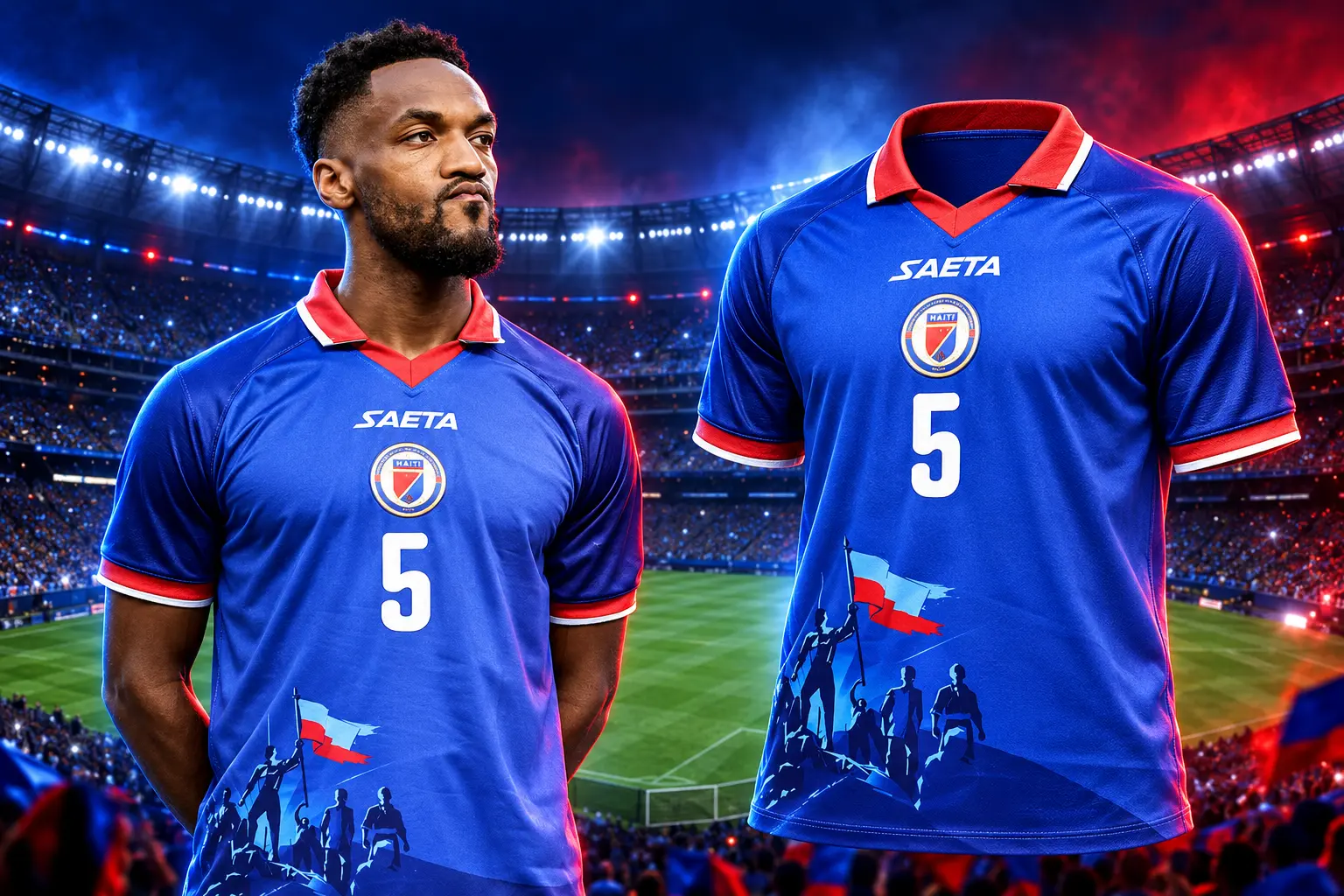
Why FIFA Struck the Vertières Mural?
Saeta said the shirt was a tribute, not a manifesto. Blue stood for the sea and red for “strength and passion,” and the firm said it had worked through FIFA’s standard review over several months. Then the governing body asked for a change anyway.
The final design presented by Saeta was intended as tribute to the men and women who contribute every day to Haiti’s future and was not intended as a political statement. During the review process, FIFA determined that certain visual elements could be interpreted differently under its equipment regulations and ultimately requested modifications to the design. While this interpretation differed from our intention, Saeta respected the process and implemented the final requirements communicated by FIFA.
Saeta, statement on Instagram, June 2026
The company added that it remained proud to have worked with the Haitian Football Federation on a first World Cup in 52 years. It still reprinted. The amended shirts kept the collars, the crest, and the palm and mountain work on the fabric. The fighters and the flag on the hip did not survive.
Law 4 Names Dead People and Specific Events
The veto sat in two stacked texts. Article 28.1 of FIFA’s World Cup 26 regulations says the display of political messages is prohibited on playing kits, outerwear, bags, bottles, and even the body, before and after matches. Teams also had to send full kit samples and attend a kit-day inspection, with rejected items sent back for a reprint.
The IFAB Laws of the Game go further. Law 4 says equipment must not carry political slogans, statements or images. The law admits that “political” is “less clear” than religious or personal, then lists what is out of bounds.
WHAT LAW 4 TREATS AS POLITICAL
- Named people: Any person, living or dead, unless the name is part of the official competition title.
- Parties and groups: Local, regional, national, or international political organisations.
- Governments: Any local, regional, or national government and its offices.
- Specific events: Any specific political act or event, which is the clause that fits a named battle.
- Commemorations: When a shirt marks a national event, the other team’s fans and the wider public “should be carefully considered.”
Flags, crests, numbers, and the facts of a match are usually allowed. A founding battle with named heroes is both a dead-person problem and a specific-event problem under that list. FIFA did not have to argue that Vertières was a modern party line. The small print already treated the birth of the state as a slogan.
Stella Jean Painted Out Toussaint First
The World Cup reprint was Haiti’s second uniform fight of 2026. Italian-Haitian designer Stella Jean had built the Milan Cortina opening-ceremony suits around a 2006 painting by Edouard Duval-Carrié of Toussaint Louverture on a red horse. On 4 January 2026 the IOC ruled that the founding father violated Olympic rules against political symbolism on uniforms.
Jean’s Rome workshop painted Louverture out by hand, leaving the horse against tropical foliage. “For 24 hours, I was in total despair,” she said, after a year of work and no spare budget. The finished suits reached Milan two days before the 6 February ceremony. Haiti sent two winter athletes in that riderless design.
Either way, Haiti has to be setting a record: Two rebukes from the highest international sports authorities in just a few months.
Stella Jean, designer of Haiti’s Milan Cortina uniforms
She later sold a production version with Louverture restored. The horse without the rider was the official Games image; the man FIFA’s sister rule would also have blocked went back on the clothes people could actually buy. Jean said the rules had been followed. She also said his absence spoke louder than his presence.
Two Goals in Atlanta, Then Out
Haiti opened on 13 June 2026 against Scotland at Gillette Stadium in Foxborough and lost 0-1 to a 28th-minute John McGinn goal. Five-time champion Brazil won 3-0 in Philadelphia on 19 June, with Matheus Cunha scoring twice and Vinícius Júnior adding one before half-time. That second defeat made Haiti the first side out of the 48-team tournament.
Already eliminated, the Grenadiers led twice in Atlanta on 24 June before Haiti fell 4-2 to Morocco. Goalkeeper Yassine Bounou turned Lenny Joseph’s backheel into an own goal in the 10th minute. Wilson Isidor, then of Sunderland, smashed in from outside the box in the 43rd for Haiti’s first World Cup goal by a Haitian player since Emmanuel Sanon in 1974. Achraf Hakimi, Ismael Saibari, Soufiane Rahimi, and Gessime Yassine answered for Morocco.
HAITI AT WORLD CUP 2026, GROUP C
| Date | Opponent | Score | Haiti scorers | Venue, attendance |
|---|---|---|---|---|
| 13 June 2026 | Scotland | 0-1 | None | Gillette Stadium, Foxborough, 64,146 |
| 19 June 2026 | Brazil | 0-3 | None | Lincoln Financial Field, Philadelphia, 68,324 |
| 24 June 2026 | Morocco | 2-4 | Bounou 10′ (og), Isidor 43′ | Mercedes-Benz Stadium, Atlanta, 68,239 |
Haiti finished fourth in Group C at 0 wins, 0 draws, 3 losses, two goals for and eight against, goal difference minus six, 0 points. Across two World Cups the record is now six defeats and no wins. The mural was not on the pitch for any of those 2026 minutes.
Racks Emptied Before Kickoff in Foxborough
Saeta has been Haiti’s kit supplier since 2013, a commercial bond the Bogotá firm dates to 2011, after it sent 5,000 shirts through the Red Cross following the 2010 earthquake. Qualification turned a small account into a rush. Orders in the first day after the Nicaragua result blew past the stock meant for the United States, Canada, and France, where the diaspora buys.
The initial World Cup run sold out within hours of the launch. Once FIFA’s objection became public, all three mural shirts, home, away, and third, were marked sold out on the SaetaUSA shop. The manufacturer did not appear to be lining up a replacement consumer batch of the amended design. FIFA’s own shop, at the same moment, listed two Haiti items: a trucker hat and a scarf.
The banned original was still the shirt people wanted after the last match. In late August, weeks after Morocco, that first Saeta design was still turning up in Haitian cafes among fans who had watched the group games. The reprint satisfied the inspectors. The version with Vertières on it is the one that left the factory and did not come back.
FIFA’s other political tests at the same tournament made the Haiti ruling look narrower, not calmer. A founding battle was treated as unsafe print. Other national claims on flags and banners moved through the month with less friction. The kit rule did not keep politics off the 2026 World Cup. It kept Haiti’s origin story off Haiti’s chest.
Haiti left with no points, two goals, and a jersey FIFA would not let the players wear. The original Saeta design stayed sold out.
Frequently Asked Questions
What Was the Battle of Vertières?
It was fought on 18 November 1803 just south of Cap-Français, with Dessalines and François Capois leading an Indigenous Army put at about 27,000 against roughly 2,000 French troops under Donatien de Rochambeau. Haitian losses are given as about 1,200 killed and 2,000 wounded. Rochambeau sought an armistice that night, and independence was proclaimed in Gonaïves on 1 January 1804.
Who Is Saeta, Haiti’s Kit Maker?
Saeta is a Bogotá sportswear firm founded in the 1980s and the only Colombian brand to dress a team at a men’s World Cup. About 70 staff make the blue, white, and red shirts, which were sold at about $100 to $125. Thirteen makers supplied the 48-team field; Adidas, Nike, and Puma dressed 77% of the sides.
Did Haiti Score at the 2026 World Cup?
Yes, twice, both in the last group match. Joseph’s backheel went down as a Bounou own goal, and Isidor’s strike from outside the box was Haiti’s first World Cup goal by one of its own players since Sanon’s two in 1974. Haiti had already been eliminated after the Brazil defeat, so those two goals did not change the table.
What Did the IOC Remove From Haiti’s Olympic Uniform?
The IOC rejected a recreation of Duval-Carrié’s 2006 portrait of Louverture on a red horse, a figure holding a snake in place of a sword in a nod to the Vodou spirit Danbala. Jean’s artisans painted out the rider and the snake but kept the horse and the foliage, and she later offered a limited run with the original figure restored.

Kily Gonzalez Has the Inter Miami Job Without Papers

Chelsea Puts USDC on the Shirt for One Year

Esther González Joins Al Qadsiah After Gotham’s Free Exit

Chelsea Stay on Adam Wharton After Palace Hold Firm

Fiorentina Pays for Pellegrino After Juve’s Loan Fails

Only One of Villa’s Five Winger Targets Actually Signed

SoFi Workers Won Pay and an ICE Walk-Off Clause

Hughes Hired Iraola Twice, Then Left for Al-Hilal

Sunderland’s 53-Year European Wait Ends Against AZ

FIFA Took IShowSpeed’s World Cup Bet to the Final
-
 NEWS5 months ago
Only One of Villa’s Five Winger Targets Actually Signed
-
 NEWS5 months ago
SoFi Workers Won Pay and an ICE Walk-Off Clause
-
 NEWS5 months ago
Hughes Hired Iraola Twice, Then Left for Al-Hilal
-
 EUROPA LEAGUE5 months ago
Sunderland’s 53-Year European Wait Ends Against AZ
-
 NEWS5 months ago
Summerville Turned a Shock Call-Up Into Two World Cup Goals
-
 NEWS5 months ago
FIFA Took IShowSpeed’s World Cup Bet to the Final
-
 NEWS5 months ago
SNRT Put Morocco’s World Cup Matches on Free TV
-
 CHAMPIONS LEAGUE5 months ago
Jordan Brand’s 2018 Football Bet Pays on PSG’s Repeat