
NEWS
Alfie Haaland’s ‘Robbed’ Claim Collides With a Split Refereeing Record
Erling Haaland’s father called England’s 2-1 World Cup win over Norway a robbery, but FIFA’s ball data and the match record tell a messier story.

Alf-Inge Haaland needed less than 12 hours to turn a World Cup quarterfinal loss into a full-blown referee controversy. Erling Haaland’s father accused match officials of gifting England their 2-1 extra-time win over Norway in Miami, then doubled down Sunday morning with a message accusing the referee of saving the Three Lions.
The video review record from that match, and FIFA’s own ball-tracking data, tell a far messier story than his one-word verdict of “robbed.” Two of the night’s three biggest calls actually went against the team he says was cheated, and the technology behind the third contradicts the specific complaint Norway’s own bench raised in real time.
Alfie Haaland’s Weekend of Fury
The frustration started the moment the final whistle blew. The former Manchester City midfielder didn’t hide his frustration with the officiating, as he appeared to make an offensive gesture and took to social media to vent his anger at the referee and Jude Bellingham. His post read simply, “Well done Bellingham and referee.”
By Sunday morning he was still going. He replied to a post from English sports journalist Henry Winter, who had just written that “Odegaard was beginning to run the game” during England’s first-half equaliser. Alfie fired back with a longer, angrier message.
Really? Saved bye the referee. Hope you win the WC now. But feel we got robbed today.
Alf-Inge Haaland posted the message accusing the referee of saving England on X, less than a day after full time in Miami. It set off a debate that has now run longer than the match itself.
Was Torbjorn Heggem’s Disallowed Goal Really the Wrong Call?
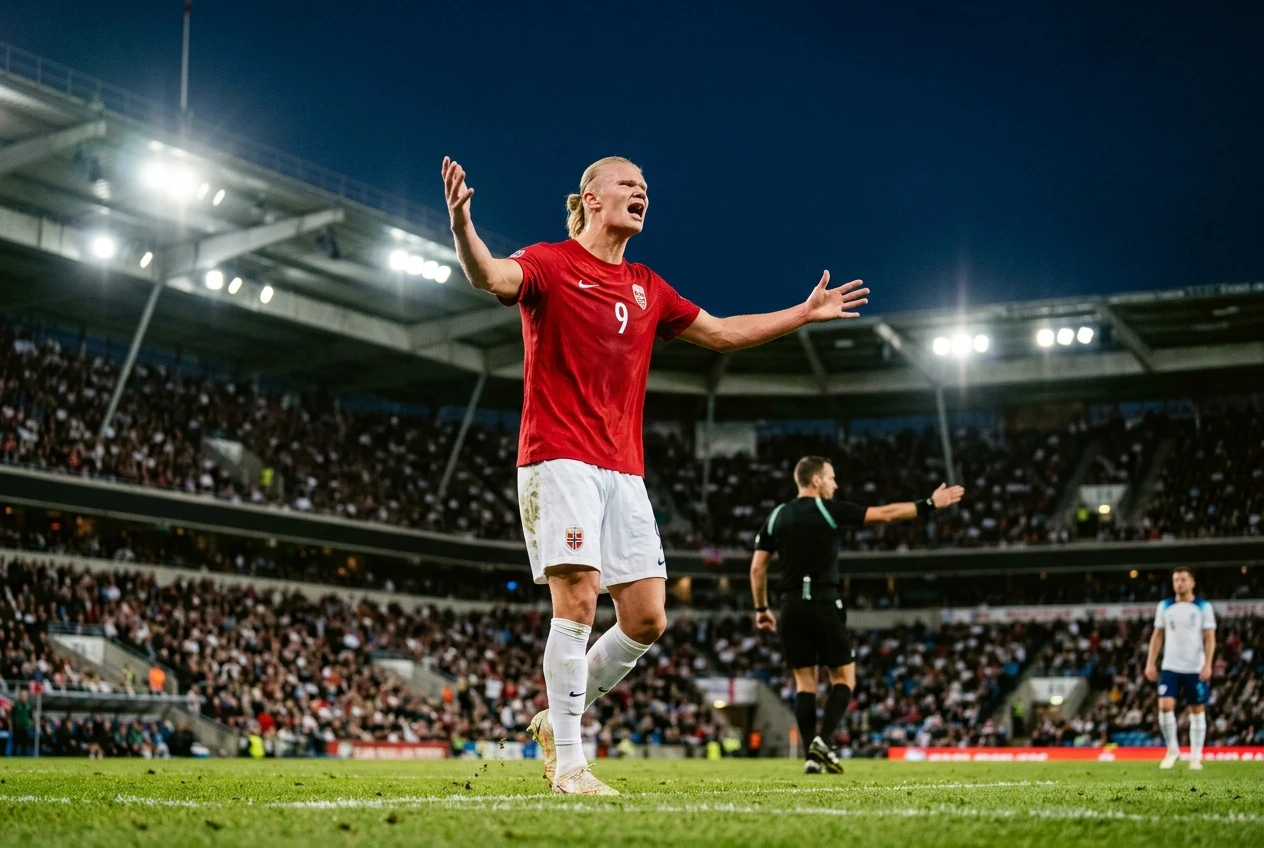
Mostly yes, based on the video review and the pundits who broke it down afterward. Erling Haaland shoved England midfielder Elliot Anderson with both arms just before Torbjorn Heggem bundled the ball in from a corner. The referee went to the pitchside monitor, and the goal was wiped out.
The sequence started with a Norwegian corner. A corner was nudged down to Alexander Sorloth, whose effort was kept out by Jordan Pickford, but the goalkeeper tipped the ball straight to the feet of Torbjorn Heggem, who bundled it into the net. Replays showed the problem in the buildup. Haaland used two extended arms to shove Anderson in an attempt to make space, and after the referee went to the monitor, the video assistant referee (VAR) ruled the goal out.
Former Premier League referee Mark Clattenburg, working as a pundit for the broadcast, sided with the officials on this one. Clattenburg agreed with the VAR decision to disallow the goal. That is not the call Alfie Haaland has spent the weekend describing.
FIFA’s Ball Sensors Contradict Norway’s Cable Complaint
The genuinely contested moment came earlier, in first-half stoppage time. Norway goalkeeper Orjan Nyland’s goal kick appeared to touch a cable above Miami Stadium before England worked the loose ball forward. The ball dropped to Elliot Anderson, who exchanged a pass with Anthony Gordon, and Gordon picked out Bellingham, who dribbled into the area and finished strongly.
Norway’s players wanted the goal stopped before it ever got that far. Nyland was furious after conceding and rushed to referee Clement Turpin to protest, and Stale Solbakken and his coaching staff remonstrated with Turpin again at the interval. None of it changed the outcome. VAR did not intervene, and the goal stood, leaving the score level at 1-1 heading into the break.
Clattenburg argued the incident should have at least been checked. Referring to the goal kick that led into Bellingham’s goal, he said, “So, it should have been picked up by the VAR.”
FIFA disagreed with the premise entirely. The governing body issued a statement saying its embedded ball sensor recorded “no evidence that the ball touched the overhead wire” in the moments before the goal. Without a detectable spike in the ball’s data, officials had no technical trigger to stop play.
- Mark Clattenburg (pundit, former Premier League referee): says any contact between the ball and an object like a camera cable ahead of a goal is a reviewable incident, and this one should have gone to the monitor.
- FIFA: says its in-ball sensor showed no reading consistent with the ball striking the wire, meaning there was nothing for the video assistant referee to flag.
- Norway’s bench: insists the contact was visible and wanted a stoppage before Bellingham even got the ball.
The disagreement is not going to be settled by another replay. It sits exactly where FIFA’s statement left it.
England Had a Big Call Overturned Too
Alfie Haaland’s framing leaves out the moment the video review worked against his son’s opponents. Thomas Tuchel’s side saw a penalty overturned not long after Bellingham’s extra-time winner, right around the same passage of play in which Stale Solbakken substituted Haaland. ESPN’s live match report was blunt about it: Heggem’s early second-half goal was chalked off for the foul in the buildup, while England’s hopes of a game-sealing penalty were also dashed by VAR.
The specific passage involved a long-range effort from Djed Spence that Nyland spilled into danger. Despite Spence’s potential penalty being ruled out in the aftermath, England still advanced to reach only their fourth World Cup semi-final. One call chalked off a Norwegian goal. A different one denied England an insurance goal of their own. That is not the one-way night Alfie Haaland described.
The underlying numbers back up how tight this actually was on the pitch, controversy aside.
| Category | Norway | England |
|---|---|---|
| Possession | 44% | 47% |
| Shots (on target) | 13 (4) | 14 (7) |
| Expected goals (xG) | 0.77 | 0.96 |
| Fouls committed | 8 | 10 |
| Yellow cards | 0 | 1 |
England actually finished with more fouls and the lone yellow card of the match, hardly the profile of a side the referee was protecting. Norway produced 0.77 expected goals to England’s 0.96, a gap that reflects a tight, cagey game more than a stitched-up one.
The Dressing Room Didn’t Sound Like Alfie
A Milder Verdict From the Captain
Norway’s own players and coaches were far less inflammatory than the man in the stands. Captain Martin Odegaard said the team didn’t get much help from the referee, adding that the margins went against Norway and that some of it came down to bad luck rather than a fixed outcome. Winger Andreas Schjelderup struck a similar note, saying the margins and the odds had been against Norway and that some of the referee’s decisions were bitter to take.
Alfie Haaland went further in comments picked up elsewhere, arguing that Heggem’s disallowed goal still stung the most and that too many key moments seemed to go England’s way to write off as coincidence. That is a stronger claim than either his son’s teammates or the match record fully support.
The Replies Alfie Got Online
Fans didn’t let the claim go unchallenged. One reply cut straight to the point: “I mean we had a clear penalty overturned mate.” Another noted that Norway themselves had a goal disallowed for a blatant foul, which undercuts the idea the whole night was rigged against them.
Norway’s own bench added a separate controversy to the pile. Erling Haaland was controversially subbed off during the loss, sparking widespread outrage on social media of its own, entirely separate from his father’s referee complaints. Solbakken pulled his top scorer at the start of the second period of extra time with Norway still chasing an equaliser.
Haaland’s Tournament Ends on Seven Goals, Not a Trophy
Whatever happened with the officials, Erling Haaland’s individual tournament was one of the stories of the summer. He arrived at the quarterfinal with seven goals in his first World Cup, with Norway making its first finals appearance since 1998. England shut that scoring run down completely. The Three Lions became the first team to prevent Haaland from scoring in a competitive international fixture since Austria managed it in October 2024, a drought spanning 636 days.
- Group stage: Norway opened with wins that carried Haaland’s scoring touch through to the knockout rounds.
- Round of 32: the winning goal against Ivory Coast sent Norway through.
- Round of 16: a brace against Brazil delivered a first-ever quarterfinal berth.
- Quarterfinal: held scoreless for the first time in 636 days, then substituted with Norway chasing the game.
The run still rewrote Norwegian football history. The quarterfinal marked the first time Norway had reached the last eight of a major tournament, after returning to the World Cup for the first time since 1998. Erling now carries a Norway international record of 62 goals in 55 appearances, making him the country’s all-time leading scorer.
His father has his own history with this fixture line. Alf-Inge Haaland, who earned 34 caps for Norway between 1994 and 2001, was part of a very different Norwegian story once. He was a member of Norway’s 1998 squad, which famously defeated Brazil in the group stage before reaching the round of 16. That may explain why Saturday’s exit, controversy and all, cut deeper than a normal quarterfinal loss.
England’s Prize Is a Semifinal With Messi’s Argentina
England’s reward for surviving Miami is the biggest game left on the board. Argentina beat Switzerland 3-1 after extra time on the same day, just hours after the final whistle in the Norway match. England now returns to Atlanta, where it beat DR Congo earlier in the tournament, to face Lionel Messi’s Argentina in the semi-final on Wednesday, July 15.
It is already a landmark run regardless of what comes next. This marks the fourth time in England’s history that the team has reached a World Cup semi-final, following 1966, 1990 and 2018. Jordan Pickford added his own piece of history in Miami. The goalkeeper became England’s record appearance holder at the tournament, overtaking fellow goalkeeper Peter Shilton’s mark of 17 with his 18th cap. Bellingham’s brace put him level with Pele’s tally of seven World Cup goals, with only Kylian Mbappe scoring more among players 23 or younger.
Messi arrives with his own case. He leads the tournament with eight goals, the same total Mbappe has managed for France. The final follows five days later, on Sunday, July 19, at the New York-New Jersey Stadium. Norway flies home with the best World Cup finish in its history. England has five days to get ready for Messi.

-

 NEWS3 months ago
The Five Wingers Aston Villa Are Chasing This Summer
-

 NEWS3 months ago
SoFi Stadium Strike Vote Puts U.S. World Cup Opener on Alert
-
 NEWS3 months ago
Liverpool Agree Deal With Iraola to Lead Anfield’s Rebuild
-
 EUROPA LEAGUE3 months ago
Sunderland’s Europa League Dates Start a Travel Race
-
 NEWS3 months ago
SNRT Gives Morocco’s World Cup Games a Public TV Window
-

 NEWS3 months ago
Summerville Went From Zero Caps to a World Cup in Seven Days
-
 CHAMPIONS LEAGUE3 months ago
Michael Jordan’s PSG Payday Runs Through the Club Shop
-
 EUROPA LEAGUE3 months ago
Rangers in Talks for Sparta Prague Friendly Before Europa League Draw