
NEWS
Juventus Keep Yildiz From Arsenal, Then Surgery Hits
Juventus told Arsenal that Kenan Yildiz was not for sale, kept him on a 2030 contract, then lost their No. 10 to foot surgery as the new season began.

Juventus told Arsenal that Kenan Yildiz was not for sale, then watched their No. 10 last 69 minutes of the new season. The Premier League champions asked about the Turkey forward in June and were sent away. On 31 August he had surgery on a fractured fifth metatarsal in his left foot.
Turin kept the one player Europe wanted most, on a deal running to 30 June 2030, and still opened a Europa League campaign without him. The refusal was clean. The season that followed has not been.
Arsenal Asked and Turin Closed the File
In June, Arsenal sporting director Andrea Berta and Mikel Arteta sounded out Juventus while hunting a left-sided attacker. They were told, in plain terms, that Yildiz would not be sold, and they moved on to other names. Transfer reporter Fabrizio Romano said the same morning that an exit had “never been a topic,” that Juventus had “closed doors already months ago,” and that the 21-year-old was “staying even without UCL.”
Then-CEO Damien Comolli had already drawn the line. On 27 May, after a sixth-place Serie A finish sent the club into the Europa League, he was asked about selling the highly rated youngster and said, “Certainly not.” He told la Repubblica the club would have to sell one more player than planned. Yildiz was not that player.
WHAT WE KNOW
- The approach: Arsenal made an enquiry for Yildiz as a left winger and were told he was not available.
- The contract: He signed through 30 June 2030 on 7 February 2026, months before the call came.
- The window: The 2026 summer market shut on 1 September with Yildiz still in Turin.
WHAT IS UNCONFIRMED
- A formal bid: No club filing shows a completed Arsenal offer; the documented act was an enquiry that hit a wall.
- A nine-figure fee: Talk of 100 million euros floated around the name. Juventus never put a ticket in the window.
That vacuum still produced noise. In mid-August, posts claiming an £80 million agreement kept circulating after coach Luciano Spalletti had already shut the door. Replies under the loudest of those posts called them fake, which they were. The demand for a Yildiz-to-the-Emirates story ran ahead of anything Turin was prepared to discuss.
The February Contract That Froze the Market
Juventus announced the renewal on 7 February 2026, with Comolli, Spalletti and the player together in a press conference on his 2030 renewal. The previous deal ran to 2029. The new one added a year and moved him from about 1.7 million euros net a season to 6 million euros net, plus bonuses, at a point when Dusan Vlahovic was still the top earner on an older, heavier contract.
Comolli called him “a true champion and, as his name suggests, a star,” and thanked him for staying. Spalletti said the day showed the club’s intentions and that it was “great to think about having him here for the long-term.” John Elkann, Giorgio Chiellini, Francois Modesto and Marco Ottolini attended the signing. There was no public release clause. For a buying club, that is a closed door with no handle on the outside.
I thank John Elkann, Damien Comolli and the whole Club, as well as the coach, my teammates and the fans. I’m very happy to renew here, as this Club is a family to me. I’m sure we’ll do great things together. I love Juventus.
Kenan Yildiz, Juventus forward, at the Allianz Stadium announcement
He joined from the Bayern Munich academy as a free agent in 2022, took the No. 10 shirt, and by last season was the attacking reference Spalletti built around. Across all competitions in 2025/26 he scored 11 goals and added 10 assists in 47 matches. Arsenal asked anyway, because a sixth-place Juventus side without Champions League football looked, from the outside, like a club that might have to cash its best chip.
Comolli Budgeted Extra Sales Around Yildiz
Missing Europe’s top competition cut the UEFA prize path. Calcio e Finanza put Juventus’s Europa League take at about 14.6 million euros (about $17 million), against an estimated 42.6 million euros from the Champions League, a 28 million euro gap on that line alone. Comolli’s answer was another sale, then replacements “of equal level, if not higher.” It was not a Yildiz sale.
The window that followed did not produce a flagship outgoing fee. Vlahovic left as a free agent for Besiktas. Jonathan David went on loan to Atletico Madrid. Loïs Openda, a costly extra striker, was loaned to Lyon. Fabio Miretti joined Besiktas on loan. The money Juventus did spend came inward, on Randal Kolo Muani from Paris Saint-Germain and 18-year-old Kerim Alajbegovic from Bayer Leverkusen, plus loans and free additions around the squad.
WHO LEFT AND WHO ARRIVED AROUND YILDIZ
| Player | Move | How it hit the No. 10 |
|---|---|---|
| Kenan Yildiz | Stayed, contract to 2030 | The one Comolli would not sell |
| Dusan Vlahovic | Free to Besiktas | A wage off the books, not a star fee |
| Jonathan David | Loan to Atletico Madrid | Another forward parked elsewhere |
| Loïs Openda | Loan to Lyon | The extra striker moved on |
| Randal Kolo Muani | Signed from PSG | The centre-forward they did buy |
| Kerim Alajbegovic | Signed from Leverkusen | Eighteen, now covering the left |
Keeping Yildiz did not spare the rest of the attack. It just meant the supporting names, not the 10, had to be the ones who moved, often as loans and free exits rather than as a single cheque that would have rewritten the accounts.
What Arsenal Bought When Yildiz Stayed
Arsenal’s left-wing file did not stay empty. After Turin said no, and after a public miss on Vinicius Junior, the champions turned to Christos Tzolis from Club Brugge. The Greek winger was listed among the club’s completed summer arrivals and departures alongside Bruno Guimaraes, Piero Hincapie, Ezri Konsa and Illan Meslier.
On the way out, Arsenal also finished Trossard’s path toward a Besiktas exit, a left-sided forward leaving as the new one arrived. Reiss Nelson was released. The shape of the window is clear from those names: they wanted a high-ceiling wide attacker, asked for Yildiz, and settled for a different profile when the Italian door stayed shut.
HOW THE LEFT-WING SEARCH RAN
- The first ask: An enquiry to Juventus for Yildiz, answered with a hard no.
- The miss: A run at Vinicius Junior that never became a signing.
- The arrival: Tzolis from Club Brugge on a deal the club listed as undisclosed.
- The departure: Trossard sold to Besiktas, thinning the old left-side options.
Some Arsenal voices spent the first days after deadline arguing the wide positions still look unfinished. That complaint sits on a simple fact: the player they asked for in June never made it onto a medical flight to London. He made one to Augsburg instead.
69 Minutes, Then a Flight to Augsburg
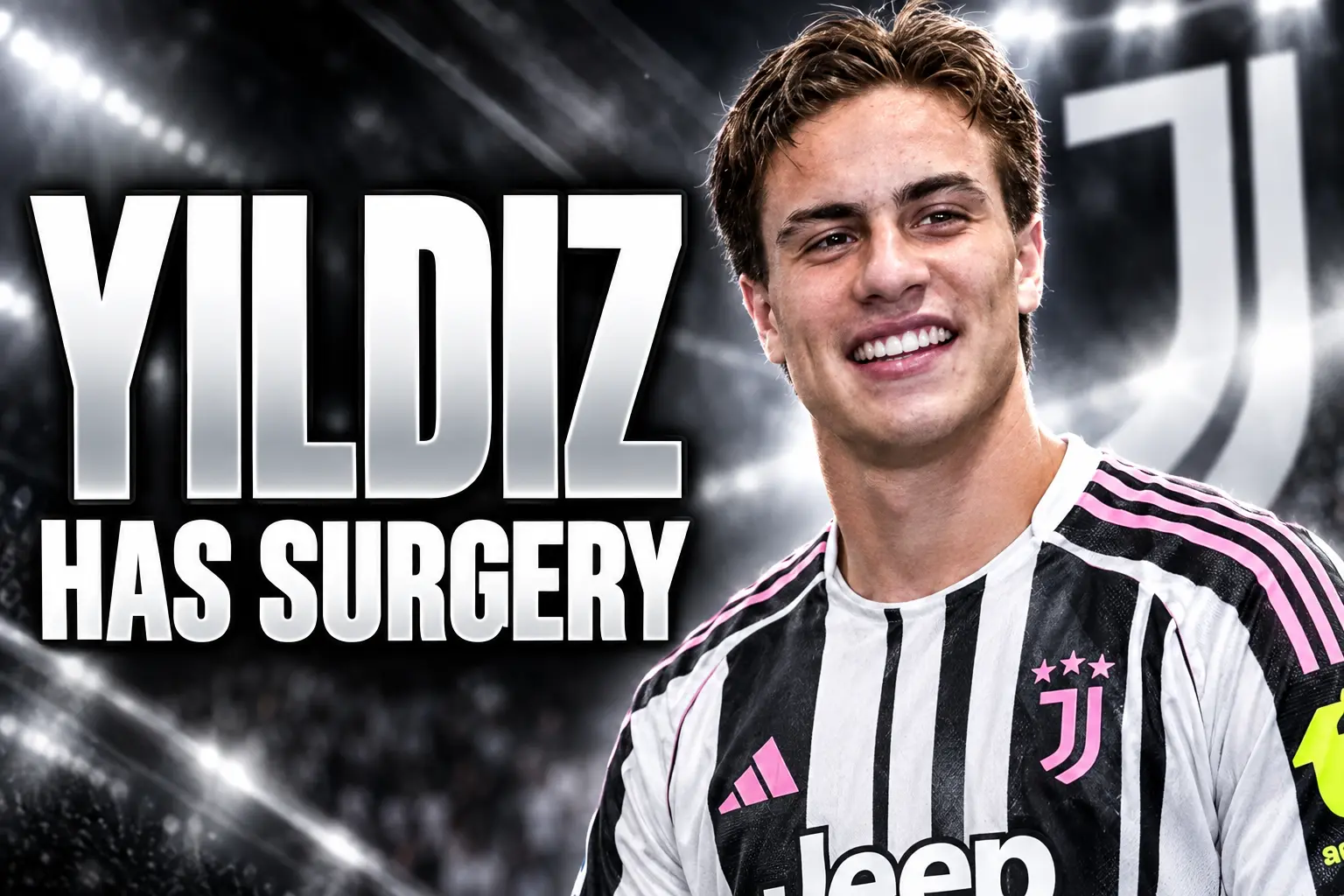
Yildiz played 69 minutes of competitive football this season, in a 1-0 win at Frosinone, before scans showed a fracture at the base of the fifth metatarsal in his left foot. Juventus sent him to the Hessingpark Klinik in Augsburg. On 31 August the club said he had undergone osteosynthesis surgery on the left foot, performed by Dr. Martin Jordan with club doctor Marco Freschi present, and that the operation was a complete success. Rehab started the next day.
Chiellini, speaking as a Juventus director, called it “an annoying hitch” and said Yildiz would be out for a few months. “It’s not an injury that will affect things in the future. Once he returns he will be at 100%,” he said. Jeremie Boga, Alajbegovic and Nico Gonzalez are the names in line to take the minutes on that side until he is back.
FROM THE 2030 DEAL TO THE OPERATING TABLE
- February 7, 2026: Signs a new contract through 30 June 2030 and says he loves Juventus.
- May 27, 2026: Comolli rules out a Yildiz sale after a sixth-place finish and a Europa League season.
- June 9, 2026: Arsenal enquire; Romano says there are no chances of an exit this summer.
- August 22, 2026: Spalletti says clubs can offer whatever they like and that he wants Yildiz on the field.
- August 31, 2026: Successful osteosynthesis in Augsburg for the left fifth metatarsal.
He is still on the club’s UEFA Europa League list, on List B, a registered player who cannot yet play. The squad they would not break up around him is now covering for him, in a competition they did not want, without the attacker they refused to price.
Spalletti Still Wants Him in Every XI
Eleven days before the operation, with the window still open and Arsenal still linked in the usual way, Spalletti was asked about a sale and declined to entertain one. He sounded like a coach protecting a starter, not a director running an auction.
They can offer whatever they like, I want Yildiz here and will always put him on the field. He’s a perfect lad to talk to, he’s mature, and knows he doesn’t need to rush anything.
Luciano Spalletti, Juventus coach, August 2026
Real Madrid’s interest has been rumoured around the same name for months, and Arsenal have been described since deadline day as keeping him on a longer list. None of that moved him in 2026. The February contract, Comolli’s “certainly not,” and Spalletti’s public line all pointed the same way, and the window closed on 1 September with the player still a Bianconero.
The club that would not sell him now waits on a bone in his left foot. Until he is fit, the No. 10 Arsenal could not buy is a List B name on a Europa League roster, working through rehab after a successful operation in Augsburg.
Frequently Asked Questions
When Does Kenan Yildiz’s Juventus Contract Expire?
It runs to 30 June 2030. He was already tied to the club until 2029, so the February signing added a year and lifted him into the top of the wage bill once Vlahovic’s heavier deal ended. Owner John Elkann sat in on the ceremony with Chiellini, Modesto and Ottolini, which is how Turin chose to show who the contract was for.
How Did Kenan Yildiz Join Juventus From Bayern?
He arrived from Bayern Munich’s academy as a free agent in the summer of 2022. In his first year he scored 15 goals in 37 Under-19 matches, then debuted for Next Gen on 17 December 2022. His first Serie A start, and first league goal, came against Frosinone on 23 December 2023, the same opponent he lasted 69 minutes against this season before the foot injury.
Did Kenan Yildiz Captain Juventus?
Yes. Against Verona on 20 September 2025 he became the youngest player in Juventus history to wear the armband. The club used that night, and the No. 10 shirt, as part of the case for tying him down through 2030 while he was still 20.
What Were His Numbers When He Signed the 2030 Deal?
At the 7 February announcement he had 25 goals and 19 assists in 115 first-team appearances over two and a half seasons, and 8 Serie A goals with 5 assists in 2025/26 up to that point. The full-season count later settled at 11 goals and 10 assists in 47 matches in all competitions.
Who Is Covering for Yildiz While He Recovers?
Jeremie Boga, whose Nice loan was made permanent, 18-year-old Kerim Alajbegovic after his move from Bayer Leverkusen, and Nico Gonzalez, back from Atletico Madrid, are the forwards in line on that side. Juventus still put Yildiz on UEFA List B for the Europa League, so he remains registered even while he cannot play.

Kily Gonzalez Has the Inter Miami Job Without Papers

Chelsea Puts USDC on the Shirt for One Year

Esther González Joins Al Qadsiah After Gotham’s Free Exit

Chelsea Stay on Adam Wharton After Palace Hold Firm

Fiorentina Pays for Pellegrino After Juve’s Loan Fails

Only One of Villa’s Five Winger Targets Actually Signed

SoFi Workers Won Pay and an ICE Walk-Off Clause

Hughes Hired Iraola Twice, Then Left for Al-Hilal

Sunderland’s 53-Year European Wait Ends Against AZ

Summerville Turned a Shock Call-Up Into Two World Cup Goals
-
 NEWS4 months ago
Only One of Villa’s Five Winger Targets Actually Signed
-
 NEWS4 months ago
SoFi Workers Won Pay and an ICE Walk-Off Clause
-
 NEWS4 months ago
Hughes Hired Iraola Twice, Then Left for Al-Hilal
-
 EUROPA LEAGUE4 months ago
Sunderland’s 53-Year European Wait Ends Against AZ
-
 NEWS4 months ago
Summerville Turned a Shock Call-Up Into Two World Cup Goals
-

 NEWS4 months ago
SNRT Put Morocco’s World Cup Matches on Free TV
-

 CHAMPIONS LEAGUE4 months ago
Jordan Brand’s 2018 Football Bet Pays on PSG’s Repeat
-

 EUROPA LEAGUE3 months ago
Rangers Never Played the Sparta Prague Sharpener