
NEWS
Villa’s Onana FIFA Payout Is a Capped Daily Wage
FIFA will cover Amadou Onana’s fixed wages at a daily cap after his World Cup ACL tear, with a 28-day unpaid gap and no help for the midfield hole.

Aston Villa will recoup Amadou Onana’s basic wages from FIFA at a daily cap of EUR 20,548 after he ruptured the anterior cruciate ligament in his right knee at the World Cup. The Belgian midfielder went off after 21 minutes of Belgium’s 4-1 last-16 win over the United States on 6 July 2026.
The figure circulating since then, £6.6m, is the sterling reading of FIFA’s annual ceiling for one player, not a cheque written for Villa. Cover starts only after 28 consecutive days out, bonuses are excluded, and the club has already signed new midfielders while Onana remains on the books.
FIFA’s Daily Cap Sets the Real Ceiling
FIFA’s Club Protection Programme, extended through 2026 in circular 1852, pays a club when a senior international suffers a temporary total disablement from an accident on duty and cannot play for more than 28 days in a row. The bulletin sets compensation at a maximum of EUR 7,500,000 per player per accident, worked out as a daily pro rata sum of up to EUR 20,548, payable for at most 365 days. The whole programme is capped at EUR 80,000,000 a year.
That EUR 7.5m line converts to about £6.6m, which is why the July figure attached itself to Onana. It is the scheme’s roof. The daily rate is 1/365 of that roof. A club whose player earns less than the cap gets the fixed wage. A club whose player earns more gets the cap. Either way the money arrives as a wage subsidy, not as a transfer budget.
European Football Clubs, which pushed for the scheme with FIFA, describes cover for all official A-national team matches, including training, friendlies, travel and rest under the association. Cover starts when the player leaves home or the club to report and ends at midnight on the day of return, or 48 hours after leaving the team, whichever comes first. Onana was still inside that window when he went down in Seattle.
HOW FIFA PAYS CLUBS FOR INTERNATIONAL DUTY
| Rule | Club Protection Programme | Club Benefits Programme |
|---|---|---|
| What it is for | Basic wages while a player is injured | A fee for releasing a player to the World Cup |
| Trigger | Accident on duty, out more than 28 days | Player on a finals start list |
| Unit | Up to EUR 20,548 a day | About USD 5,000 a player a day |
| Ceiling | EUR 7,500,000 per player, 365 days | Share of a USD 250m finals pot |
| Medical bills | Not covered | Not a medical scheme |
The second column is a separate FIFA pot. The Club Benefits Programme for the 2026 World Cup is a USD 355 million fund, 70 percent larger than the 2022 edition, split into USD 100 million for qualifiers and USD 250 million for the finals. FIFA said clubs would receive approximately USD 5,000 per player, per day at the finals, with the exact rate fixed after the tournament, and about USD 2,360 per player per qualifying match.
Mandatory release for the finals was 25 May 2026. Belgium’s last match was the 2-1 quarter-final defeat by Spain on 10 July in Los Angeles, so Villa’s benefits clock for Onana ran to the day after that exit even though he had already been ruled out. EFC chairman Nasser Al-Khelaifi called the programme an essential part of the clubs’ deal with FIFA and welcomed the first-time cover for qualifying matches. It is still a release fee. It does not pay a replacement.
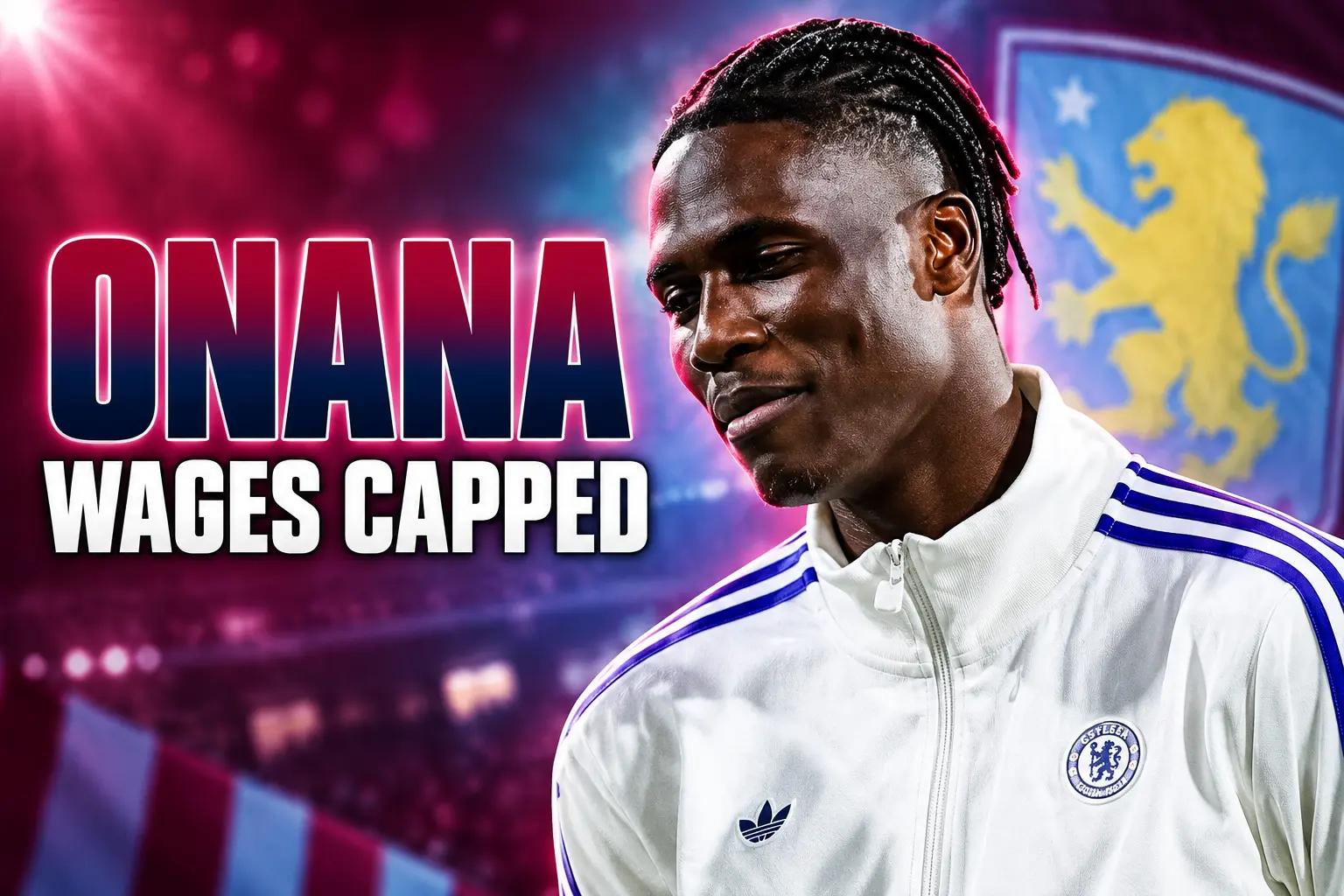
Onana’s Listed Wage Is £140,000 a Week
Salary tracker Capology lists Onana on £140,000 per week in fixed pay for 2026-27, or £7,280,000 a year, and does not mark the figure as verified. Other wage lists put him in the same band. At that rate four weeks of basic pay is £560,000, which is the stretch FIFA does not touch because of the 28-day excess.
ONANA’S LISTED PAY
- Fixed week: £140,000, the only slice FIFA will consider.
- Fixed year: £7,280,000, before any bonus layer the tracker also prints.
- Daily math: £140,000 divided by seven is £20,000, close to FIFA’s euro cap once exchange is applied.
- Contract on file: Capology still shows an expiry of 30 June 2029.
FIFA’s bulletin is blunt about what counts. Compensation is based solely on the fixed salary paid in weekly or monthly instalments, including mandatory social security charges, in the written contract in force when the accident happened. Variable sums, one-off payments, performance bonuses, signing-on fees, appearance money and any separate image or services deal are out. If Capology’s bonus line is even roughly right, Villa keep paying that layer with no FIFA offset for as long as Onana is unable to play.
Fabrizio Romano reported the original 2024 move as a £50m fee on a five-year contract until June 2029. That deal, not a new one, is the contract FIFA will read for the daily rate, unless a signed amendment predates 6 July. Talks this September to add two years sit after the accident, so they do not raise the claim.
The First 28 Days Stay on Villa’s Books
The programme does not pay from the moment a player hits the turf. The club must show a temporary total disablement that lasts more than 28 consecutive days. Claims go through QuestGates UK Ltd, and the accident has to be reported within 28 days or later losses can be rejected. Onana cleared the time test in early August. The first month of wages stayed with Villa.
Belgium team doctor Brahim Hacene confirmed the diagnosis after medical exams, and the federation said it had already spoken to Villa about the next steps.
This is devastating news, both for him personally and for the team.
Brahim Hacene, Belgium team doctor, Belgian FA statement
Hacene added that staff would jointly decide treatment and rehabilitation in the days that followed, and that Onana would stay with the squad for the quarter-final against Spain. He did. Belgium lost 2-1 in Los Angeles on 10 July, Mikel Merino scoring in the 88th minute after Senne Lammens, on for the injured Thibaut Courtois, spilled a shot. Youri Tielemans, then still a Villa player, had gone over in the warm-up, so Belgium’s midfield was already short before kick-off.
ONANA’S INJURY CALENDAR
- 6 July 2026: Goes down in the 19th minute against the United States, replaced in the 21st, later seen on crutches with a brace on the right knee.
- 7 July 2026: Hacene confirms a ruptured anterior cruciate ligament and says the tournament is over for him.
- 10 July 2026: Belgium exit 2-1 to Spain in the quarter-finals; Onana is already out.
- Late July 2026: Undergoes ACL surgery in Lyon, with a nine-month outlook pointing at a return in spring 2027.
- Early August 2026: The 28-day unpaid excess ends and any accepted FIFA wage claim can start.
- 2 September 2026: Villa close the window with 10 new signings and still list Onana as No. 24.
Sofascore, updated on 4 September 2026, lists the injury from 7 July and an expected return in May 2027. That is later than a straight nine-month count from a late-July operation, which would land in April. Either date keeps him out of the opening months of the Premier League season and the Champions League group stage. Onana himself said his whole world collapsed when he went down.
What the Club Protection Programme Leaves Out
The July conversation treated the FIFA money as a boost. The bulletin reads more like a narrow wage policy. Death, permanent disablement and medical costs are outside the scheme. The club still pays the surgeons. The club still pays the first 28 days. The club still pays anything that is not basic salary.
WHAT FIFA WILL NOT PAY VILLA
- The excess: The first 28 consecutive days of wages stay on the club’s payroll.
- Bonuses and extras: Appearance fees, signing-on sums and any image or services contract are excluded.
- The hospital: Treatment, rehab and travel for surgery are not covered.
- A new player: The daily sum cannot be spent as a transfer fee; it offsets pay Villa already owes Onana.
- A full year at the roof: Cover stops when he is fit, or at 365 days, whichever comes first.
An accident, in FIFA’s wording, is a bodily injury from a sudden external force at an identifiable time and place, or a sudden act of exertion. Heart attacks and strokes are also treated as accidents. A non-contact ACL from a landing sits inside that definition. Illness does not. A knock that clears in three weeks does not. The scheme is built for long absences, and it still leaves the sporting problem with the manager who has to name a midfield on Saturday.
That is the objection that followed the injury in public, stripped of the noise. International weeks take the player. FIFA’s answer is a daily slice of basic pay after a month, with a euro cap. Unai Emery does not get those days back in the Champions League.
Villa Bought a New Midfield in July Anyway
Villa had not gone into the summer looking for a holding midfielder. The plan shifted when Tielemans left for Manchester United after his release clause was triggered and Onana’s knee gave way in the same window. The club then moved at speed.
Johan Manzambi arrived from Freiburg, Villa’s Europa League final opponents, in mid-July in a club-record signing of Johan Manzambi that had been heading toward Newcastle. Four days later came João Gomes from Wolverhampton Wanderers. In the final week of the window the club announced Leon Goretzka arriving from Bayern Munich, a free agent after leaving Germany, before deadline-day deals elsewhere in the squad.
On 2 September, Aston Villa said the window had closed with the club welcoming no less than 10 new signings. The published first-team list still carries Onana at No. 24, between Ian Maatsen and Lamare Bogarde, with Gomes at 35, Goretzka at 27 and Manzambi at 44. Boubacar Kamara remains at No. 8. The midfield Emery wanted to build around Onana, Kamara and Tielemans no longer exists in that form.
Those arrivals are the real cash outgoing. FIFA’s daily cap, even if it runs for most of a nine-month layoff, is a partial rebate on a wage Villa are still contracted to pay. It does not fund Gomes. It does not fund Manzambi. It does not put a 195 cm destroyer next to Kamara in October. The physical profile Onana gave Emery, the height and the ground he covers, is the piece a wage subsidy cannot copy.
A Spring Return, and Talks That Run to 2031
Onana is 25, born in Dakar on 16 August 2001. He joined Villa from Everton in July 2024, has made 72 appearances and scored seven goals, and was part of the side that won the Europa League in 2025-26. He had played four matches at this World Cup, making his second start against the United States, before the knee went.
A nine-month recovery from the Lyon operation points at spring 2027. Sofascore’s May 2027 marker would take him even deeper into the campaign. Either way, the 2026-27 group stage and the first half of the league season are gone. The Club Protection Programme can keep paying the basic wage through that spell, up to 365 days, and then it stops whether or not he has played.
In early September, with the window shut, Onana entered talks on a two-year extension that would run to June 2031. Sacha Tavolieri said an agreement had been reached. The club has not posted a confirmation, and Capology’s file still expires in 2029. The timing is still a statement. Villa are treating a player who will miss this season as a long-term asset, not as a wage they are happy to see FIFA carry.
Number 24 is still on the squad sheet. The daily FIFA cap can lighten the payroll while he works back. The midfield he left is already someone else’s.

Kily Gonzalez Has the Inter Miami Job Without Papers

Chelsea Puts USDC on the Shirt for One Year

Esther González Joins Al Qadsiah After Gotham’s Free Exit

Chelsea Stay on Adam Wharton After Palace Hold Firm

Fiorentina Pays for Pellegrino After Juve’s Loan Fails

Only One of Villa’s Five Winger Targets Actually Signed

SoFi Workers Won Pay and an ICE Walk-Off Clause

Hughes Hired Iraola Twice, Then Left for Al-Hilal

Sunderland’s 53-Year European Wait Ends Against AZ

Summerville Turned a Shock Call-Up Into Two World Cup Goals
-
 NEWS4 months ago
Only One of Villa’s Five Winger Targets Actually Signed
-
 NEWS4 months ago
SoFi Workers Won Pay and an ICE Walk-Off Clause
-
 NEWS4 months ago
Hughes Hired Iraola Twice, Then Left for Al-Hilal
-
 EUROPA LEAGUE4 months ago
Sunderland’s 53-Year European Wait Ends Against AZ
-
 NEWS4 months ago
Summerville Turned a Shock Call-Up Into Two World Cup Goals
-

 NEWS4 months ago
SNRT Put Morocco’s World Cup Matches on Free TV
-

 CHAMPIONS LEAGUE4 months ago
Jordan Brand’s 2018 Football Bet Pays on PSG’s Repeat
-

 EUROPA LEAGUE4 months ago
Rangers Never Played the Sparta Prague Sharpener