
NEWS
Norway Turns Balogun’s World Cup Ban Into Infantino’s Ethics Case
Norway’s board asked Gianni Infantino to resign and to face a three-count ethics file that now includes Folarin Balogun’s parked World Cup ban.

Norway’s football board voted on 6 August 2026 to ask FIFA president Gianni Infantino to resign and to put Folarin Balogun’s World Cup red card into a formal ethics complaint. The same letter is meant to cover the Peace Prize handed to Donald Trump and the collapsed plan to sell a stake in FIFA events.
Lise Klaveness, president of the Norwegian Football Federation, said trust in Infantino was gone. On 8 September more than 100,000 people added their names to a follow-up filing by the human rights group FairSquare, which still has no public ruling on a file FIFA acknowledged on 12 December 2025.
Norway’s Board Turned a Red Card Into a Resignation Demand
The vote came on a Thursday night in Oslo, after a summer in which Infantino’s private-equity scheme, branded FIFA Forward Enterprise, was abandoned under pressure from UEFA. Norway became the first member association to call for the president to step down at once. Klaveness, a former Norway international who has led the NFF since March 2022 and sits on UEFA’s executive committee, had spent July asking only that Infantino call the Balogun ruling an error.
By August the ask had changed. “We decided that there is no trust in Infantino now,” she said after the meeting. “The trust is now gone for us, there is no way back for Infantino.”
We’re left in a very polarised cooperation globally and, I would say, chaos. So we will ask him to resign immediately so that the global football community can look ahead and cooperate going into the future.
Lise Klaveness, president, Norwegian Football Federation
She said the NFF would write that resignation letter in the following week and would also send a fresh ethics submission that treats three situations as separate cases in one envelope: the FFE offer, the Peace Prize, and the Balogun ban. “We will join them in one letter but they are very different cases and we want the ethical committee to treat them separately,” she said. Infantino has said he will stand again at the presidential election in March. CAF, Mexico and Argentina have backed him to stay.
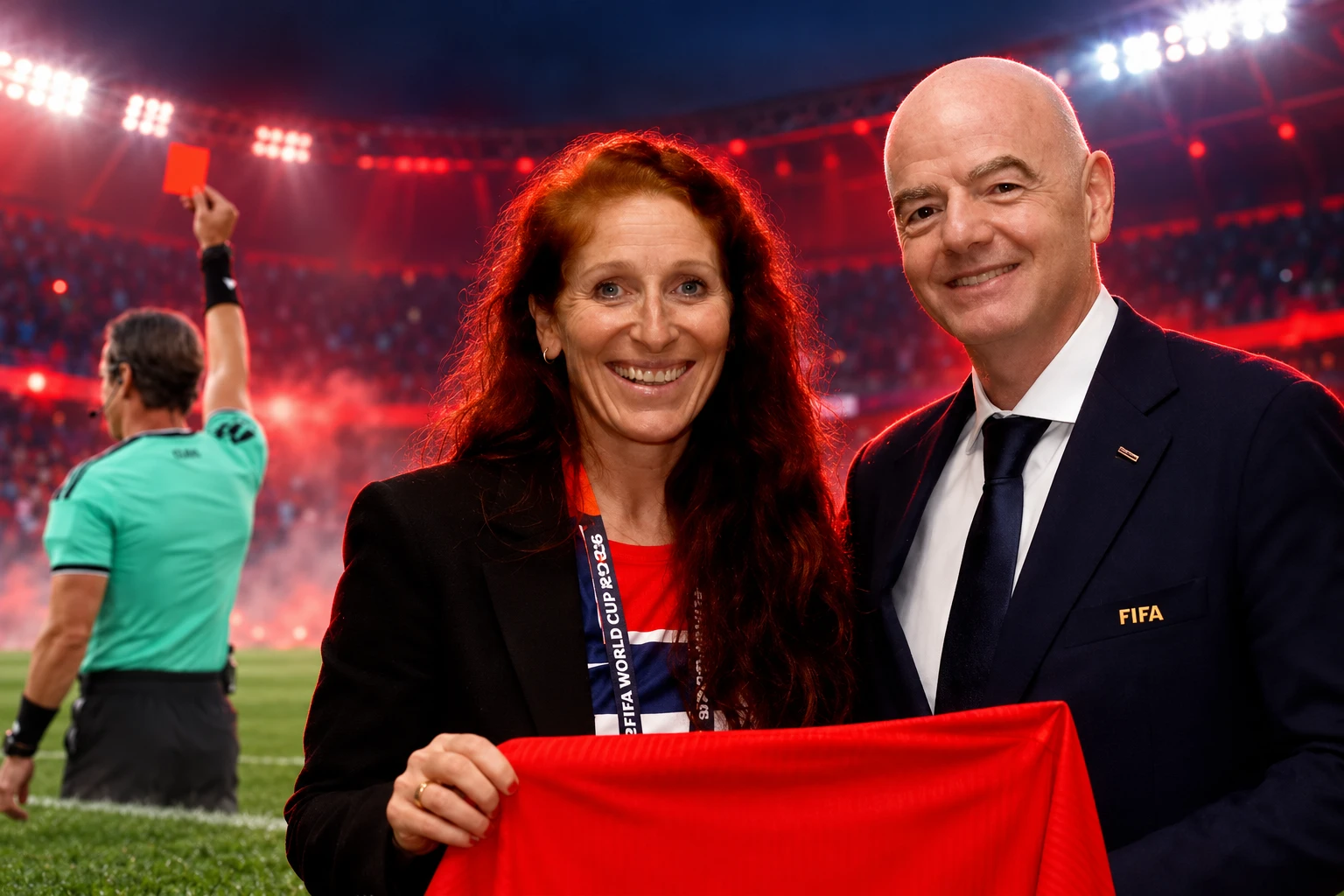
How FIFA Parked a One-Match Ban for a Year
United States forward Folarin Balogun, the team’s top scorer at the tournament with 3 goals, was sent off in the 64th minute of a 2-0 round-of-32 win over Bosnia and Herzegovina on 1 July 2026. Brazilian referee Raphael Claus showed the red after a VAR review of Balogun planting his boot on the ankle of defender Tarik Muharemovic. World Cup regulation Article 10.5 and Disciplinary Code Article 66.4 both say a sending-off brings an automatic suspension from the next match. That next match was Belgium, in Seattle, with a quarterfinal place on the line.
President Trump called the red card a “horrible” call and contacted Infantino. On 5 July, after what the Americans lived as a chaotic 36 hours, FIFA’s disciplinary committee said it had found Balogun guilty of the red-card offence and of coming back onto the field to celebrate after the ejection. It fined him $40,000, which U.S. Soccer can pay, and then used Article 27 of the Disciplinary Code to put the one-match ban on one year of probation instead of making him sit against Belgium.
Article 27 lets a judicial body fully or partly suspend a sanction and set probation of one to four years. If the player commits a similar offence in that window, the parked ban is added to whatever new penalty follows. The code does not list the facts that justify using the clause, except that match-fixing bans cannot be parked. FIFA later said it had already used Article 27 in 2026 World Cup qualifiers, including a deferred ban for Cristiano Ronaldo. Those cases were qualifier bans. Balogun’s red card was in the finals, and no World Cup sending-off had skipped its next-match ban since Brazil’s Garrincha in 1962, when the president of host nation Chile argued he should play the final.
THE BALOGUN RULING NEXT TO THE RULEBOOK
| Rule | What it requires | What FIFA did |
|---|---|---|
| World Cup Article 10.5 | A player sent off misses the next match | Balogun started against Belgium |
| Disciplinary Code Article 66.4 | A sending-off automatically incurs a next-match suspension | The suspension was not served in the tournament |
| Disciplinary Code Article 27 | A judicial body may park a sanction on probation of one to four years | One-year probation plus a $40,000 fine |
People familiar with the file said Mohammad Al Kamali of the United Arab Emirates, chair of the disciplinary committee, made the call on his own. The committee ordinarily decides with at least three members, though FIFA’s 2023 rewrite of the code lets the chairperson can rule alone as a single judge on urgent cases, on bans of up to five matches, and on fines up to CHF 100,000. Klaveness’s objection was the isolation of that vote after a head of state had called. “When there has been an external, very powerful voice in your ear, it’s very important you have more voices making the decision,” she said. “If you don’t, it’s a mistake.” FIFA has not published the judges’ written reasons. Infantino has said the judicial bodies act independently.
Belgium Lost the Appeal and Won the Night
Balogun started at Lumen Field on 6 July. Belgium won 4-1 and went through. The Royal Belgian Football Federation said it was deeply concerned and would fight for fair competition. UEFA said FIFA had crossed a red line by letting a red-carded player take the field when the tournament’s own rules said the next match was automatic. FIFA answered that the committee had not reversed the sending-off, that Article 27 sat alongside the automatic-ban clauses, and that UEFA was in no position to lecture anyone about discipline.
Belgium asked for a formal explanation and was told the request was inadmissible, which closed the in-house appeal. The result on the pitch stood. The political argument did not. Trump took credit for getting FIFA to look again. Klaveness, who had no team in that tie, treated the parked ban as a problem for every association that still has to sell a red card to its own players as a rule rather than a suggestion.
Klaveness Has Been Filing Since the Peace Prize
The Balogun letter is a sequel. On 5 December 2025, at the World Cup draw in Washington, Infantino presented Trump with FIFA’s first Peace Prize. A video at the event praised Trump’s foreign policy. Three days later FairSquare lodged a complaint of 8 December 2025 with the investigatory chamber of FIFA’s Ethics Committee, listing four public shows of support for Trump and asking whether the prize had gone through the FIFA Council at all.
Article 15 of the Code of Ethics, in force from 1 February 2023, says people bound by the code must remain politically neutral in dealings with governments. A breach carries a fine of at least CHF 10,000 and a ban from football activity of up to two years, which can rise if the breaches repeat. The secretariat acknowledged FairSquare’s papers on 12 December 2025 and said it might open a preliminary investigation on instructions from the chamber chair. No public finding has followed.
On 1 June 2026, before Norway flew to the World Cup, the NFF wrote in support and asked that the file be handled under the rules and that the decision be published. Klaveness said FIFA people had already bristled at a meeting in Budapest. On 29 June, 50 members of the European Parliament sent their own letter to Infantino, the FIFA Council, secretary general Mattias Grafström and the investigatory chamber. Complaints of that kind now go to the ethics body Infantino reshaped in 2017, when the lead investigator and the judge were both replaced in the second year of his presidency.
FairSquare’s 100,000 Names Land in the Same Inbox
FairSquare’s Reboot campaign had promised to come back after the World Cup with a larger complaint. On 8 September 2026 it did. The group said more than 100,000 people had signed, and that the new text lists eight incidents rather than four. The extra counts take in Trump’s call about Balogun and the abandoned FFE sale. Nicholas McGeehan, FairSquare’s director, framed the follow-up as a test of the chamber itself. “Are you capable of holding your senior officials to account? That’s what we’re trying to do with this follow-up.”
Norway’s board had already decided to put Balogun on the same desk, as one of three files, not as a rewrite of the peace-prize case. Klaveness said in early August that the NFF would send that new complaint and that control mechanisms had to work on the person who holds the office, not only on everyone under him. She is a lawyer and a judge in Oslo, and she has used that register since she took the NFF job: the problem is process, then the result.
NORWAY’S THREE COUNTS
- The Peace Prize: Infantino created and awarded FIFA’s first prize to Trump on 5 December 2025 without, critics say, a FIFA Council decision.
- The Balogun ban: A finals red card that should have meant a night off against Belgium was parked for one year after Trump called Infantino.
- The FFE sale: A plan to sell a stake in FIFA events to private investors, later dropped, which Norway says may have been an abuse of position so close to a presidential vote.
The English FA and the FA of Wales had already pulled their endorsements for March. Six Nordic associations later said they had lost confidence. That is still a European quarrel. Infantino’s support outside Europe has not moved with Oslo.
The Ethics File FIFA Will Not Answer
FairSquare also went to the International Olympic Committee, where Infantino has been a member since 10 January 2020. The 14 July filing alleged five clear breaches of IOC neutrality rules and asked the ethics commission to look at two more, including the Balogun affair as a further breach. On 24 July the IOC said no investigation would open, because the complaint did not concern FIFA’s or Infantino’s specific relations with the Olympic body and because, under the Olympic Charter, each International Federation maintains its independence. The Olympic door closed. The FIFA door has not opened in public.
FROM THE PRIZE TO THE 100,000-NAME FILE
- 5 December 2025: Infantino awards Trump the FIFA Peace Prize at the World Cup draw in Washington.
- 8 December 2025: FairSquare files with FIFA’s Ethics Committee over political neutrality.
- 12 December 2025: The investigatory chamber secretariat acknowledges the papers and says a preliminary inquiry may follow.
- 1 July 2026: Balogun is sent off against Bosnia and Herzegovina.
- 5 July 2026: FIFA parks the automatic ban on one year of probation and fines him $40,000.
- 6 July 2026: Balogun starts; Belgium wins 4-1. Belgium’s appeal is ruled inadmissible.
- 14 July 2026: FairSquare files at the IOC; ten days later the IOC declines jurisdiction.
- 6 August 2026: Norway’s board asks Infantino to resign and to face a three-count ethics letter.
- 8 September 2026: FairSquare submits a follow-up signed by more than 100,000 people, now listing eight incidents.
Klaveness wanted Infantino to say the Balogun verdict was an error and to show the ethics committee’s work. “There are all kinds of control mechanisms in place but they are not really holding the council and president accountable,” she said. FIFA rarely comments on ethics files before a chamber speaks. The December papers are still in that quiet. The parked red card, which did not save the United States from a 4-1 defeat, is now another exhibit in the same unread stack, and Infantino’s name is still on the March ballot.

Kily Gonzalez Has the Inter Miami Job Without Papers

Chelsea Puts USDC on the Shirt for One Year

Esther González Joins Al Qadsiah After Gotham’s Free Exit

Chelsea Stay on Adam Wharton After Palace Hold Firm

Fiorentina Pays for Pellegrino After Juve’s Loan Fails

Only One of Villa’s Five Winger Targets Actually Signed

SoFi Workers Won Pay and an ICE Walk-Off Clause

Hughes Hired Iraola Twice, Then Left for Al-Hilal

Sunderland’s 53-Year European Wait Ends Against AZ

Summerville Turned a Shock Call-Up Into Two World Cup Goals
-
 NEWS5 months ago
Only One of Villa’s Five Winger Targets Actually Signed
-
 NEWS5 months ago
SoFi Workers Won Pay and an ICE Walk-Off Clause
-
 NEWS5 months ago
Hughes Hired Iraola Twice, Then Left for Al-Hilal
-
 EUROPA LEAGUE5 months ago
Sunderland’s 53-Year European Wait Ends Against AZ
-
 NEWS5 months ago
Summerville Turned a Shock Call-Up Into Two World Cup Goals
-
 NEWS5 months ago
FIFA Took IShowSpeed’s World Cup Bet to the Final
-
 NEWS5 months ago
SNRT Put Morocco’s World Cup Matches on Free TV
-
 CHAMPIONS LEAGUE5 months ago
Jordan Brand’s 2018 Football Bet Pays on PSG’s Repeat